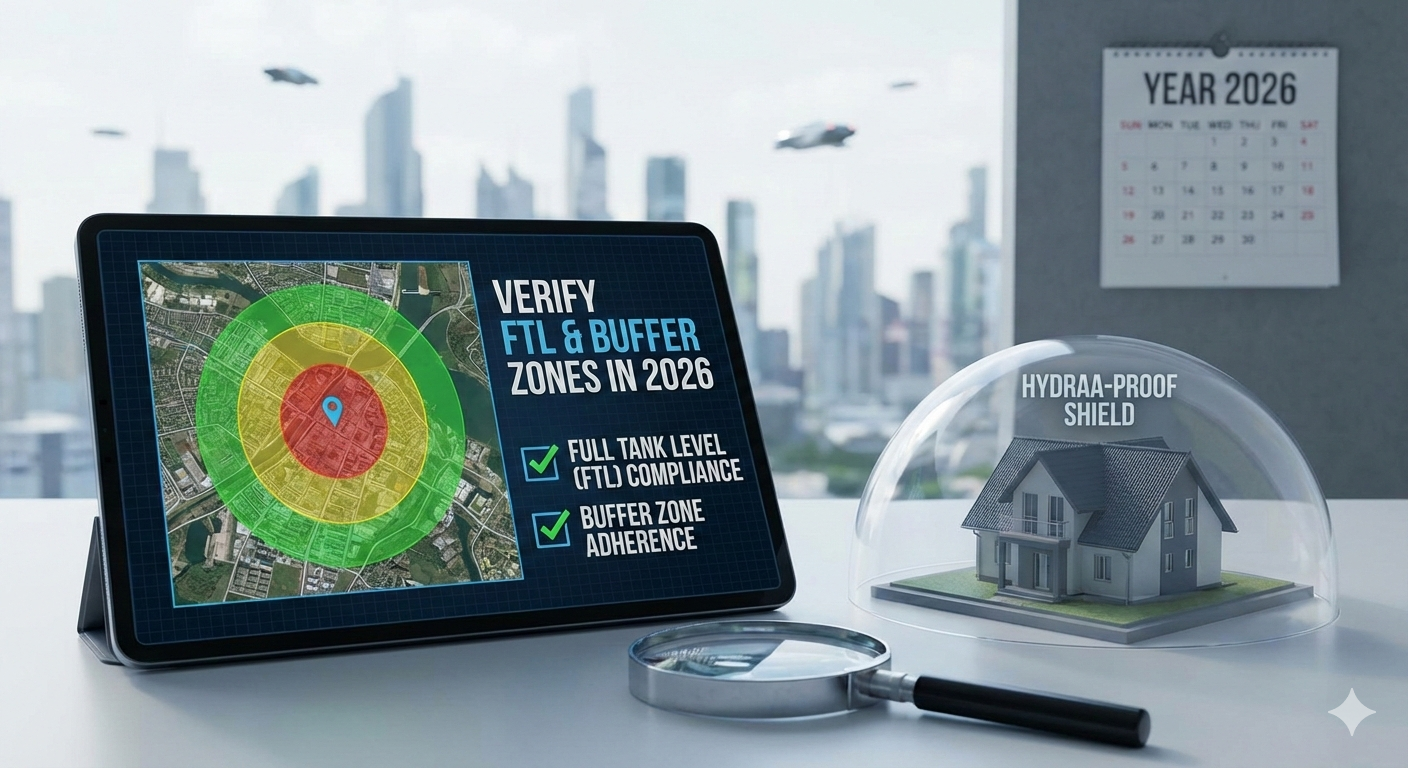
HYDRAA-Proofing Your Investment: Verify FTL & Buffer Zones in 2026
Introduction
By 2026, one fear dominates the Hyderabad property market more than pricing or location — safety from demolition and legal action. After the December 2025 demolition drives across Nizampet, Bachupally, and Bandlaguda, buyers are no longer asking, “Is the project good?” They are asking, “Is it safe?”
This concern is valid. Many properties that looked perfectly legal on paper turned out to be built inside FTL (Full Tank Level) boundaries or buffer zones of lakes and nalas. The harsh reality is that RERA approval alone does not guarantee safety from HYDRAA enforcement.
This blog is a practical buyer’s guide — not about headlines, but about how to verify lake boundaries, read survey numbers, and cross-check buffer zones using official Irrigation Department and HMDA land maps. If you are a risk-averse buyer ready to purchase but frozen by fear, this guide is for you.
Target search intent covered: HYDRAA safe projects Hyderabad, check FTL buffer zone survey number, Nizampet property safety guide.
Why “HYDRAA-Safe” Is Now More Important Than “RERA-Approved”
One of the biggest misconceptions among buyers is assuming that RERA approval equals legal safety. It does not.
RERA Approval Means
Project is registered for sales transparency
Builder disclosures are regulated
Delivery timelines and layouts are approved
You can verify this on the official Telangana RERA portal.
HYDRAA Safety Means
The building does not violate FTL boundaries
It lies outside lake and nala buffer zones
It complies with environmental and irrigation regulations
HYDRAA acts based on land and water body laws, not RERA registrations. A project can be RERA-approved and still be demolished if it violates buffer norms.
This is why buyers must now do dual verification — commercial legality plus hydrological safety.
Understanding FTL and Buffer Zones in Simple Terms
What Is FTL (Full Tank Level)?
FTL is the maximum water spread level of a lake during peak rainfall. Any construction inside this boundary is considered an encroachment, regardless of approvals.
Mandatory Buffer Zones (2026 Rules Still Applied)
As per prevailing regulations:
30 meters buffer from lake boundaries
9 meters buffer from nalas (stormwater drains)
These distances are measured from the FTL line, not from where water is currently visible.
This is where most buyers make mistakes — assuming dry land equals safe land.
The Core Skill Buyers Need: Reading Survey Numbers Against Maps
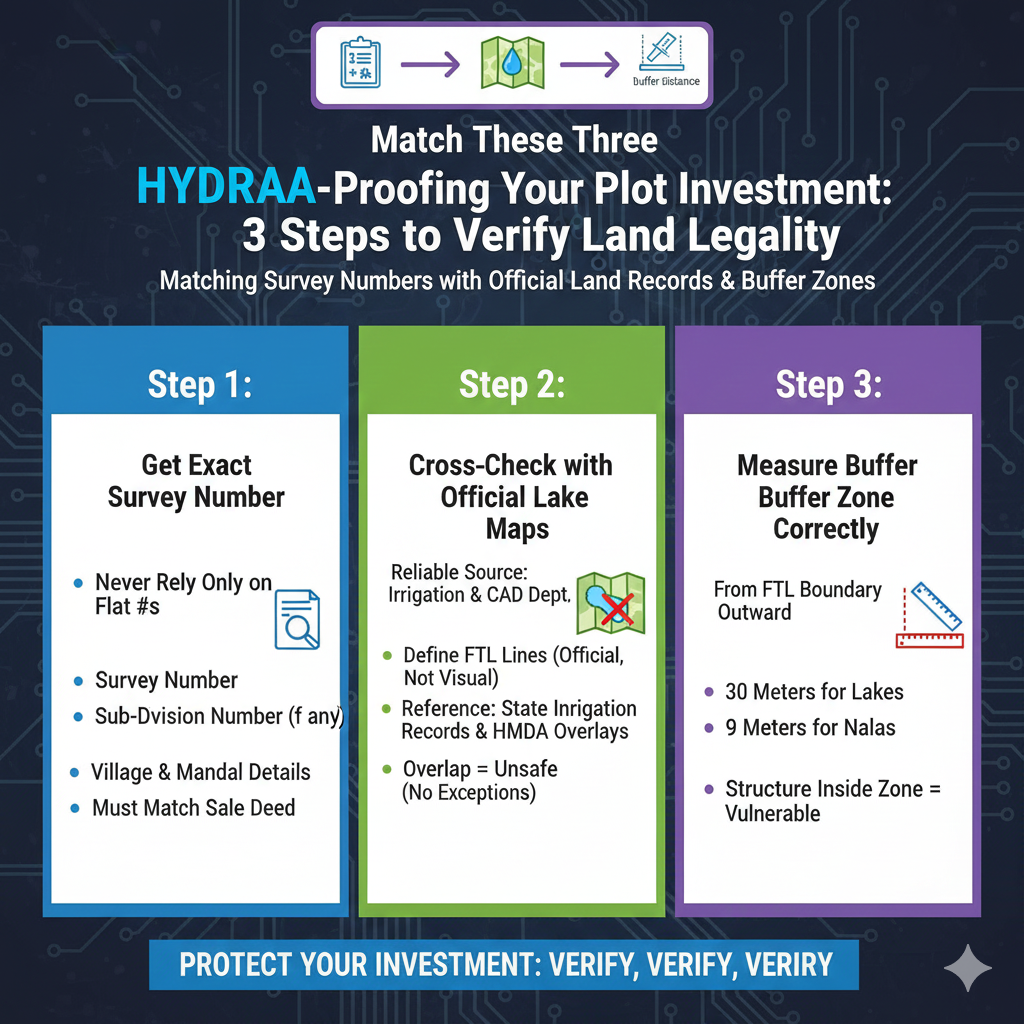
To HYDRAA-proof your investment, you must match three things accurately:
Your property’s survey number
Lake / nala boundary maps
Buffer distance measurement
Step 1: Get the Exact Survey Number
Never rely only on flat numbers or layout names. Ask for:
Survey number
Sub-division number (if any)
Village and mandal details
This information must match sale deed records.
Step 2: Cross-Check with Irrigation Department Lake Maps
The most reliable source for lake boundaries is the Irrigation & CAD Department. These maps define FTL lines officially, not visually.
You can reference verified lake boundary data through state irrigation records and HMDA planning overlays available via HMDA’s master planning resources.
If your survey number overlaps even partially with the FTL polygon, the property is unsafe — no exceptions.
Step 3: Measure the Buffer Zone Correctly
Once the FTL boundary is identified:
Measure 30 meters outward for lakes
Measure 9 meters outward for nalas
If any part of the structure or compound wall falls inside this zone, it remains vulnerable to HYDRAA action.
Many demolished properties were not inside lakes, but inside buffer zones.
Why Pragathi Nagar and Gajularamaram Are Seeing Price Corrections
What Went Wrong in These Micro-Markets
Pragathi Nagar and Gajularamaram grew rapidly before strict enforcement. Several layouts were approved decades ago without modern hydrological mapping.
Problems buyers now face:
Old nalas that were covered or diverted
Lakes that shrank visually but still retain legal FTL boundaries
Survey number mismatches between old and new layouts
This uncertainty has led to price corrections, not because demand disappeared, but because buyers are segmenting safe vs unsafe pockets.
How to Identify the “Safe Pockets” Within These Areas
Safe properties in Pragathi Nagar and Gajularamaram usually share these traits:
Located on higher natural contours, away from drainage lines
Survey numbers that do not intersect irrigation maps
Smaller independent layouts with clear title lineage
No historical water flow paths on satellite overlays
Buyers who do proper verification are still purchasing here — but only selectively.
Common Red Flags Buyers Should Never Ignore
Be cautious if you encounter:
“FTL is far away” without map proof
Builder showing only RERA certificate
No mention of survey numbers in brochures
Compound walls built suspiciously close to nalas
Verbal assurances instead of written zoning clarity
In 2026, verbal clarity has zero legal value.
Who This Verification Matters Most For
This guide is especially critical if you are:
Buying in Nizampet, Bachupally, Bandlaguda, Pragathi Nagar
Purchasing resale flats in older layouts
Investing life savings into a first home
Risk-averse but ready to buy immediately
The cost of verification is minor. The cost of ignoring it is permanent.
FAQ Section
Q: How can I check if my property is HYDRAA safe?
A: Verify the survey number against Irrigation Department lake maps and confirm the property lies outside FTL and mandatory buffer zones.
Q: Is RERA approval enough to protect my property?
A: No. RERA governs sales compliance. HYDRAA enforces land and water body protection laws independently.
Q: What is the buffer zone distance for lakes and nalas?
A: 30 meters from lake FTL boundaries and 9 meters from nalas.
Q: Why are prices falling in Pragathi Nagar and Gajularamaram?
A: Market correction due to uncertainty around older layouts and undocumented drainage lines. Safe pockets still exist.
Q: Can a completed apartment still be demolished?
A: Yes, if it is found within FTL or buffer zones, regardless of occupancy or approvals.
Conclusion

In 2026, smart real estate buying in Hyderabad is no longer about location alone. It is about legal survival.
HYDRAA-proofing your investment means:
Looking beyond RERA
Understanding FTL and buffer rules
Reading survey numbers with official maps
Identifying safe pockets within risky micro-markets
Buyers who do this homework are not avoiding Hyderabad real estate — they are buying with confidence while others hesitate.
Safety is not fear. Safety is preparation.
Let’s Join Together to Bring Change to the World of Real Estate.
Relai – For right home.
Thinking about your next home?
relai scores every project on data, not paid placements, and it's free for buyers.