How Buyer Advisory Will Replace Traditional Brokerage

For decades, residential real estate has operated on a simple structure.
Brokers showed properties. Developers paid commissions. Buyers assumed guidance was neutral.
That structure is now under pressure.
As real estate decisions become larger, riskier, and more data-driven, buyers are beginning to question a system where advice is funded by the party selling the asset. Slowly, quietly, buyer advisory models are emerging as an alternative.
This shift is not about replacing agents. It is about redefining whose interest the system serves.
Why Commission-Led Models Are Breaking
Traditional brokerage works on a success-fee model. The faster a deal closes, the sooner commissions are earned.
This creates built-in distortions.
Brokers are incentivised to:
• Push inventory that pays higher commissions
• Accelerate decisions rather than slow them down
• Focus on closing, not long-term fit
In rising markets, these conflicts stayed hidden because prices covered mistakes. In slower, more supply-heavy markets, they are becoming visible.
Buyers are increasingly realising that speed and suitability are not the same thing.
The Conflict of Interest Buyers Rarely See
Most buyers believe they are receiving guidance.
In reality, they are often receiving filtered options.
What gets shown is influenced by:
• Active channel partner agreements
• Inventory pressure from developers
• Sales targets and incentives
This does not mean brokers act in bad faith. It means the system itself prioritises transactions over outcomes.
For first-time buyers especially, this creates asymmetry. The least experienced participant carries the most risk, while relying on advice that is not structurally aligned to them.
Why Property Pushing Is Losing Effectiveness
Buyers today are more informed than ever.
They compare prices online, read forums, track approvals, and visit multiple projects. When pushed aggressively, trust erodes quickly.
High-pressure tactics that once worked now backfire.
Buyers are resisting:
• Artificial urgency
• Limited-unit narratives
• Price-rise threats without data
As information becomes abundant, persuasion loses power. Analysis gains it.
The Rise of Buyer-Paid Advisory
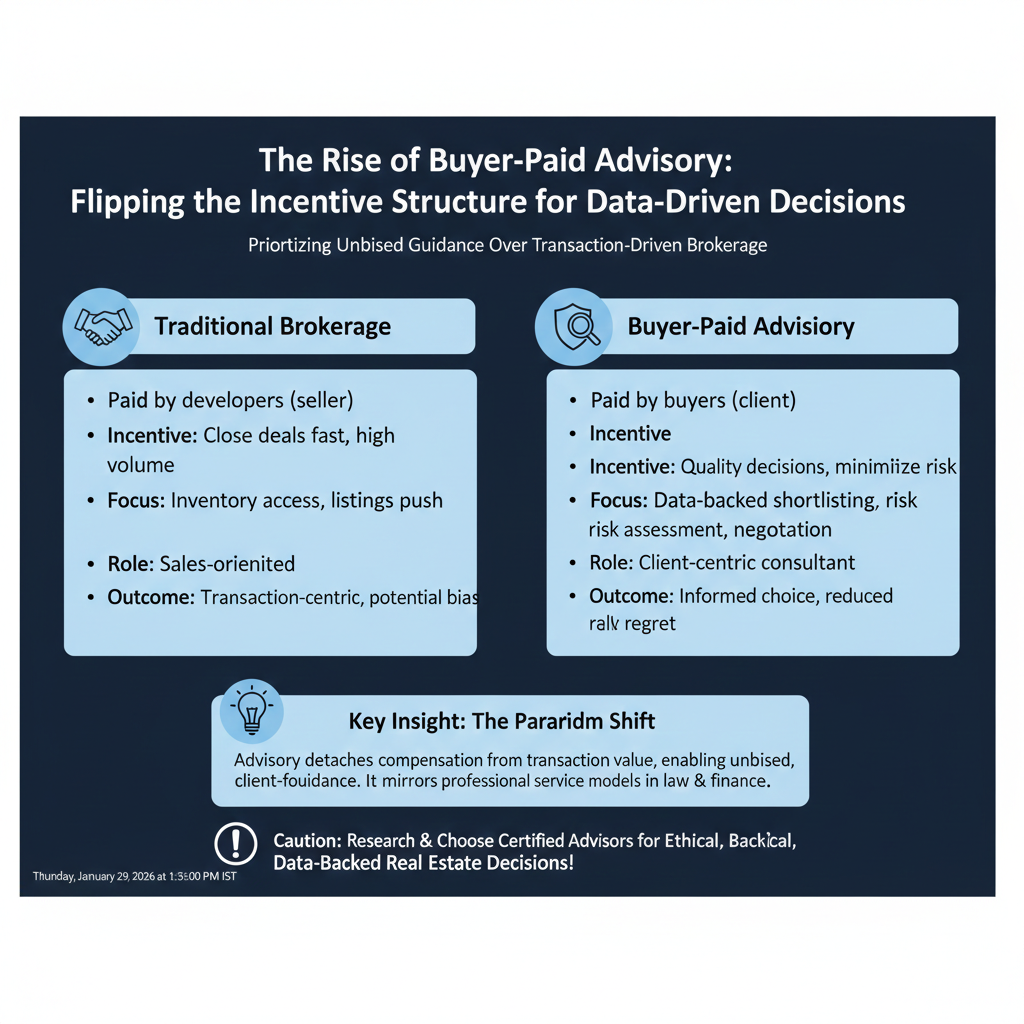
Buyer advisory flips the incentive structure.
Instead of being paid by developers, advisors are paid by buyers for:
• Shortlisting
• Risk assessment
• Negotiation support
• Decision validation
Because compensation is detached from the transaction value, advice can slow the process instead of rushing it.
This model mirrors how financial advisors, lawyers, and architects operate. Advice is paid for, not bundled invisibly into the product price.
What Advisory Looks Like in Practice
Buyer advisory is not about showing more properties.
It focuses on:
• Eliminating unsuitable options early
• Highlighting risks buyers overlook
• Aligning homes with lifestyle and financial reality
• Stress-testing decisions against future scenarios
Advisors are measured not by how many deals close, but by how few regrets remain.
Why First-Time Buyers Benefit the Most
First-time buyers face the steepest learning curve.
They juggle:
• Emotional pressure
• Budget stretch
• Legal complexity
• Fear of missing out
Traditional brokerage adds speed to an already stressful process.
Advisory adds structure.
For first-time buyers, this often means:
• Clear budget buffers
• Defined non-negotiables
• Realistic timelines
• Fewer impulsive compromises
The result is not faster buying, but better buying.
Does Advisory Mean Higher Cost?
At first glance, buyer advisory appears more expensive because fees are explicit.
In reality, brokerage costs are embedded invisibly in property prices through commissions.
Advisory fees are transparent and often offset by:
• Better price negotiations
• Avoided mistakes
• Lower long-term regret
Paying for advice upfront is cheaper than paying for wrong decisions over years.
Why This Shift Is Accelerating Now
Several forces are pushing this change:
• Oversupply and choice overload
• Slower appreciation cycles
• Higher ticket sizes and EMIs
• Buyers prioritising outcome over urgency
As real estate matures, it begins to resemble other high-stakes purchases—where advice is separated from selling.
FAQ Section
Will brokers become irrelevant?
No. Transaction support, market access, and execution still matter. The role is evolving, not disappearing.
Is buyer advisory only for premium buyers?
No. Advisory is often most valuable for mid-segment and first-time buyers, where mistakes are hardest to reverse.
Can buyers combine advisory and brokerage?
Yes. Many buyers use advisory for decision-making and brokers for execution.
Is buyer advisory regulated?
It is still evolving in India, but transparency and alignment are its core differentiators.
Conclusion

Real estate is moving from persuasion-led selling to outcome-led decision-making.
As buyers become more aware of conflicts embedded in commission-led models, advisory structures offer a clearer alternative.
The future of buying is not about who shows more projects. It is about who helps buyers choose less—and choose better.
Thinking about your next home?
relai scores every project on data, not paid placements, and it's free for buyers.