CURE–PURE–RARE: How Hyderabad’s New Zoning Model Will Shape the Next Decade of Real Estate
CURE–PURE–RARE: How Hyderabad’s New Zoning Model Will Shape the Next Decade of Real Estate
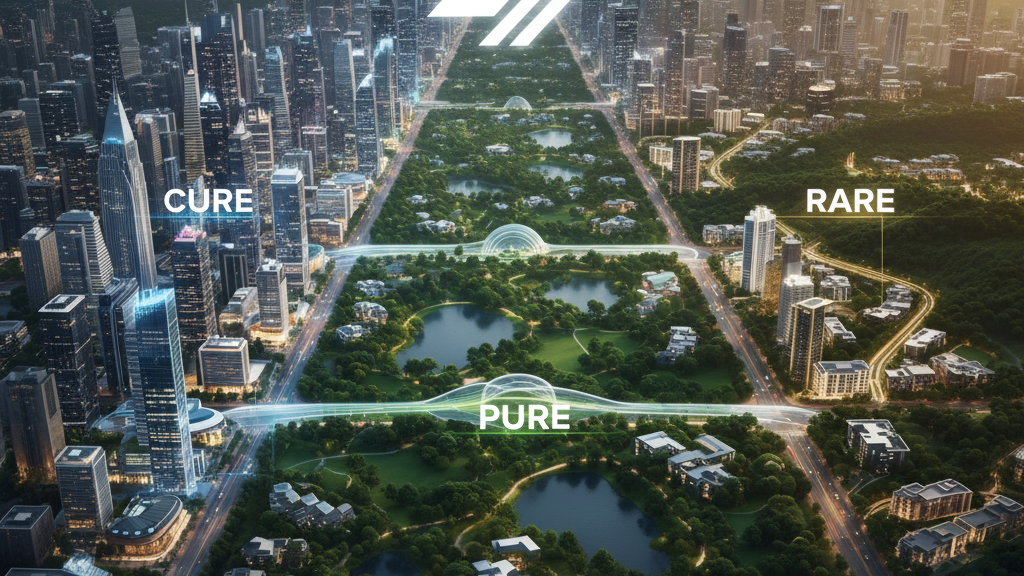
Hyderabad is entering a new phase of structured urban planning, and the CURE–PURE–RARE development model is at the center of the conversation. This zoning framework—recently highlighted in multiple policy discussions and industry forums—is designed to organise land use across three large belts: inside the ORR, between the ORR and RRR, and beyond the RRR.
With the state targeting a $1 trillion economy by 2034, this model is being treated not just as a zoning reform, but as a roadmap for jobs, housing, mobility, and long-term urban expansion. Developers, investors, and homebuyers are all trying to understand what this means for growth corridors like Kollur, Tellapur, Narsingi, Mokila, and Sangareddy.
This blog breaks down what’s changing, why it matters, and how it ties into Hyderabad’s future real estate demand.
1. What the CURE–PURE–RARE Model Actually Means
CURE: Inside ORR – The High-Value Urban Core
“CURE” stands for Core Urban Regulated Ecosystem. Everything inside the Outer Ring Road is now positioned for sectors that thrive on proximity, density, and premium infrastructure.
This includes IT services, corporate headquarters, R&D labs, finance, luxury housing, and high-value commercial spaces.
Reports from Knight Frank show that Hyderabad’s office market continues to perform strongly, with 2.4 million sq. ft. absorption in Q2 2024, led by BFSI and captive centers (Knight Frank India Real Estate Report). This trend supports the state’s plan to keep the urban core focused on high-skilled jobs and premium real estate.
PURE: Between ORR and RRR – The New Industrial & Township Belt
“PURE” stands for Peripheral Urban Regulated Ecosystem, covering the rapidly expanding belt between the ORR and the Regional Ring Road (RRR).
This zone is seeing rising interest from manufacturing, EV, electronics, pharma, and logistics players, supported by government incentives and corridor-based planning. Telangana attracted ₹40,582 crore in investments in 2023–24, with strong inflows in life sciences and electronics (as per Telangana State Industries reports).
Because industries bring workforce migration, this zone is already seeing demand for mid-segment housing, integrated townships, and community-focused residential clusters—especially in Kollur, Tellapur, Narsingi, Velimela, and Mokila.
RARE: Beyond RRR – The Agri-Logistics Growth Arc
“RARE,” or Rural Agricultural Regulated Ecosystem, covers the areas beyond the RRR.
The focus here is clean logistics, cold chains, farm-to-market networks, rural industrial parks, and large-format infrastructure projects.
Studies show that India’s agricultural logistics market is expected to reach $64 billion by 2030 (Deloitte India Food Supply Chain Report), and Hyderabad is positioning itself as a major node in this shift.
The idea is simple:
– CURE will drive services
– PURE will drive manufacturing
– RARE will drive logistics and rural productivity
Together, they aim to reduce unplanned sprawl and bring order to the way Hyderabad expands.
2. Why This Model Matters for Real Estate
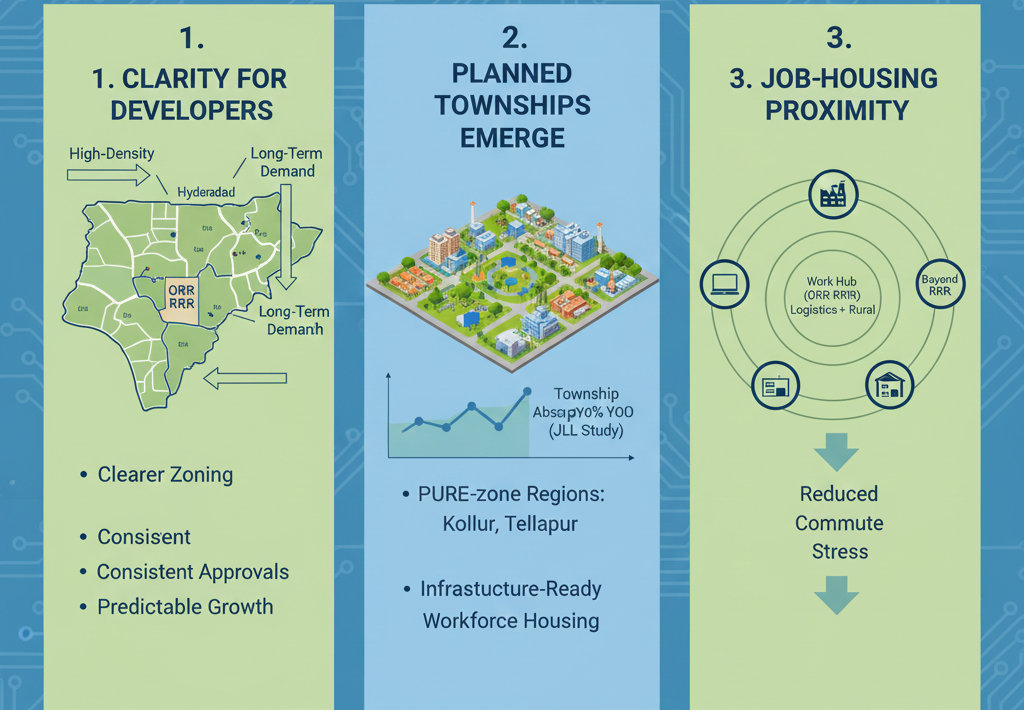
Clarity for Developers
For years, developers worked around ambiguous zoning boundaries, leading to inconsistent project approvals. The new model gives clearer direction on:
– what kind of development fits where
– what long-term demand patterns look like
– where high-density vs. low-density growth will happen
Emergence of Planned Townships
PURE-zone regions like Kollur, Tellapur, Mokila, and Ameenpur are already seeing interest from township developers.
A JLL India study notes that integrated townships have risen in demand due to infrastructure availability and lifestyle convenience, with township absorption growing 14% YoY (JLL Residential Market Update).
This aligns perfectly with the government’s plan to anchor workforce housing near emerging industrial clusters.
Job-Housing Proximity
Every global city eventually struggles with commute-based stress. Hyderabad is trying to solve it early:
– Work hubs inside ORR
– Manufacturing between ORR–RRR
– Logistics + rural development beyond RRR
This structure could reduce commute distances and support a more balanced, equitable urban spread.
3. Impact on Buyers and Investors
Inside ORR: Premium & Luxury Appreciation
Areas like Banjara Hills, Jubilee Hills, Gachibowli, Nanakramguda, and Kokapet will continue to command higher pricing due to:
– limited supply
– service-sector expansion
– strong white-collar migration
Anarock data already shows Hyderabad’s luxury housing share rising from 10% in 2021 to 21% in 2024 (Anarock Residential Report).
Between ORR–RRR: Mid-Segment Growth + Long-Term Returns
This is where infrastructure spending—RRR, metro expansions, radial roads—is concentrated.
With affordability still significantly better than other metros, this belt may act as the “next big wave” for first-time buyers.
Beyond RRR: Early-Stage Investment
RARE zones offer lower entry prices but depend heavily on upcoming infrastructure.
Early investors will be betting on:
– RRR completion
– logistics parks
– freight corridors
– multi-modal transport links
The upside potential is tied to execution.
FAQ Section
1. Is the CURE–PURE–RARE model already approved and active?
Yes, it has been outlined in government planning documents and is being integrated into land-use and zoning frameworks. Its rollout is phased, tied to mega infrastructure projects like the RRR and metro extensions.
2. Will this model affect home prices in Hyderabad?
Indirectly, yes.
CURE areas may see further price strengthening due to limited land, while PURE belt regions could see more supply, townships, and organised planning that support price stability.
3. Is Kollur–Tellapur the biggest beneficiary?
These areas sit at the heart of the PURE zone and are well-positioned for residential, commercial, and township growth. Multiple developers and infrastructure reports highlight this belt as a core growth corridor.
4. Does this change industrial zoning rules?
PURE and RARE zones will see clearer industrial-use guidelines, ensuring industries move outward while services stay in the core city to reduce congestion.
Conclusion

The CURE–PURE–RARE model marks a defining shift in how Hyderabad is planning its next decade.
By separating services, manufacturing, and logistics into clear belts, the city is addressing future jobs, housing, mobility, and infrastructure—all at once.
If execution matches intent, this may become one of India’s most forward-looking urban frameworks.
Let’s Join Together to Bring Change to the World of Real Estate.
Relai – For right home.
Thinking about your next home?
relai scores every project on data, not paid placements, and it's free for buyers.