Are Flats Really Depreciating Assets? A Reality Check for Buyers

One of the most common statements buyers hear is, “Flats are depreciating assets. Only land appreciates.” It sounds logical and often stops people from buying apartments altogether. But real estate does not behave in theory; it behaves in markets, cities, and timelines. In Indian cities, especially growing urban centres, the reality is far more nuanced.
This article breaks down how flats have actually behaved across Indian cities, explains the difference between land value and building value in simple terms, and clearly outlines when flats lose value and when they do not. The goal is clarity, not myths.
How Flats Have Actually Behaved in Indian Cities
If flats were truly depreciating assets, apartment prices in major Indian cities would be falling over time. The data shows the opposite.
According to the Reserve Bank of India’s House Price Index, residential property prices in cities like Hyderabad, Bengaluru, Mumbai, and Pune have shown long-term upward movement over the last decade, despite short-term cycles (RBI House Price Index).
Take Hyderabad as a practical example. Areas such as Gachibowli, Kondapur, Kukatpally, and Miyapur saw apartment prices in the ₹3,000–₹4,000 per sq ft range around 2014–15. By 2024–25, many of these micro-markets crossed ₹7,000–₹10,000 per sq ft, driven by IT expansion, infrastructure, and sustained end-user demand (Knight Frank India Residential Report).
What this clearly shows is that flats, as market products, have appreciated in value across Indian metros and high-growth cities. They may not behave like vacant land, but they are not inherently depreciating in real terms.
The confusion arises because buyers mix up accounting depreciation with market price movement.
Land Value vs Building Value Explained Simply
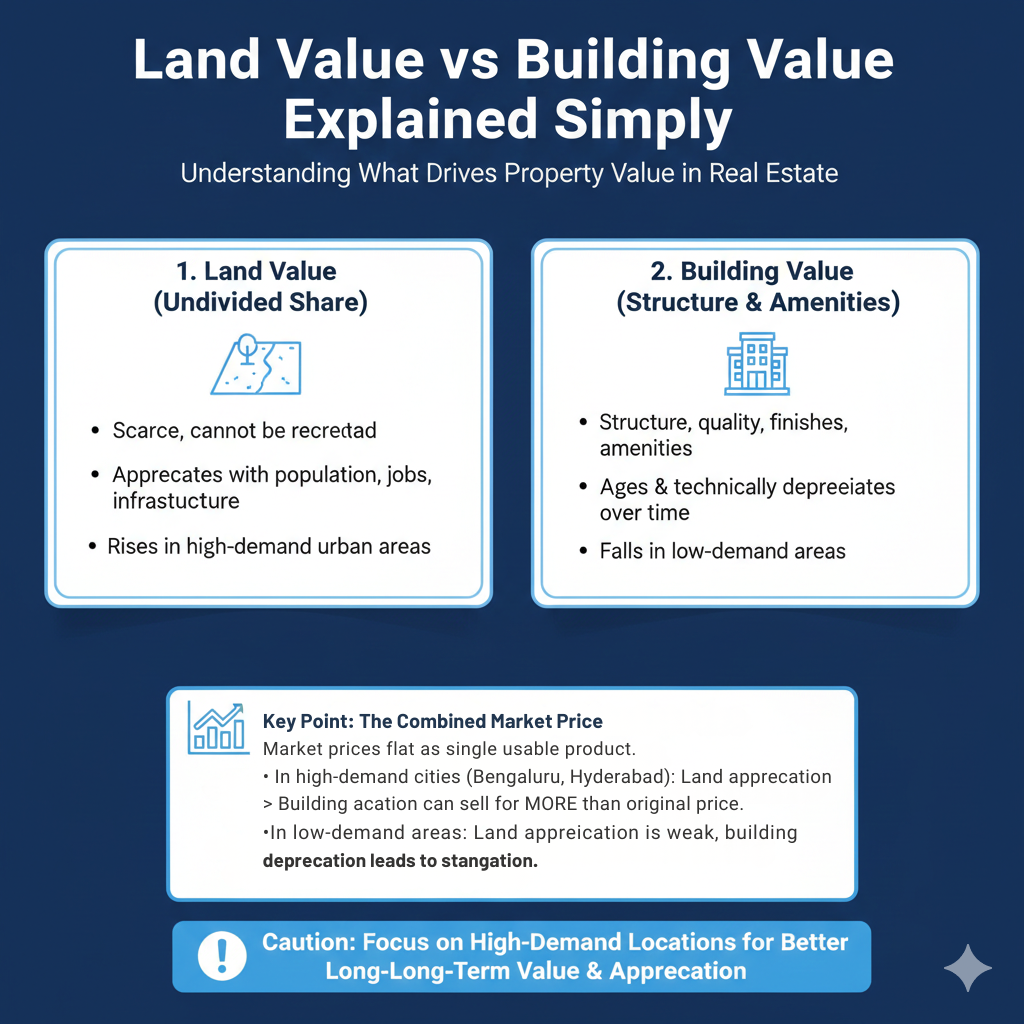
Every flat has two components embedded in its price.
First is land value. This is the undivided share of land (UDS) you own as part of the apartment. Land is scarce in cities, cannot be recreated, and usually appreciates as population, jobs, and infrastructure increase.
Second is building value. This includes the structure, construction quality, finishes, and amenities. Like any physical asset, this portion ages over time and technically depreciates.
However, buyers do not transact these two components separately. The market prices the flat as a single usable product.
Here is the key point most people miss: in high-demand urban locations, land appreciation often outpaces building depreciation. The land value rise masks and exceeds the ageing of the structure.
This is why a 15-year-old apartment in a prime Bengaluru or Hyderabad location can sell for more than its original purchase price, even though the building itself is older.
In contrast, in low-demand or oversupplied areas, land appreciation is weak. There, building depreciation becomes visible, and prices stagnate or fall.
When Flats Actually Lose Value
Flats do lose value under certain conditions. Ignoring these realities leads to bad buying decisions.
Flats tend to underperform or depreciate when they are located in areas with poor long-term demand. This includes locations far from employment hubs, weak infrastructure connectivity, or speculative growth without real end-user absorption.
Oversupply is another major factor. When too many similar apartments are launched in the same micro-market, resale competition increases and price growth slows. NCR is a textbook example where several apartment markets remained flat for nearly a decade due to excess inventory (Anarock Research).
Poor construction quality also accelerates value erosion. Structural issues, water seepage, low maintenance standards, and weak association management directly impact resale demand.
Finally, very old apartments without redevelopment potential may struggle. If the land parcel is small, redevelopment is not viable, and maintenance costs rise, buyers discount such properties heavily.
In these cases, flats behave closer to depreciating assets.
When Flats Do Not Lose Value
Flats hold value and often appreciate when they meet certain conditions.
Location remains the strongest factor. Apartments close to job corridors, metro connectivity, schools, hospitals, and commercial centres retain demand across cycles.
Strong UDS allocation improves long-term value. Projects with lower density and better land share per flat perform better over time, especially during redevelopment or resale.
Quality construction and professional maintenance matter. Buyers pay a premium for buildings that age well, have active associations, and maintain amenities.
Redevelopment potential is a hidden advantage. In cities like Mumbai and Bengaluru, older apartments on large land parcels often see value support because buyers factor in future redevelopment upside (JLL India Urban Redevelopment Insights).
Most importantly, end-user demand protects prices. Markets driven by real living needs behave very differently from purely investor-led markets.
Flats vs Plots: A More Practical Comparison
Plots are often positioned as the superior asset because they are “pure land.” While true in theory, plots come with higher ticket sizes, liquidity challenges, development costs, and legal complexity.
Flats, on the other hand, offer usability, rental income, easier resale in urban markets, and lower management effort. For most buyers, the decision is not about depreciation versus appreciation, but about suitability, cash flow, and risk.
According to a 2023 report by CBRE, apartments accounted for over 70% of residential transactions in India’s top cities, highlighting where actual buyer demand lies (CBRE India Residential Market View).
FAQ Section
Are flats depreciating assets in India?
No. Flats are not inherently depreciating assets. In high-demand urban locations, land appreciation often outweighs building depreciation, leading to overall price growth.
Why do people say flats depreciate?
This belief comes from accounting concepts and from observing poorly located or oversupplied apartment markets. It does not reflect how strong city markets actually behave.
Do older flats lose resale value?
Older flats can retain or even increase value if they are in prime locations, have good maintenance, and offer redevelopment potential. Age alone does not determine value.
Is buying a flat a bad long-term decision?
Not necessarily. A well-chosen flat in a demand-driven location can deliver appreciation, rental income, and liquidity, making it a practical long-term asset.
Conclusion
Flats are not automatically depreciating assets, nor are they guaranteed wealth creators. Their performance depends on location, demand, land share, construction quality, and market dynamics. In Indian cities, data clearly shows that well-located apartments have appreciated over time, even if the building itself ages.
Instead of repeating blanket statements, buyers should evaluate flats as urban land-backed products. When chosen correctly, flats remain one of the most practical and stable real estate assets for Indian buyers.
Let’s Join Together to Bring Change to the World of Real Estate
Thinking about your next home?
relai scores every project on data, not paid placements, and it's free for buyers.