What Really Drives Price Growth After a Project Is Completed
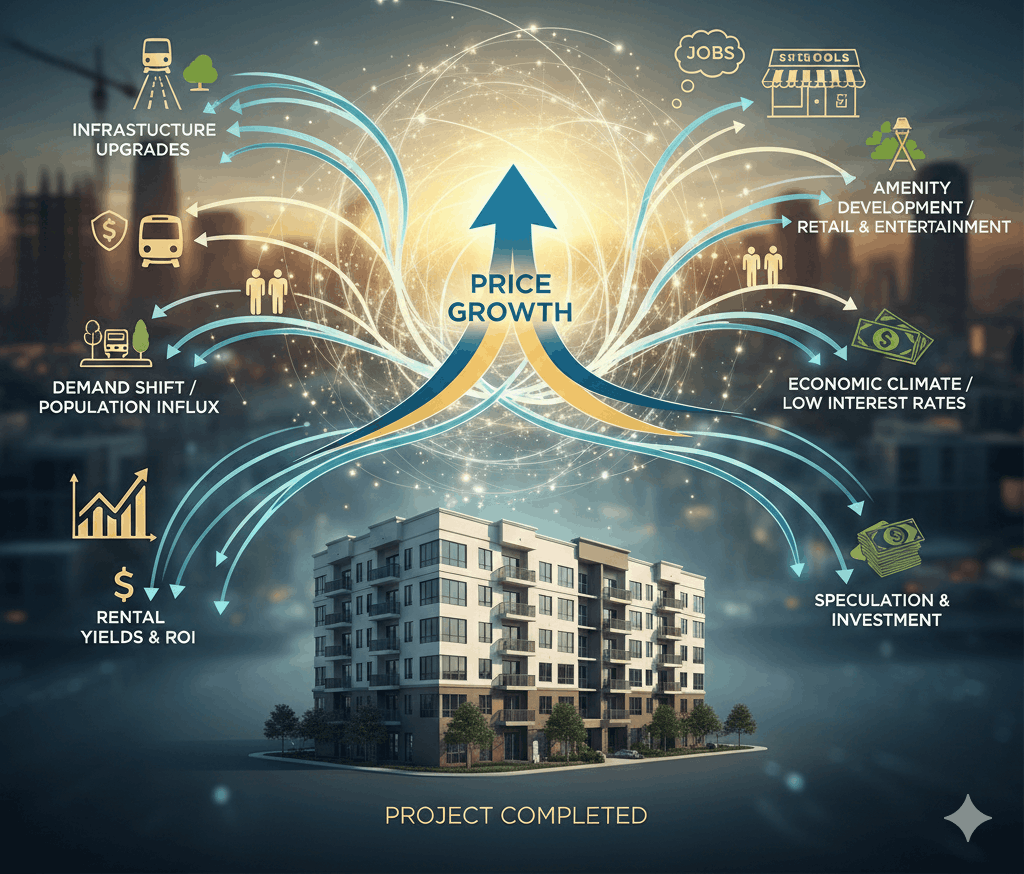
Many buyers believe price growth slows down once a project is completed. In reality, completion is not the end of value creation. It is the point where real market forces start working without marketing noise, launch discounts, or future promises.
In Hyderabad and other Indian cities, some completed projects outperform expectations while others stagnate for years despite similar launch prices. The difference lies in what happens after people move in.
This blog explains the three real drivers of price growth after completion, and why they matter more than brochures or pre-launch hype.
Community Quality and Occupancy Mix
Once possession begins, the buyer profile starts shaping the project’s long-term value.
Projects with a high proportion of genuine end users behave very differently from investor-heavy ones. End users care about maintenance, behaviour norms, security, and long-term livability. This creates stability.
A healthy occupancy mix usually shows:
High self-occupied units
Families staying longer instead of frequent churn
Active resident associations
Better upkeep of common areas
Investor-dominated projects often struggle with:
Empty units and low occupancy
Short-term tenants
Slower community formation
Reduced emotional attachment to the property
Over time, buyers pay a premium for projects that feel lived in and well managed. Community quality quietly becomes a pricing advantage.
Infrastructure Delivery, Not Announcements
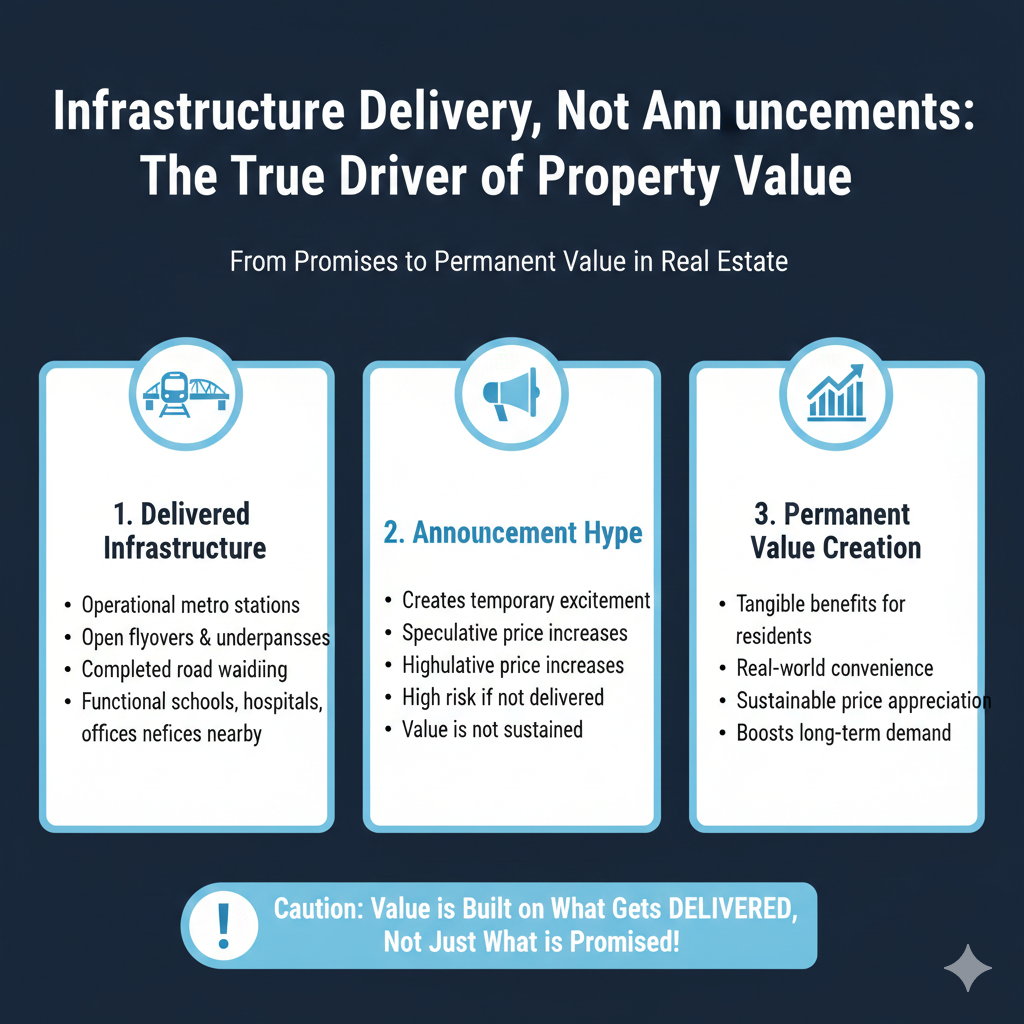
Price growth after completion depends far more on what actually gets delivered than what was announced during launch.
Infrastructure that truly moves prices includes:
Operational metro stations
Open flyovers and underpasses
Completed road widening
Functional schools, hospitals, and offices nearby
Announcements create temporary excitement. Delivery creates permanent value.
Many completed projects stagnate because surrounding infrastructure remains stuck in planning or litigation. Others see steady appreciation once access improves and daily commute friction reduces.
Buyers in the resale market evaluate present convenience, not future promises. This is why completed infrastructure has a much stronger impact on price than upcoming plans.
Supply Constraints Over Time
After a project is completed and fully sold, fresh supply becomes limited.
If:
Land parcels nearby are exhausted
Zoning restricts high-density development
New launches shift further away
then resale prices gain support naturally.
In contrast, areas with constant new supply struggle to push resale prices meaningfully. Buyers compare older completed units with newer launches offering better layouts or amenities at similar prices.
Supply constraint is one of the strongest but least discussed drivers of long-term price growth.
Why Some Completed Projects Still Underperform
Even after completion, prices may stagnate if:
Maintenance quality drops
Occupancy remains low
Infrastructure stalls
Competing projects keep launching nearby
Completion removes uncertainty, but it does not guarantee appreciation. The post-handover phase exposes the true strength of the location and the community.
FAQ Section
Do prices always rise after project completion?
No. Prices rise only when occupancy, livability, and surrounding infrastructure support demand.
Is end-user demand more important than investor demand post-completion?
Yes. End users create stability, better maintenance, and long-term price support.
How long after completion does appreciation usually pick up?
Typically 2–4 years, once occupancy stabilises and infrastructure benefits are visible.
Does maintenance quality really affect resale value?
Yes. Poor maintenance directly reduces buyer willingness to pay.
Conclusion

Project completion marks the start of real value discovery, not the end of growth.
Community quality, delivered infrastructure, and supply constraints decide whether prices move steadily upward or remain flat. Buyers who understand these drivers evaluate completed projects with far more clarity than those chasing launch-stage narratives.
Price growth after completion is quiet, gradual, and driven by daily living realities.
Let’s Join Together to Bring Change to the World of Real Estate.
Thinking about your next home?
relai scores every project on data, not paid placements, and it's free for buyers.