Tokenization and Fractional Ownership Platforms: Real Estate’s New Frontier
Real estate has long been one of the world’s largest asset classes, yet for most people it has remained illiquid, expensive to enter, and slow to trade. Traditional investment typically requires large capital, lengthy paperwork, and limited liquidity — especially for commercial or institutional-grade properties.
Blockchain-enabled tokenization is changing this. By turning physical real estate into digital tokens, markets are opening up to investors of all sizes, enabling fractional ownership, faster liquidity, and global access. In 2026, this shift is becoming more tangible as regulated platforms emerge, smart contracts automate processes, and fractional systems gain real traction in practice, not just theory.
What Real Estate Tokenization Really Means
Tokenization uses blockchain technology to represent ownership of a real-world asset as digital tokens on a distributed ledger. Each token corresponds to a fractional share of a property or income stream. This can apply to residential homes, commercial offices, retail complexes, or even specialized income-producing assets.
These tokens are typically governed by smart contracts, which automatically enforce rules such as rental income distribution, ownership transfers, and compliance checks. This automation reduces manual processes and intermediaries, increasing transparency and efficiency — key benefits for investors and developers alike.
How Tokenization Democratizes Real Estate Investment
Traditional barriers — whether high entry costs or geographic restrictions — are dissolving:
Investors can buy small fractions of real estate, sometimes with entry points as low as $50–$500, democratizing access to high-value assets that once required crores of rupees.
Tokenized assets can be bought, sold, or traded more easily, with some platforms developing secondary marketplaces for liquidity beyond traditional sale timelines.
Global participation becomes feasible because digital tokens are not bound by local paperwork-heavy processes, though regulatory compliance remains essential.
This opens real estate to a much broader investor base — from individual retail buyers to institutional funds — enabling portfolio diversification and global exposure.
Leading Platforms Moving Tokenization Forward
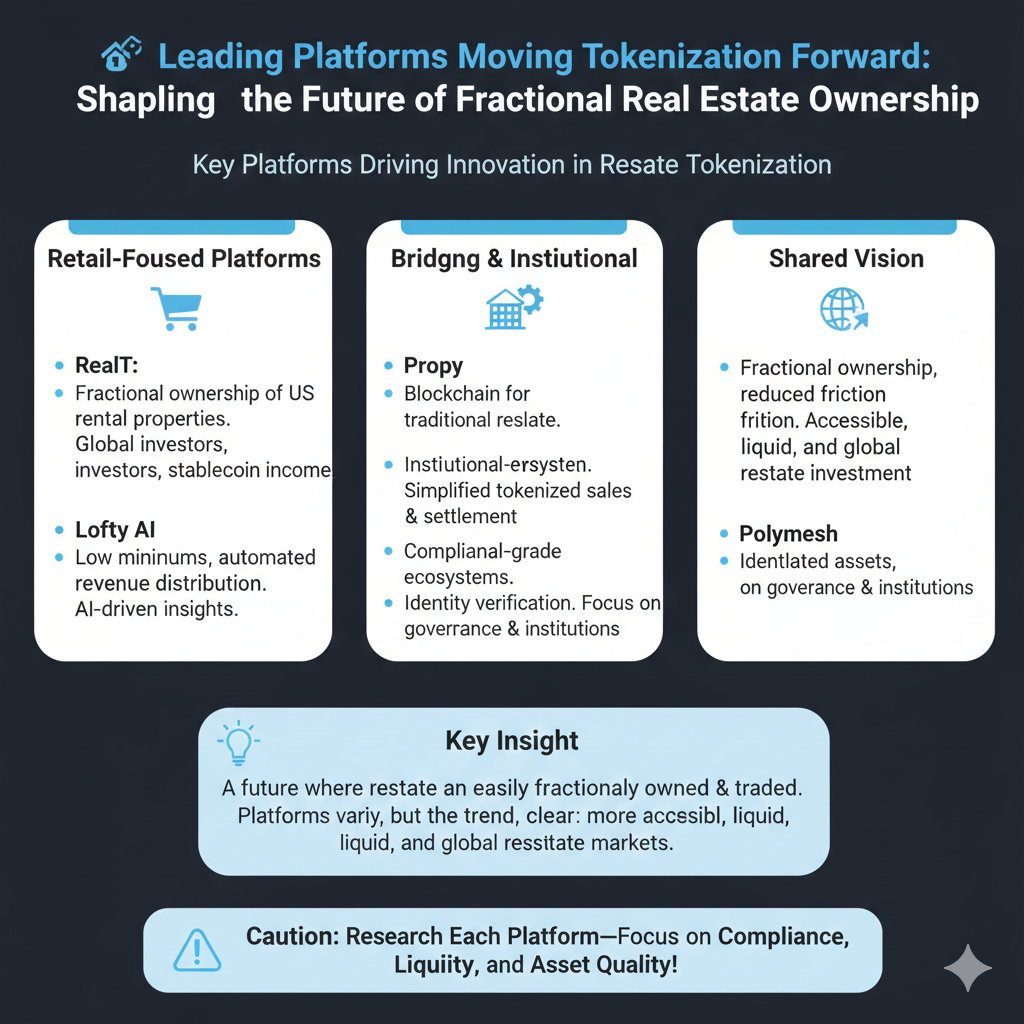
Several platforms are already shaping the tokenization landscape:
RealT allows investors globally to buy fractions of U.S. rental properties and earn income via stablecoin payouts.
Lofty AI lets users buy fractional ownership in income-producing real estate with low minimums and automated revenue distribution.
Propy bridges traditional property processes with blockchain, simplifying tokenized fractional sales and settlement mechanics.
Zoniqx and StegX.Finance are building institutional-grade ecosystems for global real estate tokenization with compliance tools and cross-chain infrastructure.
Platforms built on Polymesh prioritize identity verification and regulated asset management, attractive for institutional investors and governance-focused offerings.
These platforms vary in focus and sophistication, but all point toward a future where real estate can be fractionally owned and traded with reduced friction.
Role of Smart Contracts in 2026
Smart contracts are the engine of tokenization. These self-executing agreements automate key processes:
Distributing rental income
Enforcing ownership rights
Recording transfers on immutable ledgers
Ensuring compliance with investor requirements
By handling these tasks automatically, smart contracts reduce manual effort, lower costs, and increase transparency. As of 2026, automation driven by smart contracts is becoming mainstream on tokenization platforms, enabling more passive and efficient income generation for investors.
Regulatory Progress and Platforms Going Legit
One of the biggest challenges for real estate tokenization has been uncertainty around regulations — especially in countries like India where property rights and digital asset laws intersect.
However, global moves toward regulated frameworks are underway. For example:
Markets such as the U.S., UAE, Singapore, and parts of Europe are actively developing clearer guidelines for tokenized securities and real-world assets.
Platforms like tZERO are building compliant secondary markets for tokenized property rights with constant trading support.
India’s capital markets and sandbox initiatives are exploring ways to handle tokenized assets under unified ledger systems.
Despite progress, legal clarity around title rights, ownership enforcement, and taxation remains dependent on underlying structures (for example, tokenizing shares of an SPV that owns the property rather than the property title itself).
Measurable Operational and Investor ROI
Tokenization promises tangible benefits, not just buzz:
Liquidity: Fractional tokens can be traded more easily than whole property interests, and 24/7 market platforms are emerging — for example, the NYSE is working on a tokenized trading venue that could support digital trading around the clock.
Lower Costs: Smart contract automation cuts back on legal, administrative, and settlement costs traditionally associated with property transactions.
Access: Investors anywhere can participate without needing local intermediaries, thanks to standardized blockchain records and compliant onboarding.
Efficiency: Smart contracts and automated distribution reduce delays and manual reconciliation in income payouts and ownership transfers.
These measurable results give real estate investing a more predictable and transparent return profile — especially important for both retail and institutional investors.
FAQ Section
Does owning a token mean you legally own the property?
Not always. Token ownership often represents fractional economic rights via an SPV, while legal title remains documented under traditional systems. The linkage must be clearly established in platform terms.
Are tokenized real estate investments secure?
Blockchain’s immutability increases transparency and record integrity, but platform compliance, regulation, and smart contract security still matter. Choose regulated, audited platforms.
Can you sell tokens anytime?
Secondary market liquidity varies. While some platforms offer frequent trading, others depend on market demand and regulatory permissions.
Is this suitable for first-time investors?
Yes — entry points are much lower than traditional real estate, making it easier to diversify with small capital.
Conclusion

Tokenization and fractional ownership platforms are transforming real estate from an illiquid, high-barrier asset class into one that’s accessible, programmable, and globally connected. With smart contracts automating income and compliance, and regulated platforms emerging in 2026, blockchain-enabled real estate is maturing beyond hype into real practical ROI for investors and operators alike.
This evolution promises to democratize investment, increase liquidity, and bring a new level of transparency — not just for big institutions but for everyday investors looking to participate in property markets worldwide.
Let’s Join Together to Bring Change to the World of Real Estate.
Thinking about your next home?
relai scores every project on data, not paid placements, and it's free for buyers.