ESG and Wellness-Focused Green Tech Integration: Why Health and Sustainability Now Decide Property Value
Green buildings were once defined by energy savings alone. Lower power bills, efficient lighting, and water conservation were considered enough. That definition is now outdated.
Today, ESG in real estate goes beyond sustainability. It includes how healthy a building is for people who live or work inside it. Air quality, noise levels, light, thermal comfort, and even access to nature are becoming measurable factors that influence pricing, demand, and long-term value.
With IoT and AI enabling real-time monitoring, ESG and wellness are no longer abstract concepts. They are operational metrics — and buildings that perform well on them increasingly command premium rents and stronger resale demand.
What ESG Really Means in Real Estate Today
ESG stands for Environmental, Social, and Governance. In real estate, this translates into three practical questions.
Environmental asks how efficiently a building uses energy, water, and materials.
Social asks how safe, healthy, and comfortable the building is for occupants.
Governance asks how transparently and responsibly the asset is managed.
Earlier, most projects focused only on the environmental side. Today, the social component — occupant health and well-being — is becoming equally important.
This shift is driven by changing tenant expectations, stricter compliance norms, and clear financial outcomes linked to healthier buildings.
From Energy Efficiency to Human Performance
Energy optimization reduces costs. Wellness improves demand.
Modern green tech now tracks:
Indoor air quality and pollutants
CO₂ levels and ventilation effectiveness
Noise pollution and acoustic comfort
Natural light exposure and glare
Thermal consistency across spaces
Poor indoor air quality alone has been shown to reduce cognitive performance and productivity. A Harvard study found that improved indoor air quality can raise cognitive scores by up to 61% in office environments (Harvard T.H. Chan School of Public Health).
For residential properties, the impact shows up as better comfort, lower health complaints, and higher willingness to pay.
IoT as the Backbone of Wellness Monitoring
Wellness-focused buildings rely heavily on IoT sensors.
These sensors continuously measure:
PM2.5 and PM10 air particles
Temperature and humidity
Noise levels
Occupancy density
Lighting conditions
Instead of annual audits or manual checks, building managers get real-time visibility into how the building actually performs day to day.
This data allows immediate corrective action — increasing fresh air intake, adjusting HVAC zones, or managing crowding — rather than reacting after complaints arise.
AI Turning Data Into Actionable ESG Compliance
Data alone does not create value. AI does.
AI systems analyze sensor data to:
Detect unhealthy patterns early
Predict air quality degradation before thresholds are crossed
Balance energy efficiency with occupant comfort
Generate ESG performance reports automatically
This enables continuous ESG compliance rather than checkbox-based certification.
According to the World Green Building Council, healthy buildings can improve occupant well-being while also delivering up to 20% higher asset value in some markets (World Green Building Council).
AI makes it possible to maintain these standards consistently at scale.
Wellness Scoring as a New Differentiator
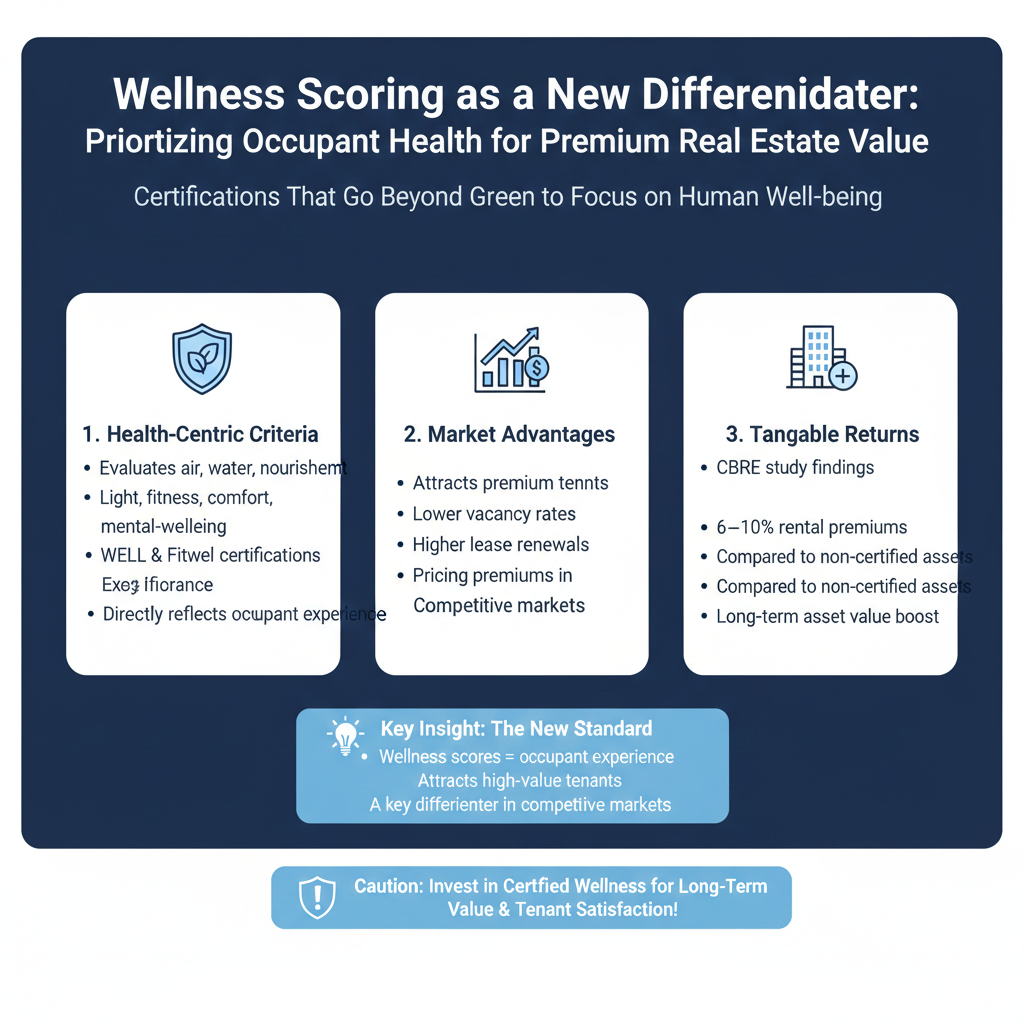
One of the biggest shifts is the emergence of wellness scoring.
Certifications such as WELL and Fitwel evaluate buildings based on health-centric criteria like air, water, nourishment, light, fitness, comfort, and mental well-being.
Unlike traditional green ratings, wellness scores directly reflect occupant experience.
Buildings with strong wellness credentials:
Attract premium tenants
Experience lower vacancy
See higher lease renewals
Command pricing premiums in competitive markets
A CBRE study found that certified green and wellness-oriented buildings can achieve rental premiums of 6–10% compared to non-certified assets (CBRE).
Noise, Light, and Biophilic Design Matter More Than Expected
Wellness is not only about air.
Noise pollution impacts sleep quality, stress levels, and productivity. Smart acoustic monitoring helps identify persistent noise zones and adjust layouts or materials accordingly.
Lighting affects circadian rhythms. Dynamic lighting systems that adjust intensity and warmth through the day improve comfort and sleep cycles, especially in residential and mixed-use buildings.
Biophilic design integrates natural elements such as greenery, water features, and natural textures. Studies show that access to nature can reduce stress and improve mental well-being (Terrapin Bright Green).
When combined with technology, these features move from design intent to measurable outcomes.
Why ESG and Wellness Directly Impact Asset Value
The financial logic is becoming clear.
Healthy buildings experience:
Higher tenant retention
Lower operational complaints
Reduced regulatory risk
Stronger brand perception
For investors, this translates into:
More predictable cash flows
Lower vacancy risk
Better exit pricing
In a market where supply is increasing, quality of experience becomes the real differentiator, not just location or size.
Who Benefits Most From Wellness-Focused Green Tech
The strongest impact is seen in:
Premium residential communities
Grade-A office buildings
Mixed-use developments
Hospitality and co-living assets
However, even mid-segment projects benefit through improved livability and long-term durability.
As sensor and AI costs decline, wellness-driven ESG integration is moving from luxury positioning to mainstream expectation.
FAQ Section
Is wellness-focused green tech expensive?
Initial costs exist, but higher rents, better retention, and lower long-term operating issues often offset them.
Does ESG certification guarantee better performance?
Certification sets standards, but real value comes from continuous monitoring and management using IoT and AI.
Is this relevant for residential buyers?
Yes. Indoor air quality, noise, and thermal comfort directly affect daily living quality and resale appeal.
Can existing buildings adopt wellness tech?
Yes. Many solutions can be retrofitted without full redevelopment.
Conclusion

ESG and wellness-focused green tech represent the next phase of real estate evolution.
Buildings are no longer evaluated only by how much energy they save, but by how well they support human health and comfort. With IoT and AI enabling real-time monitoring and wellness scoring, these factors are becoming measurable, comparable, and financially relevant.
In the coming years, properties that integrate sustainability with occupant well-being will not just feel better to live or work in — they will perform better as long-term assets.
Let’s Join Together to Bring Change to the World of Real Estate.
Thinking about your next home?
relai scores every project on data, not paid placements, and it's free for buyers.