5G-Enabled Connectivity and Smart City Synergies: How Network Speed Is Becoming a Real Estate Advantage

Connectivity has always influenced real estate value. Roads, railways, airports, and utilities shape how locations grow. Today, digital connectivity is joining that list — and 5G is becoming a critical layer of urban infrastructure.
Unlike earlier mobile networks, 5G is not just about faster internet on phones. Its real impact lies in ultra-low latency, massive device connectivity, and real-time data exchange. These capabilities allow buildings, infrastructure, and city systems to interact instantly.
For real estate, this creates a new synergy between smart buildings and smart cities, especially in fast-growing urban corridors.
What Makes 5G Different From Earlier Networks
4G improved speed. 5G changes architecture.
5G offers:
Ultra-low latency (response times measured in milliseconds)
Support for thousands of connected devices per location
Stable performance even in dense urban environments
Network slicing for critical services
This matters because smart buildings and city systems depend on continuous, reliable, real-time communication — something earlier networks struggled to provide at scale.
In practical terms, 5G allows buildings to stop acting as isolated assets and start behaving as connected urban nodes.
5G as an Enabler of Edge Computing
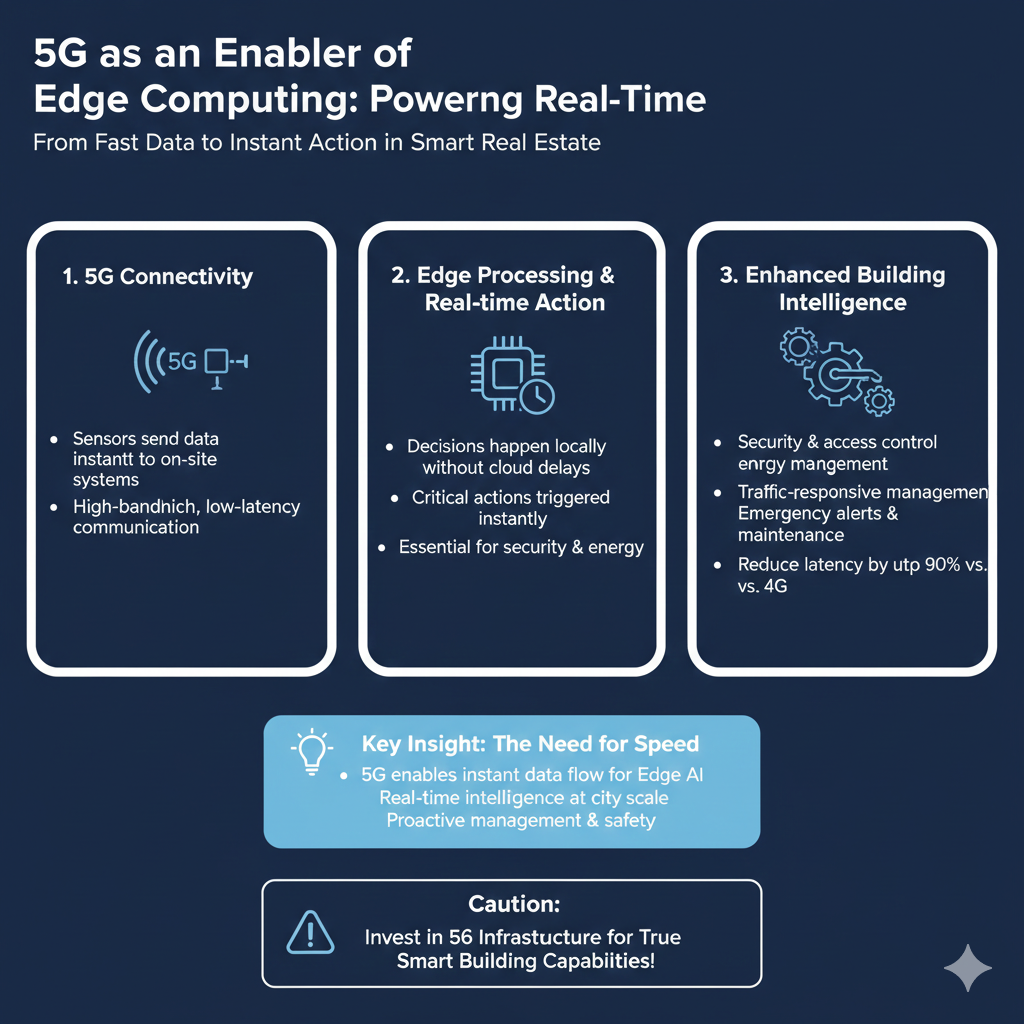
Edge computing works best when data moves quickly and reliably.
With 5G:
Sensors send data instantly to on-site edge systems
Decisions happen locally without cloud delays
Critical actions are triggered in real time
This is essential for:
Security systems
Traffic-responsive energy management
Emergency alerts
Predictive maintenance coordination
According to Ericsson, 5G can reduce latency by up to 90% compared to 4G, making real-time building intelligence feasible at city scale (Ericsson).
For large residential townships and commercial campuses, this creates a noticeable improvement in reliability and responsiveness.
Real-Time Building-to-City Integration
The real shift happens when buildings start exchanging data with city systems.
Examples include:
Traffic-aware energy management adjusting HVAC loads based on congestion patterns
Parking systems syncing with city mobility platforms
Emergency systems coordinating with municipal response units
Street lighting and building lighting working in sync
5G enables this continuous, two-way communication without lag.
In smart city pilots worldwide, integrated systems have shown energy savings of 10–15% through real-time load balancing and demand response (International Energy Agency).
For property owners, this means lower operating costs and better compliance with urban sustainability goals.
Shared Mobility and Access Infrastructure
5G also supports shared mobility ecosystems that directly influence real estate desirability.
Connected developments can integrate:
EV charging networks
Shared electric vehicles and bicycles
Smart parking and access control
Real-time transit updates
Because these systems rely on constant data exchange, low latency is critical.
Developments located along transit-oriented and mobility-enabled corridors become more attractive to residents who value convenience over car ownership. This is particularly relevant in dense urban growth zones.
According to McKinsey, mobility-enabled urban developments can improve land values by 5–20% depending on integration quality (McKinsey & Company).
Scalable IoT Deployments Without Network Bottlenecks
One of the biggest limitations of earlier smart building deployments was network congestion.
5G solves this by supporting:
Massive IoT device density
Stable connections in high-rise and dense areas
Priority routing for critical systems
This allows developers to deploy:
Air quality sensors
Noise monitoring
Smart meters
Occupancy and safety systems
All without degrading performance.
As cities densify, network scalability becomes a real estate risk factor. Properties built with future-ready connectivity are better positioned for long-term relevance.
Why Growth Corridors Benefit the Most
The impact of 5G is strongest in emerging urban corridors, not fully saturated cores.
In these areas:
Infrastructure is still being laid
Smart city frameworks are being adopted early
Large mixed-use developments are planned
When connectivity is designed in from the start, buildings integrate seamlessly with transport, utilities, and civic systems.
This creates a compounding effect:
Better livability
Higher tenant demand
Stronger investor confidence
In markets like India, Southeast Asia, and parts of the Middle East, digitally enabled growth corridors are increasingly outperforming legacy locations on long-term appreciation.
Connectivity as a Pricing and Valuation Signal
Connectivity is becoming measurable.
Investors and occupiers now assess:
Network redundancy
Latency performance
Smart infrastructure readiness
Compatibility with city platforms
CBRE notes that digitally connected buildings show higher tenant retention and stronger leasing velocity, especially among technology-driven occupiers (CBRE).
Over time, this influences valuation models as connectivity shifts from a feature to a baseline requirement.
Risks of Ignoring 5G-Readiness
Buildings that ignore connectivity face silent obsolescence.
Common risks include:
Inability to scale IoT systems
Higher retrofit costs later
Poor integration with city services
Lower appeal to future tenants
Just as buildings without parking lost relevance decades ago, buildings without digital infrastructure risk falling behind in the next cycle.
FAQ Section
Is 5G relevant for residential projects or only commercial ones?
It benefits both. Residential communities gain from better security, mobility integration, and smart services.
Does 5G increase construction costs significantly?
Core network infrastructure costs are marginal when planned early and far higher when retrofitted later.
Is 5G availability uniform across cities?
No. Impact is highest in corridors where telecom and civic infrastructure are developing together.
Does connectivity alone increase property value?
Connectivity amplifies value when combined with location, planning, and livability. It is an enabler, not a standalone factor.
Conclusion

5G-enabled connectivity is becoming a silent but powerful driver of real estate performance.
By enabling edge computing, real-time building-to-city integration, scalable IoT systems, and smarter mobility, 5G transforms how properties function within urban ecosystems. In growth corridors especially, connectivity is no longer just a utility — it is infrastructure that shapes value.
As cities evolve, real estate that connects intelligently will outperform real estate that simply exists.
Let’s Join Together to Bring Change to the World of Real Estate.
Thinking about your next home?
relai scores every project on data, not paid placements, and it's free for buyers.