The Paperless Property Era: 2026 Is the Turning Point

For decades, property transactions in India meant thick files, multiple office visits, manual verification, and long waiting periods. Registration day was physical. Documentation was physical. Even land record updates were physical.
That model is breaking.
In 2026, digital property systems are no longer pilot experiments. They are operational realities across multiple states and even globally. Aadhaar-linked digital registrations, real-time land record updates, Telangana’s Bhubharati platform, and expanded Remote Online Notarization in the United States are collectively reshaping how ownership is recorded and verified.
The question is no longer whether digitization will happen. The question is whether 2026 is the year physical registration becomes obsolete.
Let’s examine what has changed.
Aadhaar-Linked Digital Property Registrations: Identity Becomes Instant
Several Indian states began rolling out Aadhaar-linked digital property registration systems in early 2026. These systems integrate identity verification directly with property transfer workflows.
Under the Aadhaar framework managed by the Unique Identification Authority of India, biometric and OTP-based authentication enables:
Real-time identity validation
Reduced impersonation risk
Lower document forgery incidents
Faster transaction processing
According to UIDAI’s official data, Aadhaar has crossed 1.3 billion enrollments, making it one of the world’s largest digital identity systems. Integrating this scale into property registration significantly reduces fraud exposure.
The result is simple. If identity verification is instant, the need for physical presence reduces dramatically.
Telangana’s Bhubharati Portal: LPM-Based Digital Governance
Telangana introduced the Bhubharati portal in January 2026 to digitize land records using Location Parcel Mapping numbers, commonly known as LPM numbers. The initiative operates under the Government of Telangana.
Each parcel of land is assigned a unique LPM identifier. This enables:
Clear geo-tagged mapping
Unified land database access
Reduced boundary disputes
Transparent transaction tracking
Telangana has long been considered a progressive state in digital land governance, following earlier initiatives like Dharani. Bhubharati expands this by linking spatial mapping directly to ownership records.
For markets like Hyderabad, this reduces ambiguity. Investors no longer rely only on manual document chains. They can cross-verify digital parcel data.
The shift is structural. When land mapping, ownership records, and registration are digitally linked, physical paperwork becomes secondary.
Instant Land Record Updates: From Weeks to Real-Time
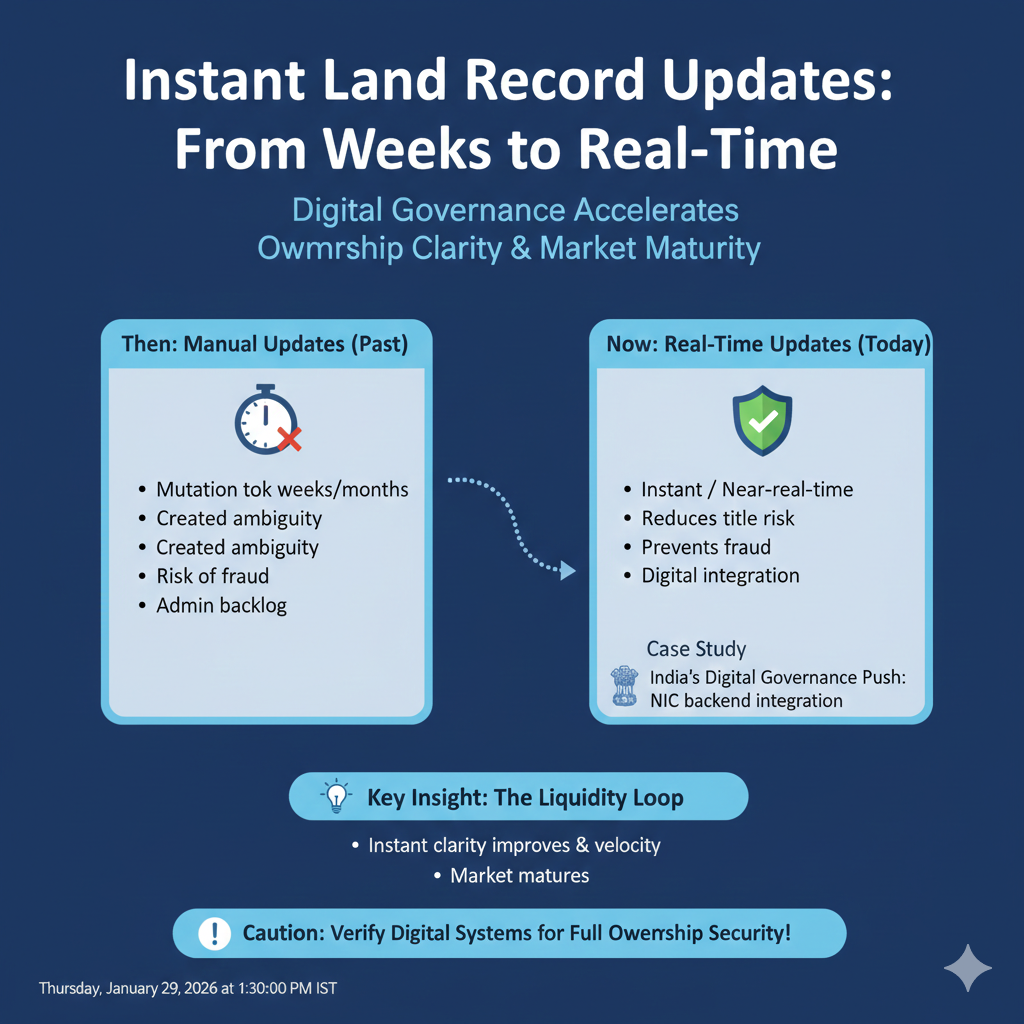
Traditionally, after property registration, land record mutation could take weeks or even months. That gap created confusion and sometimes legal disputes.
Since Q1 2026, select regions have operationalized instant or near-real-time land record updates following registration. This reduces:
Title ambiguity
Duplicate claims
Post-sale fraud
Administrative backlog
India’s digital governance push, supported by the National Informatics Centre, has enabled states to integrate backend registration databases with land record systems.
The importance of instant mutation cannot be overstated. Ownership clarity improves liquidity. Liquidity improves trust. Trust improves transaction velocity.
That is how markets mature.
The U.S. Expansion: Remote Online Notarization Goes Interstate
India is not alone in this shift.
In the United States, the SECURE Notarization Act continues expanding acceptance of interstate Remote Online Notarization through 2026. This allows notarization of property-related documents via secure digital platforms, regardless of physical location.
The U.S. framework operates under federal guidelines and state-level implementation, supported by the U.S. Congress through legislative action.
Remote Online Notarization enables:
Video-based identity verification
Digital document execution
Tamper-evident digital seals
Cross-state acceptance
The implication is global. When two major markets adopt digital verification at scale, physical presence becomes a legacy requirement, not a necessity.
Is 2026 the Year Physical Registration Becomes Obsolete?
Obsolete is a strong word. Let’s analyze realistically.
What Has Already Changed
Identity verification is digital
Parcel mapping is digital
Registration data entry is digital
Mutation updates are becoming real-time
Notarization can be remote
What Still Requires Physical Interaction
Certain rural registrations
Legacy record corrections
High-dispute properties
States yet to fully digitize
So 2026 may not eliminate physical registration entirely. But it marks a tipping point.
For urban markets like Hyderabad, Bengaluru, and parts of Maharashtra and Gujarat, physical presence is increasingly procedural rather than essential.
In practical terms, physical registration is transitioning from default to backup.
What This Means for Buyers in 2026
1. Speed Becomes a Competitive Advantage
Digital workflows compress transaction timelines. Sellers prefer buyers who can complete faster.
2. Fraud Risk Reduces
Integrated Aadhaar and digital mapping reduce impersonation and forged title chains.
3. Cross-Border Transactions Increase
NRIs benefit from remote notarization frameworks and digital document verification.
4. Advisory Becomes More Important
Digitization reduces paperwork confusion, but it does not eliminate market risk. Pricing, micro-location growth, infrastructure timing, and developer credibility still require human analysis.
Technology improves execution. It does not replace judgment.
FAQ Section
Is Aadhaar-linked property registration mandatory across India in 2026?
No. It has been rolled out in multiple states, but implementation varies by state government.
What is an LPM number in Telangana?
An LPM number is a Location Parcel Mapping identifier assigned to each land parcel under Telangana’s Bhubharati system to ensure geo-linked ownership tracking.
Are land records updated instantly everywhere?
No. Instant updates are operational in select regions since Q1 2026. Nationwide standardization is still in progress.
Can NRIs complete property transactions fully online?
In some jurisdictions, significant parts of the process can be completed digitally, especially notarization and document execution. However, local state rules still apply.
Will physical registration offices shut down?
Unlikely in the immediate future. They may continue as supervisory or exceptional-case centers rather than primary transaction hubs.
Conclusion

2026 will not erase physical registration overnight. But it is the year the balance shifts.
Digital identity, parcel mapping, real-time mutation, and remote notarization are converging. The process of transferring ownership is becoming faster, cleaner, and more transparent. The paperwork era is not disappearing in a dramatic collapse. It is fading through systemic replacement.
For buyers and investors, this means fewer procedural barriers but higher strategic responsibility. Technology will make transactions smoother. It will not decide whether you are buying the right property.
Let’s Join Together to Bring Change to the World of Real Estate.
Thinking about your next home?
relai scores every project on data, not paid placements, and it's free for buyers.