AI-Driven Regulatory Filings: RERA 2026 Is This the Beginning of AI-Regulated Real Estate?

For years, regulatory filings in Indian real estate followed a predictable pattern.
Developers uploaded PDF reports. Progress photos were attached manually. Financial disclosures were static documents. Compliance was review-based, not intelligence-driven.
That format changes in FY 2026.
With machine-readable quarterly reports, structured data submissions, and AI-enabled compliance tracking frameworks introduced under evolving norms of the Real Estate (Regulation and Development) Act, 2016, 2026 may mark the beginning of algorithm-assisted real estate governance.
This is more than digitization. It is data standardization.
Let’s break down what is changing.
Machine-Readable Quarterly Progress Reports: From PDFs to Structured Data
Starting FY 2026, several state RERA authorities are shifting toward machine-readable formats for Quarterly Progress Reports (QPRs).
Earlier:
• Developers uploaded scanned PDFs
• Financial utilization reports were non-searchable
• Construction updates were narrative-heavy
• Data extraction required manual review
From 2026 onward:
• Data fields must follow structured templates
• Financial inputs are standardized
• Construction milestones are coded into predefined categories
• Escrow usage is mapped to machine-readable formats
This allows regulators to compare projects automatically across districts, cities, and states.
Compliance becomes measurable at scale.
MoHUA Digital Submission Norms: Central Push Toward Standardization
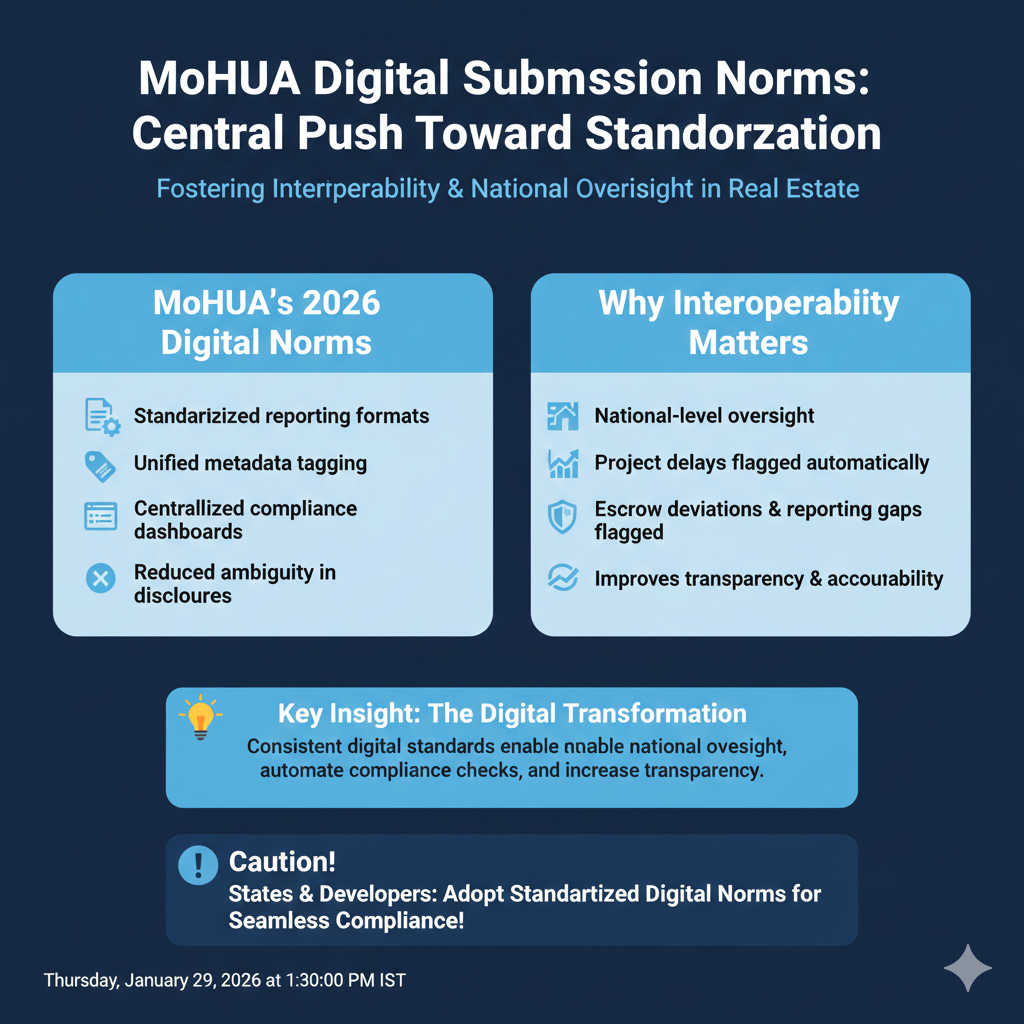
The digital reform push aligns with policy direction from the Ministry of Housing and Urban Affairs.
MoHUA’s 2026 digital submission norms encourage:
• Standardized reporting formats
• Unified metadata tagging
• Centralized compliance dashboards
• Reduced ambiguity in disclosures
The goal is interoperability.
When every state follows consistent digital standards, national-level oversight becomes easier. Project delays, escrow deviations, and reporting gaps can be flagged automatically.
This is not just transparency. It is data discipline.
AI-Based Compliance Tracking: 2026 Reporting Cycles
Once filings become machine-readable, automation becomes possible.
Beginning with 2026 reporting cycles:
• AI tools can identify abnormal escrow withdrawals
• Construction delay patterns can be detected
• Timeline inconsistencies can trigger alerts
• Repeated non-compliance trends can be flagged
Instead of waiting for complaints, regulators can proactively monitor projects.
AI does not replace regulatory officers. It enhances their capacity.
For example:
If a developer reports 60 percent construction completion but escrow utilization shows 90 percent fund usage, anomaly detection systems can highlight the mismatch instantly.
Manual systems would require deep audit cycles to detect this.
Mandatory Shift from PDF to Structured Data
The most operationally disruptive change for developers is the transition away from static PDFs.
From 2026:
• Structured spreadsheets or API-based submissions may replace uploads
• Mandatory data fields cannot be left blank
• Standard financial taxonomy must be followed
• Geo-tagged progress evidence may be integrated with filing systems
This forces internal transformation.
Developers must:
• Upgrade ERP systems
• Align finance teams with digital reporting standards
• Ensure real-time bookkeeping accuracy
• Maintain data integrity across departments
Compliance becomes operational rather than administrative.
Will 2026 Mark the Beginning of AI-Regulated Real Estate?
Let’s analyze this structurally.
1. Reactive to Predictive Oversight
Earlier, regulators responded to complaints. AI tools enable early detection of risk.
2. Transparency Moves from Documents to Data
Data can be analyzed. PDFs cannot.
3. Uniform Benchmarks Emerge
Structured reporting enables project comparison across states.
4. Compliance Becomes Continuous
Quarterly filings feed ongoing monitoring instead of isolated review cycles.
This is the foundation of AI-assisted regulation.
However, “AI-regulated” does not mean automated punishment. Human regulatory bodies still make final decisions.
It means intelligence augmentation.
What This Means for Developers
Higher Initial Compliance Cost
System upgrades and digital integration require investment.
Reduced Reporting Ambiguity
Structured fields reduce interpretation flexibility.
Stronger Financial Discipline
Escrow and milestone tracking becomes data-driven.
Improved Credibility for Compliant Developers
Clean digital trails enhance investor trust.
Over time, developers who maintain accurate reporting gain reputational advantage.
Implications for Buyers and Investors
For buyers in cities like Hyderabad, Pune, or Bengaluru:
• Quarterly disclosures become more reliable
• Escrow fund monitoring improves
• Delay detection becomes faster
• Risk assessment improves
This supports informed decision-making.
Markets mature when data becomes verifiable.
FAQ Section
What are machine-readable QPRs?
They are Quarterly Progress Reports submitted in structured digital formats that allow automated analysis instead of manual PDF review.
Who is driving digital submission reforms?
Digital compliance alignment is being encouraged by MoHUA along with state RERA authorities.
Does AI replace RERA officials?
No. AI supports anomaly detection and compliance tracking. Final enforcement decisions remain with regulatory authorities.
Will this apply across all states immediately?
Implementation may vary by state, but FY 2026 marks the beginning of structured digital compliance transition.
How does this benefit homebuyers?
Structured reporting reduces misinformation, improves transparency, and enables better risk visibility.
Conclusion

RERA transformed Indian real estate by mandating transparency. RERA 2026 may transform it again by standardizing data.
Machine-readable filings, structured submissions, and AI-assisted compliance monitoring signal a shift from document-based governance to intelligence-driven oversight.
This is not about replacing regulators. It is about making regulation smarter.
2026 may not fully automate real estate oversight. But it likely marks the beginning of AI-supported regulation shaping how projects are monitored, audited, and trusted.
Let’s Join Together to Bring Change to the World of Real Estate.
Thinking about your next home?
relai scores every project on data, not paid placements, and it's free for buyers.