Shadow Land Deals Are Over: Will 2026 End Opaque Land Banking and Option Structures?

For years, some of the most valuable real estate transactions never appeared clearly on public records.
Control agreements were layered quietly.
Option structures secured future upside without immediate disclosure.
Land banking strategies stayed strategically invisible until planning approval.
That opacity is tightening in 2026.
With mandatory contractual control registers, compulsory registration of option agreements, stronger transparency conditions tied to development approvals, and expanded land banking disclosures, the shadow layer of land control is moving into the open.
Let’s examine what changes in 2026 and whether speculative land holding truly declines.
Mandatory Contractual Controls Registers: Ownership vs. Control
Historically, land registries focused on legal ownership.
But ownership and control are not always the same.
Developers often secured:
• Promotion agreements
• Conditional contracts
• Call options
• Pre-emption rights
These structures allowed control without title transfer.
Beginning 2026 in certain jurisdictions, new regulatory frameworks require disclosure of contractual control interests through dedicated registers. In England, reforms align with land transparency mechanisms administered through the HM Land Registry.
The shift is structural.
Control interests must now be visible, not merely contractual.
This reduces hidden pipeline positioning in strategic land markets.
Compulsory Registration of Option Agreements
Option agreements have long been central to development strategy.
A developer secures the right to purchase land at a pre-agreed price upon planning approval. If planning succeeds, value multiplies.
Previously, not all option agreements were immediately or publicly registered.
From 2026 onward, compulsory registration requirements apply to qualifying option agreements.
This means:
• Control interests become searchable
• Planning authorities gain visibility into true development intent
• Competing developers see pipeline positioning
• Speculative hoarding becomes traceable
Registration shifts leverage dynamics.
Landowners gain clarity about competing interests. Local authorities gain oversight.
Opacity reduces.
Transparency Tied to Development Approvals
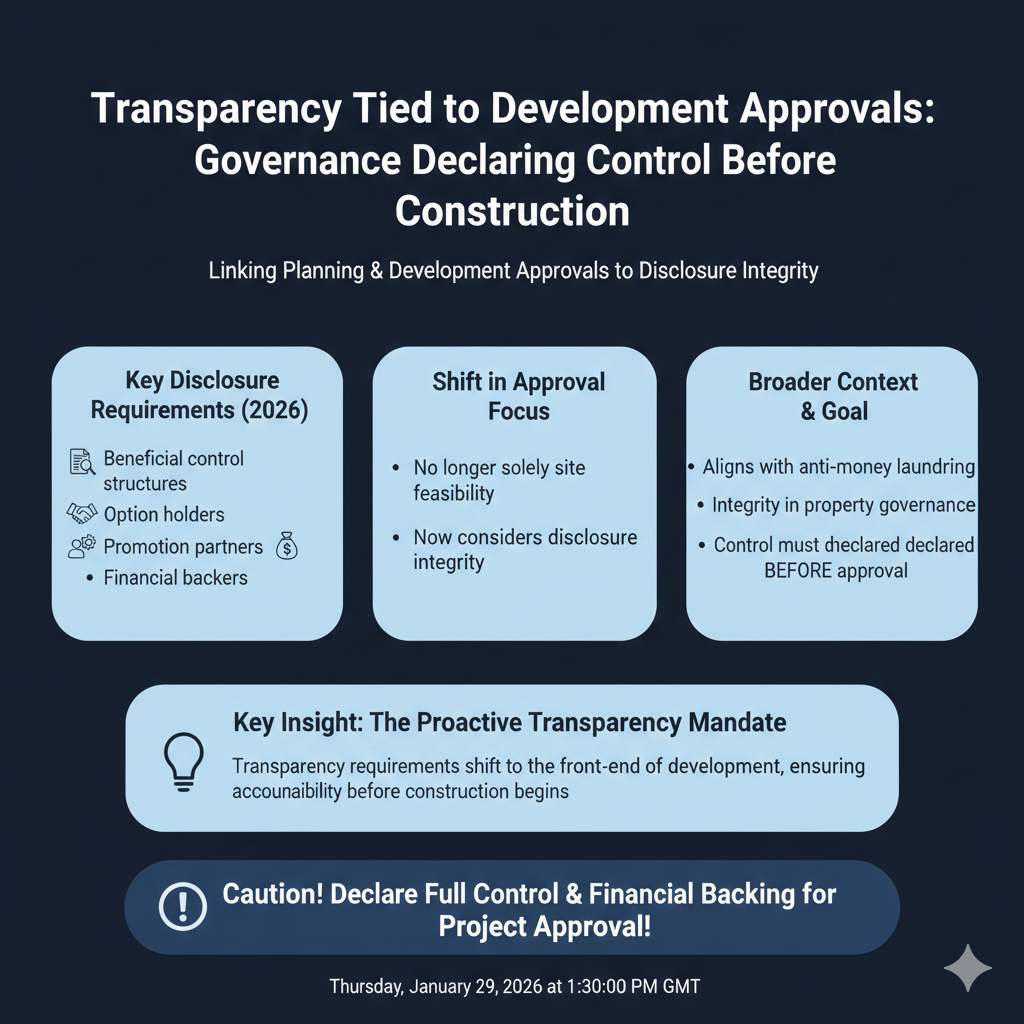
Another 2026 change links transparency obligations directly to planning and development approval processes.
Authorities increasingly require disclosure of:
• Beneficial control structures
• Option holders
• Promotion partners
• Financial backers
Planning approvals are no longer assessed solely on site feasibility.
They now consider disclosure integrity.
This aligns with broader transparency movements seen in property governance and anti-money laundering compliance frameworks.
Control must be declared before approval, not after construction begins.
Increased Land Banking Disclosures
Land banking has always been controversial.
Developers argue it stabilizes supply pipelines.
Critics argue it restricts housing delivery and inflates prices.
Beginning 2026, certain regions introduce enhanced land banking disclosure requirements, including:
• Public listing of undeveloped land holdings
• Reporting of planning status timelines
• Disclosure of optioned but unexercised sites
• Periodic updates on development progression
These measures aim to address supply bottlenecks.
When land holdings are visible, pressure to activate development increases.
Strategic delay becomes reputationally riskier.
Will Speculative Land Holding Reduce Post-2026?
This is the core market question.
The answer depends on incentives.
1. Reduced Information Advantage
Speculation thrives on asymmetry. Public control registers reduce private advantage.
2. Planning Accountability
If approval requires transparency, hidden pipeline accumulation becomes harder.
3. Market Signaling Effects
Visible land banking may influence investor sentiment and political scrutiny.
4. Financing Implications
Lenders may reassess exposure to long-term idle land banks under stricter disclosure regimes.
However, speculation will not disappear entirely.
Developers may adapt through:
• Joint venture structures
• Phased acquisition agreements
• Shorter option durations
• Earlier planning submissions
What changes is not the existence of strategic land positioning.
What changes is its visibility.
Broader Implications for Real Estate Markets
Transparency reshapes pricing.
When control data is public:
• Competing bids become more informed
• Local authorities assess supply concentration
• Investors evaluate pipeline depth more accurately
• Communities gain visibility into stalled sites
In markets facing housing shortages, increased transparency may accelerate development timelines.
In overheated markets, it may reduce artificial scarcity narratives.
The impact will vary by region.
But structurally, 2026 weakens hidden accumulation strategies.
Lessons for Emerging Markets Like India
India already requires title registration under frameworks governed by the Department of Land Resources and related state-level systems.
However, option-style agreements and development control structures can still operate through layered contracts.
Global transparency trends suggest that increased disclosure of control interests may eventually influence broader markets, particularly in urban growth corridors.
For investors, the direction is clear.
Control is becoming as important to disclose as ownership.
FAQ Section
What is a contractual control register?
It is a formal record of agreements that grant development or purchase rights over land, even if legal ownership has not transferred.
What is an option agreement?
An option agreement gives a party the right to purchase land at a future date under predefined conditions, often tied to planning approval.
Does compulsory registration eliminate speculation?
No. It reduces opacity but does not remove strategic land acquisition.
Why link transparency to planning approval?
To ensure authorities understand who ultimately controls development pipelines before granting permissions.
Will land prices fall after 2026?
Prices depend on supply, demand, and financing conditions. Transparency may moderate speculative spikes but will not override core market forces.
Conclusion

For years, land control could operate quietly behind formal ownership records. 2026 changes that balance.
Mandatory control registers, compulsory option registration, and land banking disclosures shift real estate from hidden leverage to visible positioning. Speculation may continue. But shadow accumulation strategies lose cover. And in real estate, visibility changes power.
Let’s Join Together to Bring Change to the World of Real Estate.
Thinking about your next home?
relai scores every project on data, not paid placements, and it's free for buyers.