Government Asset Monetization via REITs: Is 2026 the Turning Point for State-Led Capital Recycling?

For years, governments have owned vast portfolios of office buildings, land parcels, warehouses, and infrastructure assets that sit on balance sheets but generate limited financial efficiency.
In 2026, that is beginning to change.
Across the UK and other mature markets, legal and policy amendments are actively reshaping how public assets are held, structured, and monetized. The shift toward Real Estate Investment Trusts is not just about liquidity. It signals a broader capital recycling strategy that could redefine how public land and property are funded, managed, and accessed by investors.
Legal Amendments Enabling Public Asset REIT Conversion (Active 2026)
Recent policy direction from the HM Treasury and implementation oversight by the Valuation Office Agency reflect a structured approach to public asset transparency and valuation reform.
The UK’s REIT regime, originally introduced under the UK Government in 2007, is being operationally aligned to better accommodate public-sector portfolios. Amendments taking effect through 2026 allow:
• Easier transfer of stabilized public property into REIT structures
• Clarified tax neutrality for government-sponsored asset transfers
• Greater flexibility in portfolio composition
• Alignment with ESG disclosure standards for institutional capital
These updates reduce friction in converting income-generating public assets such as administrative buildings, healthcare facilities, and surplus land into listed yield vehicles.
This is less about privatization and more about capital efficiency.
Public Land Monetization Expands in 2026 Budget Cycles
Public land monetization is becoming a structured fiscal tool rather than an occasional funding decision.
The UK has long operated surplus asset disposal programs through the Cabinet Office’s Public Sector Land Programme. However, 2026 budget frameworks indicate a stronger emphasis on yield-generating retention rather than outright sale.
Instead of selling assets permanently, governments are increasingly:
• Transferring them into REIT structures
• Leasing them back under long-term occupancy agreements
• Recycling capital into infrastructure or deficit reduction
This allows the state to unlock liquidity without losing operational control.
From a portfolio perspective, this approach reduces the binary choice between ownership and divestment. It introduces a third route: financial optimization while retaining strategic use.
Increased Public-Private REIT Listings Projected FY 2026–27
Market analysts anticipate a rise in hybrid REIT structures where public bodies partner with private asset managers.
The appeal is clear:
• Governments contribute stabilized property portfolios
• Private managers bring capital markets expertise
• Institutional and retail investors gain access to predictable income streams
These listings are expected to accelerate through FY 2026–27, especially in sectors such as:
• Office assets with government tenancy
• Social infrastructure
• Urban regeneration land banks
• Transportation-adjacent commercial zones
The result could be a new category of quasi-sovereign yield assets, blending public credit stability with real estate returns.
For pension funds and long-term investors, this structure offers lower volatility compared to traditional commercial REIT exposure.
Retail Investor Access to Government-Backed Yield Assets (From 2026)
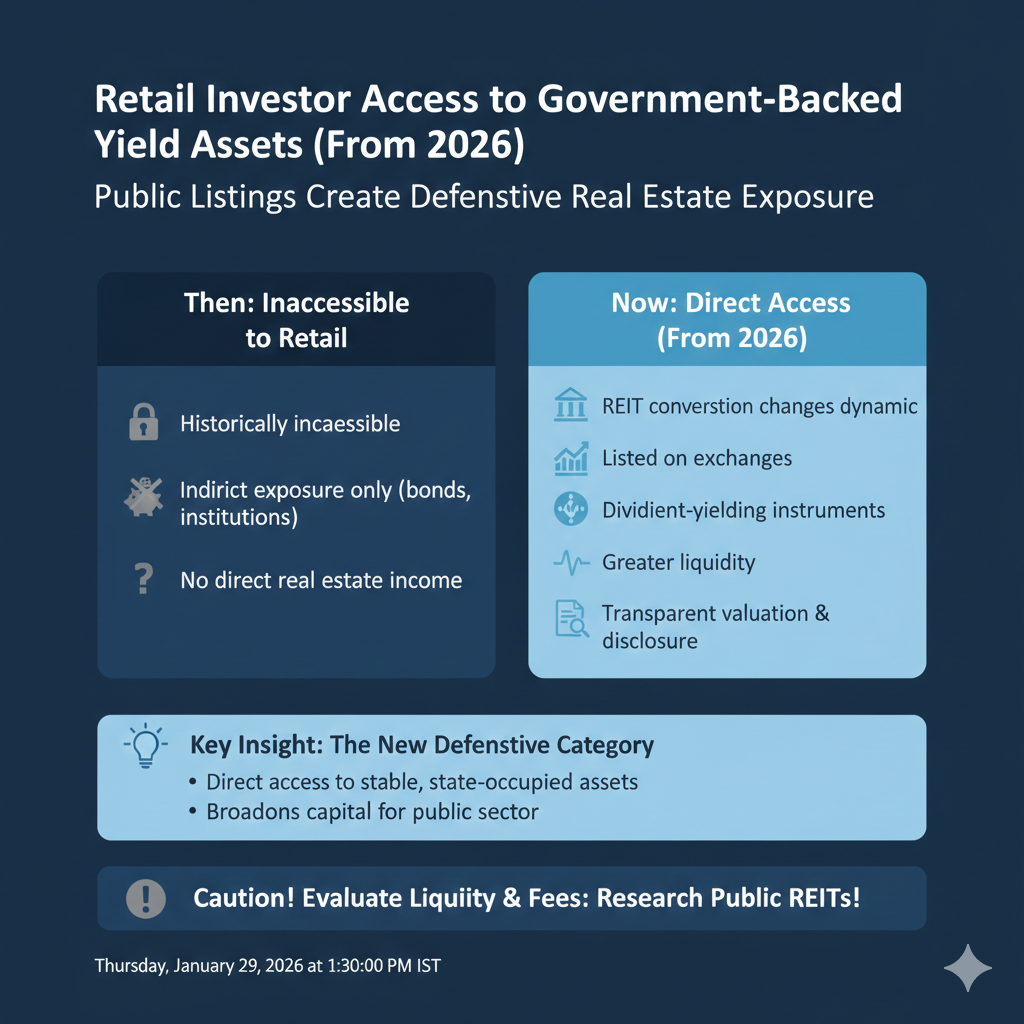
One of the most significant shifts in 2026 is accessibility.
Historically, government-backed real estate income was effectively inaccessible to retail investors. Participation required indirect exposure through sovereign bonds or institutional mandates.
REIT conversion changes that dynamic.
By listing publicly backed portfolios on exchanges, governments create:
• Dividend-yielding instruments tied to state-occupied assets
• Greater liquidity than direct property investment
• Transparent valuation reporting
• Regulated disclosure standards
For retail investors, this represents a new category of defensive real estate exposure.
It also broadens capital sources for the public sector beyond traditional debt issuance.
Strategic Capital Recycling: Is 2026 the Inflection Point?
The core concept behind government REIT monetization is capital recycling.
Instead of holding static real estate, governments can:
Transfer mature assets into income vehicles
Unlock capital via public markets
Reinvest proceeds into growth infrastructure
Improve balance sheet efficiency
This mirrors strategies used by large sovereign wealth funds and infrastructure operators.
The difference is scale.
Public-sector land and property portfolios in the UK alone are valued in the hundreds of billions of pounds. Even partial conversion into REIT structures could materially alter capital markets participation.
If executed consistently, 2026 could mark the start of large-scale state-led portfolio optimization.
Portfolio Implications for Investors
For commercial real estate investors, this shift has several implications:
1. Yield Compression Risk
Government-backed assets often command premium pricing due to perceived stability. As more of these enter public markets, demand could drive yield compression.
2. Defensive Asset Class Expansion
Public-tenant REITs may emerge as a distinct defensive segment within listed property markets.
3. Competitive Pressure on Private Assets
Private landlords competing with state-backed REIT portfolios may face higher transparency and governance expectations.
4. Capital Allocation Rebalancing
Institutional portfolios may increase allocation to hybrid public-private structures, especially during economic uncertainty.
Risks and Structural Considerations
While the model appears attractive, risks remain:
• Political sensitivity around public asset monetization
• Valuation disputes during transfer
• Market timing risks in listing cycles
• Governance complexity in hybrid ownership
Transparency and independent valuation oversight will be critical in maintaining investor confidence.
The long-term sustainability of this strategy depends less on legislation and more on disciplined execution.
FAQ Section
What is government asset monetization via REITs?
It is the process of transferring income-generating public real estate into a Real Estate Investment Trust structure, allowing capital to be raised from public markets while retaining strategic control through leasebacks or minority stakes.
Why is 2026 significant?
Legal and fiscal amendments active in 2026 streamline the transfer of public property into REIT vehicles and align tax treatment to reduce structural friction.
Does this mean privatization?
Not necessarily. In many cases, the government remains a tenant or stakeholder. The model focuses on financial efficiency rather than asset abandonment.
How does this affect retail investors?
Retail investors gain access to government-backed income streams through publicly listed REIT shares, improving diversification opportunities.
Could this strategy expand beyond the UK?
Yes. Several developed economies are evaluating similar models, especially where public land banks are extensive and infrastructure funding gaps are widening.
Conclusion

Government asset monetization via REIT structures is not a short-term budget maneuver. It reflects a structural shift in how states view real estate on their balance sheets.
2026 marks a transition from passive ownership to active capital strategy.
If implemented at scale, state-led REIT conversion could:
• Expand defensive yield assets
• Reshape commercial real estate portfolios
• Increase public market participation in sovereign-backed property
• Redefine how governments finance infrastructure
The coming fiscal cycles will determine whether this becomes a tactical adjustment or a long-term transformation in public asset management.
Thinking about your next home?
relai scores every project on data, not paid placements, and it's free for buyers.