The Myth of “Buying Close to Work” in Hybrid Work Cities

For decades, one rule dominated Indian homebuying decisions: buy as close to work as possible. Shorter commutes meant better quality of life, lower stress, and higher resale value. Entire micro-markets grew around office clusters because proximity was everything.
But hybrid work has quietly broken this rule.
In cities like Hyderabad, Bengaluru, and Pune, work is no longer a place you go to every day. It is something you do, sometimes from home, sometimes from office, and sometimes from anywhere. Yet many buyers still anchor their decisions to outdated commute logic.
This mismatch between old assumptions and new work realities is creating avoidable regret for homebuyers.
Why Office Proximity Matters Less Than Before
Hybrid work does not eliminate offices, but it reduces frequency.
Most professionals today:
Go to office 2–3 days a week
Have flexible reporting hours
Switch teams or locations more often
Work with distributed or global teams
When office visits drop from five days to two, the value of living next door to work drops sharply.
A 15-minute commute advantage matters less when it is needed only a few days a week. Meanwhile, the cost of that proximity—higher prices, smaller homes, congestion, noise—remains permanent.
Buyers are slowly realizing that they are paying a daily premium for an occasional requirement.
How Hybrid Work Is Reshaping Residential Demand
Hybrid work is not just changing where people work. It is changing how they live.
Larger Homes Over Shorter Commutes
With more time spent at home, buyers now value:
An extra room for work
Better ventilation and light
Balconies and open spaces
Quieter surroundings
Many office-adjacent locations offer the opposite: compact homes, higher density, and limited privacy.
Micro-Markets Beyond Core Office Zones
Residential demand is moving outward to:
Peripheral areas with better layouts
Communities with lower congestion
Locations that trade daily commute convenience for long-term comfort
These areas may be 30–45 minutes from office zones, but for hybrid workers, that trade-off makes sense.
Stability Over Speed
People now prioritize:
Neighborhood livability
School access
Healthcare and daily infrastructure
Community quality
Office distance is becoming one factor, not the deciding factor.
Lifestyle Trade-Offs Buyers Underestimate
Buying close to work often comes with hidden compromises that only surface after moving in.
Congestion Doesn’t Switch Off
Office hubs remain busy even when you are not commuting. Traffic, noise, and crowd density are constant, not limited to office hours.
Higher Cost, Lower Flexibility
Homes near offices are priced higher, but:
Appreciation depends heavily on office demand staying concentrated
Job changes can instantly reduce location relevance
New office clusters can shift demand elsewhere
Work-Life Blur
Living too close to work can:
Extend work hours unintentionally
Reduce psychological separation between work and personal life
Increase burnout rather than reduce it
Hybrid work makes mental space as important as physical distance.
The Risk of Anchoring to Today’s Office Location
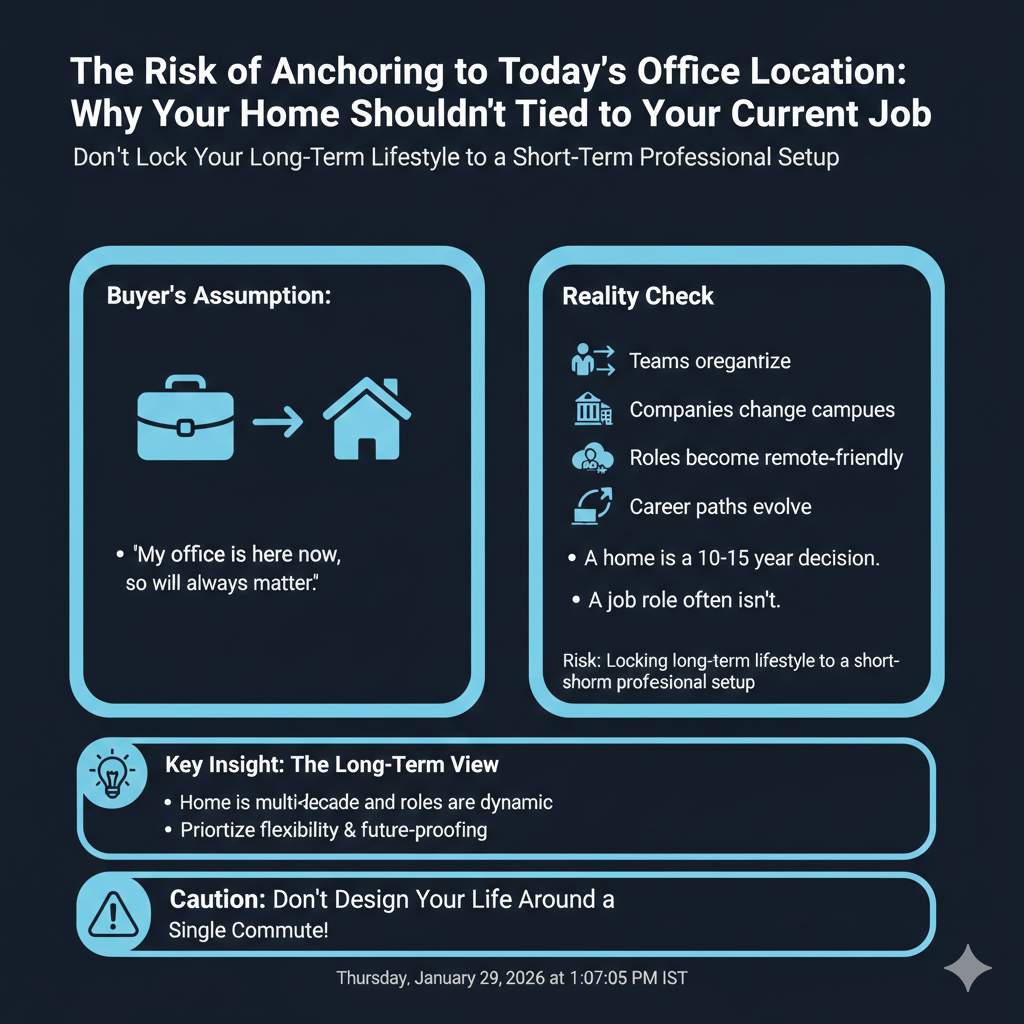
One of the biggest mistakes buyers make is assuming:
“My office is here now, so it will always matter.”
Reality check:
Teams reorganize
Companies change campuses
Roles become remote-friendly
Career paths evolve
A home is a 10–15 year decision. A job role often isn’t.
When buyers anchor to a single office location, they risk locking their long-term lifestyle to a short-term professional setup.
How to Future-Proof Location Decisions
Smart buyers are shifting from commute-first thinking to resilience-first thinking.
1. Prioritise Connectivity, Not Proximity
Instead of being close, be well-connected.
Access to ORRs, metro lines, and arterial roads
Multiple route options, not a single choke point
Connectivity to more than one employment corridor
This keeps your home relevant even if work locations change.
2. Evaluate Livability for Daily Life
Ask practical questions:
Can I live here comfortably even if I change jobs?
Does this area work for weekends, not just weekdays?
Is the environment suited for long-term living?
Homes should support life, not just workdays.
3. Look at Mixed Demand Zones
Areas that attract:
End-users
Families
Renters
Retirees
These locations are more resilient than zones dependent on a single office cluster.
4. Think in Weekly, Not Daily Commutes
If you commute twice a week, does a 45-minute travel time matter?
Often, better home quality offsets occasional longer travel.
What This Means for Hyderabad and Bengaluru
Both cities are prime examples of hybrid-driven change.
Office hubs remain important, but residential demand is spreading
Peripheral micro-markets with better planning are gaining traction
Buyers are choosing space, quality, and lifestyle over pin-code prestige
This does not mean office-adjacent areas will fail. It means their advantage is no longer absolute.
FAQ Section
Is buying close to work still a bad idea?
No. It can work if the lifestyle trade-offs align with your needs. It is a mistake only when done blindly.
Does hybrid work mean commute no longer matters at all?
Commute still matters, but frequency matters more. Occasional inconvenience is easier to manage than daily compromise.
Will office locations lose value over time?
Not necessarily, but their pricing premium may flatten if demand becomes more distributed.
What matters more than office distance today?
Connectivity, livability, flexibility, and long-term relevance.
Conclusion

The idea that buying close to work is always the smartest move belongs to a different era.
Hybrid work has changed how often we commute, how we use our homes, and what we value in daily life. Buyers who continue to prioritize office proximity without questioning lifestyle trade-offs risk paying more for less.
Future-proof homebuying is about resilience, not routines. The smartest locations today are not the closest to work, but the ones that support changing careers, evolving work patterns, and better living over time.
A good home should adapt as your life does.
Let’s Join Together to Bring Change to the World of Real Estate.
Thinking about your next home?
relai scores every project on data, not paid placements, and it's free for buyers.