Relinquishment Deed 2025: Meaning, Format, and Registration Process
Relinquishment Deed 2025: Meaning, Format, and Registration Process

When a property is inherited by multiple legal heirs, not everyone may want to retain their share. In such cases, a Relinquishment Deed becomes an essential legal tool. It ensures a smooth transfer of ownership from one heir to another—without disputes or ambiguity.
In India, this document plays a major role in safeguarding rights during property inheritance or family settlements. Here’s everything you need to know about its purpose, format, and registration process in 2025.
What is a Relinquishment Deed?
A Relinquishment Deed is a legal document used when a co-owner or legal heir voluntarily gives up their rights in an inherited property in favor of another legal heir.
It’s commonly executed among family members after the death of the original owner.
For example, if three siblings inherit a property, and one wishes to transfer their share to another, a relinquishment deed formalizes that decision.
Unlike a gift deed, it does not involve monetary exchange and applies specifically to inherited property.
Key Features of a Relinquishment Deed
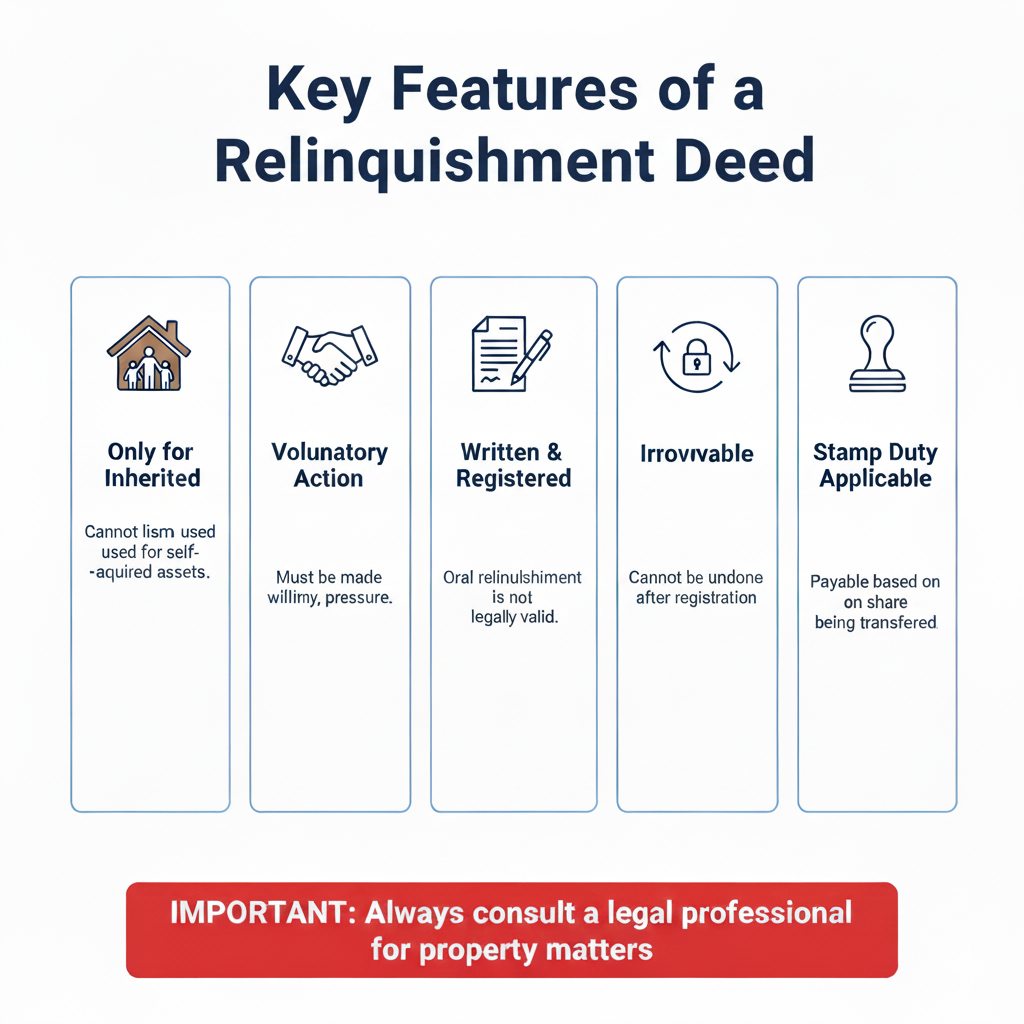
Applicable only to inherited property – It cannot be used for self-acquired assets.
Voluntary action – The relinquishment must be made willingly, without pressure or coercion.
Written and registered – Oral relinquishment is not legally valid.
Irrevocable once registered – The deed cannot be undone after registration.
Stamp duty applicable – Payable based on the share of property being transferred (varies by state).
Why is a Relinquishment Deed Important?
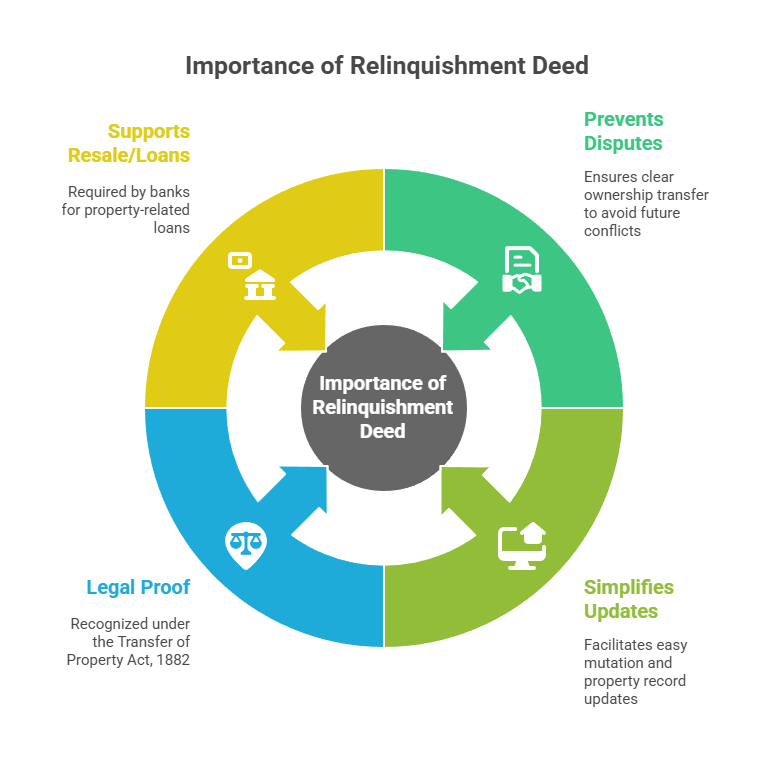
Prevents future disputes: It provides clear documentation of ownership transfer among heirs.
Simplifies mutation and property record updates: Helps the new owner get the property mutated in their name.
Acts as legal proof: It’s recognized under the Transfer of Property Act, 1882, and accepted by courts and government authorities.
Supports smooth resale or loan processing: Banks often require this document before approving property-related loans.
Format of a Relinquishment Deed (2025)
A standard deed includes:
Title: “Relinquishment Deed”
Details of parties: Names, addresses, and relationship of releasor and releasee.
Property description: Address, size, and relevant survey details.
Statement of relinquishment: Declaration of voluntary transfer.
Witness signatures: Minimum two witnesses with their details.
Date and place of execution.
Example excerpt:
“I, [Name], residing at [Address], hereby relinquish all my rights, title, and interest in the property located at [Property Address] in favor of my brother [Name], who shall henceforth be the sole owner.”
Step-by-Step Process to Register a Relinquishment Deed
Draft the deed – Prepare the document with accurate details using a lawyer’s help.
Get stamp paper – Purchase non-judicial stamp paper as per the property’s value.
Pay stamp duty – Applicable as per state law (for example, Telangana charges about 1–2% of the market value of the share being relinquished).
Visit sub-registrar’s office – Both parties must appear with ID proofs, photographs, and original property papers.
Sign in presence of witnesses – Two witnesses are mandatory for legal validation.
Receive the registered copy – The registered deed confirms the new ownership status.
Documents Required
Original property documents
Death certificate of the original owner
ID and address proofs of all parties
PAN cards
Passport-size photos
Proof of relationship (legal heir certificate or family tree)
Difference Between Relinquishment Deed and Gift Deed
Basis | Relinquishment Deed | Gift Deed |
Applicability | Only inherited property | Any property (self-acquired or inherited) |
Consideration | No monetary exchange | May or may not involve love/affection |
Parties | Legal heirs | Can be any two individuals |
Revocation | Irrevocable once registered | Can be revoked under specific conditions |
FAQ Section
1. Can a relinquishment deed be revoked?
No, once it’s registered, it cannot be revoked unless there is proof of fraud or coercion.
2. Is it mandatory to register a relinquishment deed?
Yes. Under the Registration Act, 1908, registration is compulsory for the deed to be valid in the eyes of law.
3. What happens if the deed is not registered?
An unregistered deed has no legal standing and cannot be used in disputes or property transfer processes.
4. Can relinquishment be made to an outsider?
No. It can only be made in favor of a legal heir or co-owner, not an unrelated person.
5. What if all heirs relinquish their rights to one person?
That person becomes the sole owner and can proceed with property mutation in their name.
Conclusion

A Relinquishment Deed brings clarity, legal protection, and harmony in property inheritance matters. By formalizing ownership rights among family members, it prevents future disputes and ensures that property records remain accurate and up to date.
If you’re planning to transfer your inherited property share, consult a legal expert and get your deed registered properly.
Let’s Join Together to Bring Change to the World of Real Estate.
Visit Relai Real Estate to understand property ownership and documentation the smart way.
Thinking about your next home?
relai scores every project on data, not paid placements, and it's free for buyers.