Real Estate Is Becoming a Data Problem, Not a Trust Problem

Introduction
For decades, Indian real estate decisions were driven by trust. A known broker, a family recommendation, a builder with a familiar name—these were often enough to move crores of rupees. But the market has quietly changed. Projects are larger, ticket sizes are higher, and the consequences of a wrong decision now last decades. In this environment, trust alone is no longer a safety net.
Today, real estate has become a data problem before it is a trust problem. Buyers don’t lose money because someone cheated them. They lose money because decisions were made without structured information. From micro-market supply to construction velocity, from absorption trends to financial stress indicators, outcomes are increasingly determined by what buyers measure, not who they trust.
Why Relationships No Longer Guarantee Good Outcomes
Relationships still matter, but they no longer protect buyers from risk. A trusted broker may genuinely believe in a project, but belief does not override execution delays, funding gaps, or demand mismatches. Many projects with clean reputations have struggled due to macro slowdowns, capital constraints, or unrealistic pricing assumptions.
In cities like Hyderabad and Bengaluru, buyers now face hundreds of competing launches every year. Even experienced market participants cannot track all variables intuitively. This is why relying purely on relationships often leads to blind spots. Trust explains intent, but it does not explain probability.
Data, on the other hand, exposes patterns. It shows whether similar projects in the same micro-market have delivered on time, whether inventory is building up, and whether end-user demand is actually absorbing supply. These signals matter more than personal assurances.
How Data Replaces Gut Feel and Hearsay
Gut feel works in simple markets. Real estate is no longer simple. Pricing today reflects future expectations, not just present conditions. Data allows buyers to test those expectations.
For example, absorption data published by firms like ANAROCK and Knight Frank consistently shows that projects launched in oversupplied corridors take significantly longer to stabilize, even if pricing looks attractive initially. Buyers who study this data can avoid areas where appreciation is structurally capped, regardless of short-term discounts.
Construction progress data, satellite imagery, RERA updates, and sales velocity trends also tell a clearer story than site visits alone. A project that looks active on weekends may still be lagging on monthly execution benchmarks. Data turns impressions into evidence.
What Buyers Can Measure but Often Don’t
Most buyers check approvals and price. Few go deeper. Yet the most critical risks sit beyond paperwork.
Buyers can measure construction pace by comparing planned milestones with actual progress. They can assess developer stress by tracking launch frequency, pricing corrections, and unsold inventory across the builder’s portfolio. They can evaluate livability risk by studying density, maintenance cost trends, and infrastructure load in comparable communities.
Even rental demand and resale liquidity are measurable. Portals like Magicbricks and 99acres publish locality-level demand indicators that reveal where transactions actually close, not just where listings exist. Ignoring these metrics means buying blind.
Advisory Models vs Traditional Brokerage
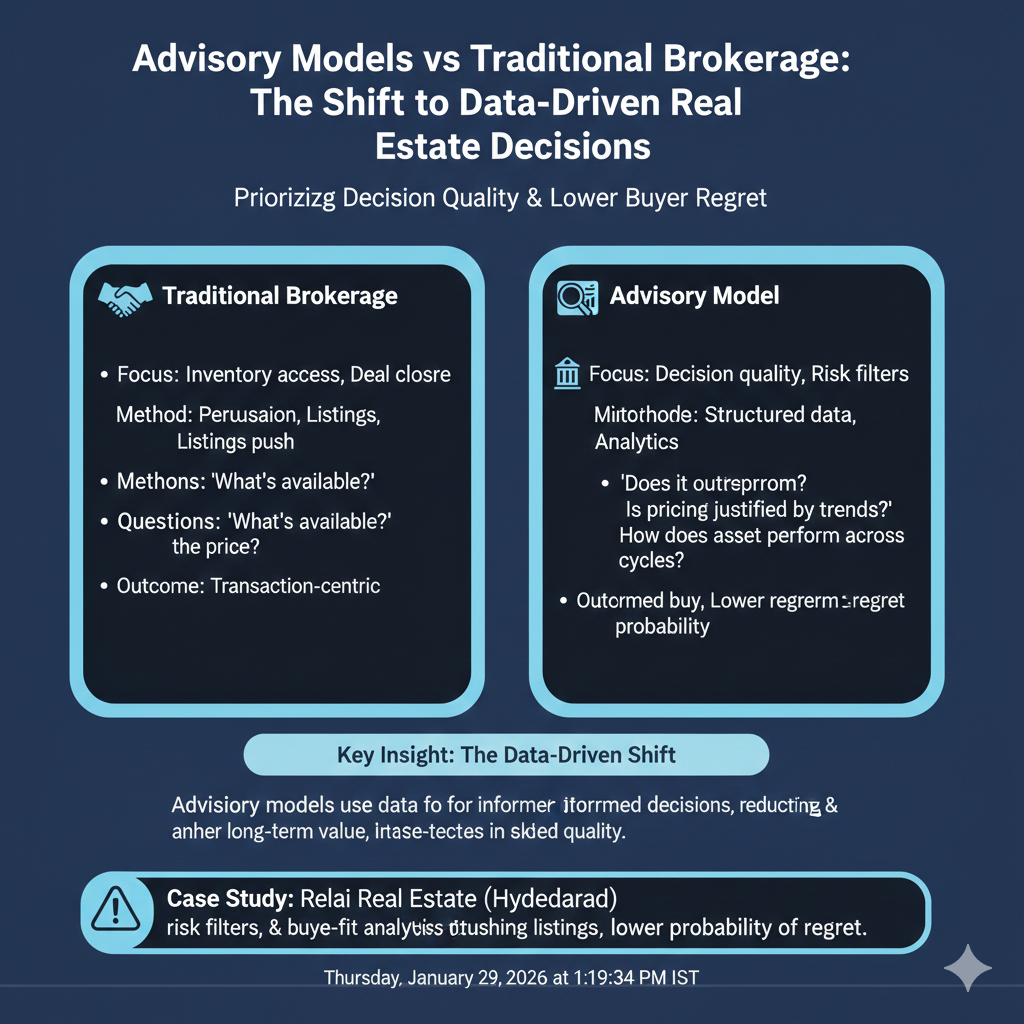
This shift toward data has given rise to advisory-first real estate models. Unlike traditional brokerage, which focuses on inventory access and deal closure, advisory models focus on decision quality.
An advisory lens asks different questions. Does this project outperform its micro-market peers? Is the pricing justified by absorption trends? How does this asset behave across different economic cycles? These questions require structured data, not persuasion.
In Hyderabad, platforms like Relai Real Estate have built their approach around this philosophy—using data-backed shortlisting, risk filters, and buyer-fit analysis instead of pushing listings. The outcome is not just a transaction, but a lower probability of regret.
Why This Shift Matters More Going Forward
As ticket sizes rise and leverage increases, decision errors compound. A two-year delay today can wipe out the equivalent of several years of appreciation. A wrong micro-market choice can trap capital for a decade.
Global capital already operates this way. Institutional investors rely heavily on data models before entering Indian cities, as highlighted in reports by JLL and CBRE. Retail buyers who adopt similar thinking don’t need complex tools—they need better questions.
Real estate is no longer about finding someone you trust. It is about building a process you trust.
FAQ Section
Is trust completely irrelevant in real estate today?
No. Trust still matters, especially when evaluating intent. But trust without data does not protect against market risk, execution delays, or demand misalignment.
What is the biggest data point buyers should track first?
Micro-market absorption and supply pipeline. These indicate whether demand can realistically support current and future pricing.
Are advisory models more expensive than brokers?
Not necessarily. In many cases, advisory models reduce long-term costs by preventing poor decisions, delays, and liquidity issues.
Can individual buyers really access this data?
Yes. Much of it is publicly available through RERA portals, research reports, and property platforms. The challenge is interpretation, not access.
Conclusion

Real estate outcomes are increasingly shaped by structure, not sentiment. Trust explains who you deal with. Data explains what will happen after you buy. Buyers who combine both make fewer mistakes and sleep better.
At Relai – For right home, the focus is simple: help buyers make decisions that stand up to data, not just sales conversations. Let’s Join Together to Bring Change to the World of Real Estate.
Thinking about your next home?
relai scores every project on data, not paid placements, and it's free for buyers.