Property Mutation in India 2025: A Step to Secure Your Ownership Rights
Property Mutation in India 2025: A Step to Secure Your Ownership Rights

Introduction
Buying a property doesn’t end with registration. Many homeowners stop at getting their sale deed registered and believe ownership is complete — but that’s only part of the process. The next and equally crucial step is property mutation.
Mutation is what makes you the official owner in the eyes of local authorities. Without it, your name won’t appear in land or municipal records — which can cause issues during resale, property tax payments, inheritance, or legal disputes.
In simple terms, registration transfers ownership legally, but mutation records it officially in government books. Let’s understand why it matters, how to get it done, and what changes have come in 2025.
What Is Property Mutation?
Property mutation is the process of updating the ownership details in the local land or municipal records after a property transaction — such as a sale, inheritance, gift, or transfer.
It ensures that the property tax records reflect the new owner’s name, confirming ownership for administrative and civic purposes.
For example, if you bought a flat in Hyderabad and registered it in your name, the next step is to apply for mutation with the Greater Hyderabad Municipal Corporation (GHMC). Once approved, all property tax bills and government records will bear your name.
Why Is Property Mutation Important?
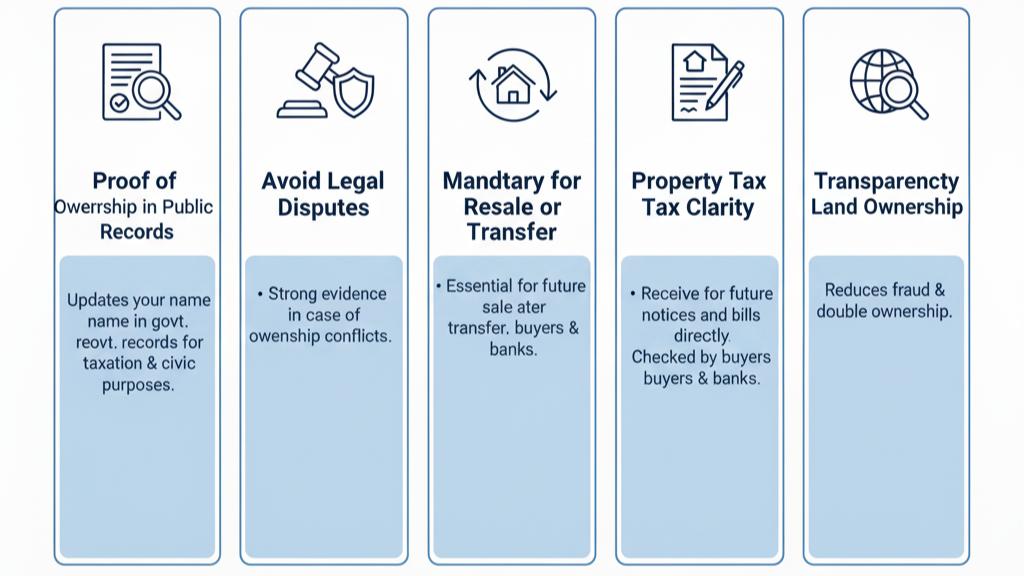
Proof of Ownership in Public Records
Mutation officially updates your name in government property records, proving ownership for taxation and civic purposes.Avoid Legal Disputes
In case of ownership conflicts, a mutated property serves as strong evidence in your favor.Mandatory for Resale or Transfer
Mutation is essential if you plan to sell or transfer property in the future. Buyers and banks often check mutation records before approving transactions or loans.Property Tax Clarity
You’ll receive property tax notices, bills, and correspondence directly in your name.Transparency in Land Ownership
Mutation ensures land and municipal records stay updated, reducing chances of fraud or double ownership.
Types of Mutation

There are generally three main types of property mutation in India:
Mutation After Sale
When property changes hands through sale or purchase.Mutation After Inheritance
When ownership changes due to the death of the previous owner, transferring to legal heirs.Mutation After Gift or Will
When property is transferred voluntarily, typically between family members.
Documents Required for Property Mutation
To apply for mutation, the following documents are commonly required (varies slightly by state):
Copy of Sale Deed / Title Deed
Latest Property Tax Receipt
Mutation Application Form (from local municipal or revenue office)
Copy of Death Certificate (for inheritance cases)
Copy of Will or Legal Heir Certificate (if applicable)
Encumbrance Certificate
Identity Proof and Address Proof of the applicant
Process of Property Mutation (2025 Update)
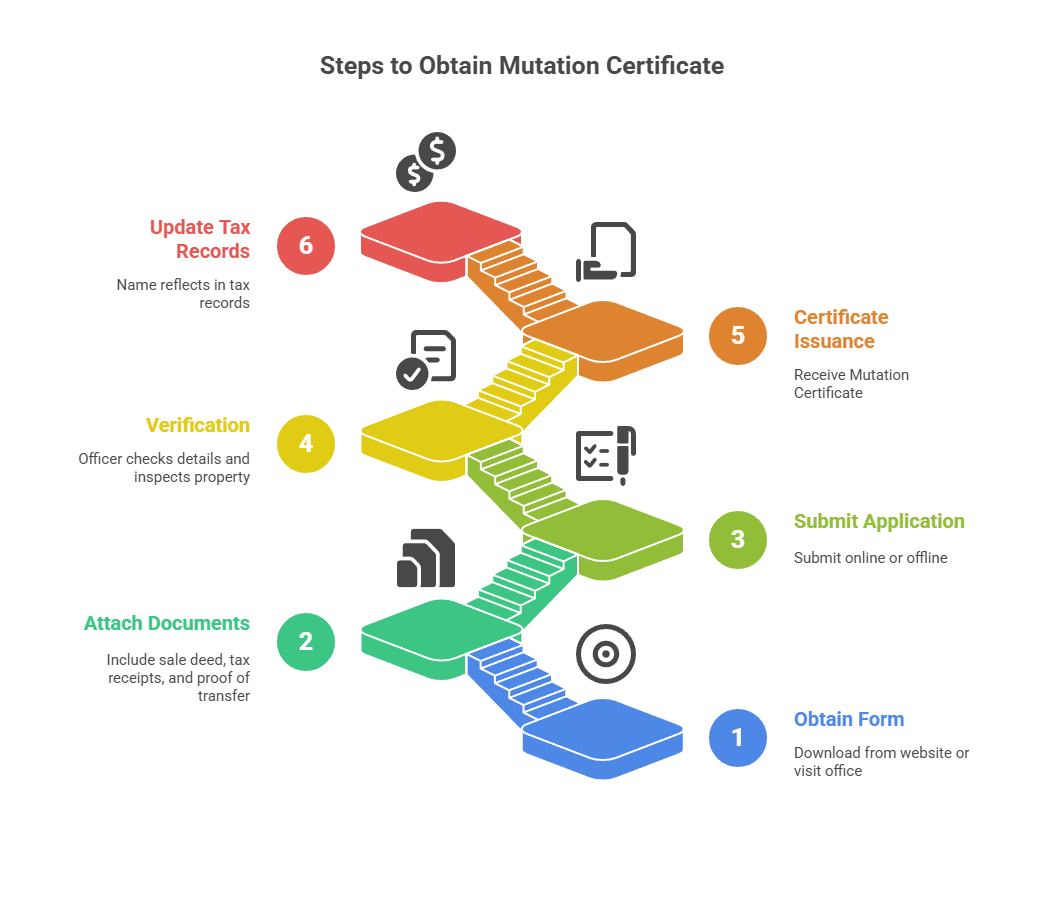
Most Indian states, including Telangana, Maharashtra, and Karnataka, have now digitized their mutation processes through municipal e-portals.
Here’s a step-by-step guide:
Obtain the Mutation Application Form
Download from the local municipal website or visit the nearest revenue office.Attach Required Documents
Include your sale deed, tax receipts, and proof of ownership transfer.Submit to Municipal or Revenue Office
Submit online via the property registration portal (like Dharani in Telangana) or offline at the local office.Verification by Revenue Officer
The officer verifies ownership details, checks for pending dues, and inspects the property if needed.Mutation Entry and Certificate Issuance
Once verified, your name is entered into municipal records and a Mutation Certificate (Pattadar Passbook or e-Mutation certificate) is issued.Update in Property Tax Records
Your name now reflects in the tax records for future billing and communication.
Mutation Fees and Processing Time
Mutation Fees: ₹100–₹500 (varies by state and property type)
Processing Time: Usually 15 to 30 working days, depending on verification and backlog.
Online systems like Telangana’s Dharani Portal or Maharashtra’s MahaBhulekh have significantly reduced waiting times in 2025.
What Happens If You Don’t Get Mutation Done?
Failure to mutate your property can lead to:
Property tax bills continuing in the seller’s name.
Complications during resale or bank loan applications.
Difficulty in establishing ownership during legal disputes.
Delays in inheritance or succession transfers.
Essentially, without mutation, your property ownership remains incomplete in administrative records.
Mutation vs Registration: Key Difference
Aspect | Registration | Mutation |
Purpose | Legal transfer of ownership | Administrative update in government records |
Authority | Sub-Registrar’s Office | Revenue/Municipal Office |
Document Issued | Registered Sale Deed | Mutation Certificate / Record Entry |
Importance | Legally establishes ownership | Updates ownership in tax and land records |
Both steps are essential — registration gives you ownership rights, while mutation ensures official recognition.
Digital Mutation Systems in India (2025 Snapshot)
State | Portal Name | Key Features |
Telangana | Dharani Portal | Online mutation for agricultural and non-agricultural lands |
Maharashtra | MahaBhulekh | Mutation status check, online application, 7/12 extract updates |
Karnataka | Bhoomi | e-Mutation, property map, RTC integration |
Delhi | MCD Portal | Online property mutation for tax and ownership records |
These digital platforms have improved transparency, minimized middlemen, and made mutation certificates easily accessible.
FAQ Section
1. Is property mutation mandatory after registration?
Yes. Mutation is essential to update ownership in government records and avoid future legal or administrative issues.
2. How long does property mutation take in Telangana?
Generally, 15–20 working days, provided all documents are correct and no objections are raised.
3. Can mutation be done online in 2025?
Yes. Most states, including Telangana, Maharashtra, and Karnataka, now offer online mutation services through dedicated portals.
4. Is a mutation certificate proof of ownership?
It is not a legal title document, but it serves as official proof of ownership for municipal and tax purposes.
5. Do NRIs need to apply for mutation after purchase?
Yes. Even NRIs must ensure mutation is completed in their name to reflect ownership and enable tax compliance in India.
6. What if there’s a dispute during mutation?
If objections arise, the revenue authority may issue a notice to both parties and hold hearings before deciding ownership updates.
Conclusion

Property mutation may sound like a small bureaucratic step, but it’s one of the most crucial in ensuring your ownership is officially recognized. In 2025, with digitization and faster verification systems, the process has become simpler, more transparent, and accessible.
Whether you’re a homeowner in Hyderabad or an NRI managing property remotely, don’t skip this step — it’s your link between legal ownership and official recognition.
Let’s Join Together to Bring Change to the World of Real Estate.
Thinking about your next home?
relai scores every project on data, not paid placements, and it's free for buyers.