Predictive Maintenance Powered by AI and Sensors: How Buildings Fix Problems Before They Break
In most buildings, maintenance still follows a reactive pattern. Something breaks, residents complain, technicians respond, and costs escalate. In slightly better cases, preventive maintenance schedules are followed, where equipment is serviced at fixed intervals regardless of its actual condition.
Both approaches have a flaw. They act after risk has already formed.
Predictive maintenance changes this by using AI and sensors to detect early warning signs of failure and act before disruption happens. For commercial and multifamily real estate, this shift is proving to be one of the most practical and cost-saving applications of artificial intelligence today.
What Predictive Maintenance Really Means
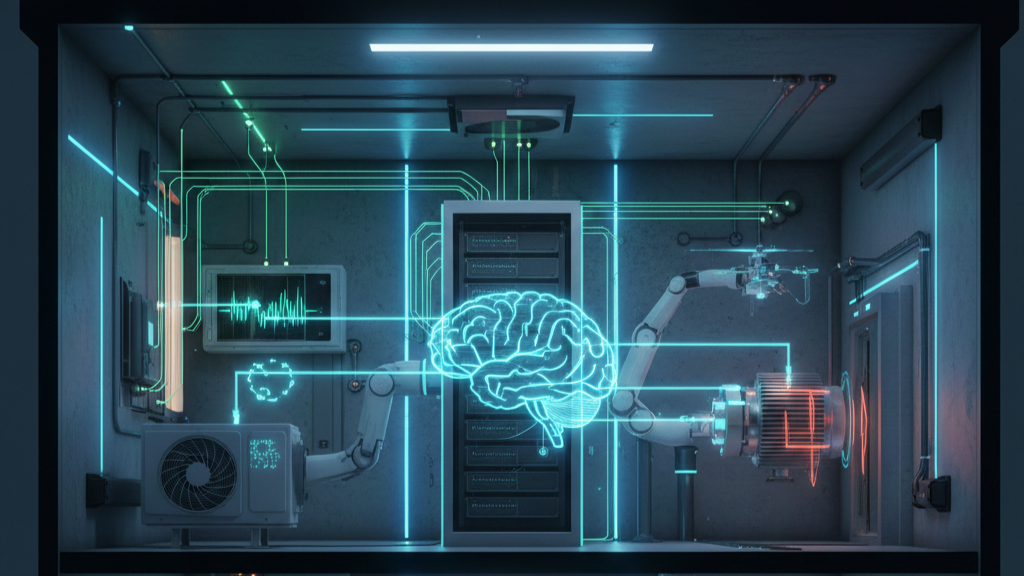
Predictive maintenance uses IoT sensors and machine learning models to continuously monitor equipment health and predict failures before they occur.
Instead of asking:
“When should this be serviced?”
The system asks:
“What is this asset telling us right now?”
Sensors track variables such as vibration, temperature, pressure, energy draw, noise patterns, and usage cycles. AI models learn what “normal” looks like and flag deviations that signal early-stage faults.
This approach moves maintenance from guesswork to data-driven decision making.
Why Traditional Maintenance Fails at Scale
In large buildings, fixed schedules often lead to two problems.
First, assets are serviced too early. Parts are replaced even though they still have usable life, inflating costs.
Second, assets fail between service cycles. Elevators stop working, HVAC systems break down during peak usage, and plumbing issues surface without warning.
According to a study by McKinsey, predictive maintenance can reduce maintenance costs by 10–40% and unplanned downtime by up to 50% compared to traditional approaches (McKinsey & Company).
In real estate operations, where downtime directly affects tenants, this difference is critical.
How AI and Sensors Work Together
Sensors alone only collect data. AI gives that data meaning.
IoT sensors continuously stream operational signals from assets like:
HVAC units
Elevators and escalators
Pumps and plumbing systems
Power backup and electrical panels
Machine learning models analyze patterns over time. They detect anomalies such as rising vibration in a motor, abnormal energy consumption, or temperature fluctuations that indicate wear.
AI then moves beyond prediction into prescriptive maintenance, recommending what action to take, when to take it, and how urgent it is.
This shift reduces human dependency and improves response accuracy.
HVAC Systems: The Biggest Beneficiary
HVAC systems are among the most expensive and failure-prone assets in large buildings.
Predictive maintenance helps by:
Identifying compressor stress early
Detecting refrigerant leaks through efficiency drops
Optimizing filter replacement based on actual usage
Preventing peak-season breakdowns
The U.S. Department of Energy reports that predictive maintenance can improve HVAC efficiency by up to 20%, directly reducing energy costs and carbon footprint (energy.gov).
For residential communities and office buildings, this translates to lower operating costs and more stable comfort levels.
Elevators and Vertical Transport Reliability
Elevator failures create immediate dissatisfaction and safety concerns.
Sensors monitor door cycles, motor load, braking patterns, and vibration levels. AI models flag early warning signs such as misalignment, excessive wear, or control system anomalies.
Companies like KONE and Otis already deploy predictive maintenance systems that have reduced elevator downtime by 30–40% in large portfolios (KONE).
In high-rise residential and commercial buildings, this reliability directly impacts asset perception and tenant trust.
Plumbing and Water Systems: Preventing Invisible Damage
Plumbing failures are costly not because of the repair, but because of secondary damage.
Predictive systems use pressure sensors, flow meters, and moisture detection to:
Identify slow leaks before walls are damaged
Detect pipe stress and corrosion patterns
Prevent pump failures and water loss
According to IBM, AI-driven asset monitoring can reduce water system failures by up to 25%, especially in large facilities (IBM).
For multifamily buildings, early intervention avoids disputes, insurance claims, and prolonged tenant disruption.
Cost Reduction and Operational Efficiency
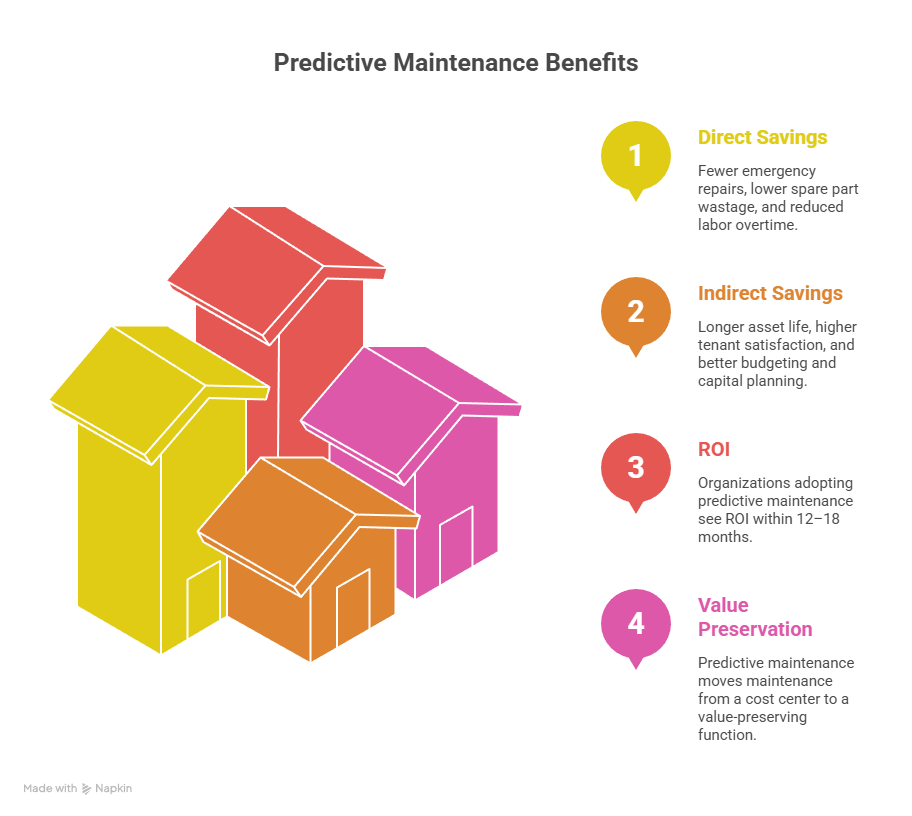
Predictive maintenance delivers value across multiple layers.
Direct savings come from:
Fewer emergency repairs
Lower spare part wastage
Reduced labor overtime
Indirect savings come from:
Longer asset life
Higher tenant satisfaction
Better budgeting and capital planning
Deloitte notes that organizations adopting predictive maintenance see ROI within 12–18 months, driven by reduced downtime and maintenance spend (Deloitte).
For real estate operators, this moves maintenance from a cost center to a value-preserving function.
Why Predictive Maintenance Scales Well in Multifamily and Commercial Assets
The larger the asset, the stronger the case for predictive maintenance.
In large residential communities and office campuses:
Failure patterns repeat across similar equipment
AI models improve faster with more data
Maintenance teams can prioritize based on real risk, not complaints
This leads to standardized performance across portfolios rather than isolated improvements.
As sensor costs fall and platforms mature, predictive maintenance is becoming viable even for mid-scale projects.
FAQ Section
Is predictive maintenance expensive to implement?
Initial setup requires sensors and software, but savings from reduced downtime and emergency repairs typically outweigh costs within a year.
Does it replace maintenance teams?
No. It enhances their effectiveness by guiding where attention is actually needed.
Is historical data required to start?
No. AI models learn over time, though existing data improves early accuracy.
Does it work for residential properties?
Yes. Multifamily buildings benefit significantly, especially for HVAC, elevators, and water systems.
Conclusion

Predictive maintenance powered by AI and sensors represents a quiet but powerful shift in how buildings are managed.
By anticipating failures instead of reacting to them, real estate operators reduce costs, extend asset life, and create smoother tenant experiences. As buildings become more complex and expectations rise, predictive maintenance is no longer optional — it is foundational infrastructure for modern real estate operations.
Let’s Join Together to Bring Change to the World of Real Estate.
Thinking about your next home?
relai scores every project on data, not paid placements, and it's free for buyers.