Off-Plan Property Investments: High Returns or Hidden Risks?

Off-plan property investments are often marketed as the smartest way to enter real estate early and maximise returns. Lower entry prices, flexible payment plans, and promises of strong appreciation make off-plan deals look compelling on paper. Yet, many buyers also carry stories of delayed handovers, stalled projects, and locked capital.
So are off-plan properties genuinely high-return opportunities, or do they hide risks that most buyers underestimate?
This article explains why off-plan investments appear attractive, the real construction and approval risks involved, and clearly outlines who should and should not consider this route.
Why Off-Plan Looks Attractive on Paper
Off-plan properties are sold before or during the early stages of construction. Because the project is not yet complete, developers typically price these units lower than ready-to-move-in homes in the same location.
This pricing gap creates the first attraction. Buyers feel they are entering at a discount and capturing future appreciation as construction progresses.
Flexible payment schedules add to the appeal. Construction-linked plans allow buyers to pay in stages, reducing immediate capital outflow. For investors, this improves cash flow efficiency compared to paying the full amount upfront.
Marketing projections further strengthen the case. Infrastructure announcements, job corridor growth, and future connectivity are often used to justify strong price appreciation by the time of possession.
In rising markets, this model has worked. Several Indian cities have seen early-stage buyers benefit when projects were delivered on time and demand stayed strong (Knight Frank India Real Estate Outlook).
However, what looks good in a spreadsheet does not always translate smoothly on the ground.
Construction Risks Buyers Often Underestimate
Construction risk is the most visible risk in off-plan investments.
Delays are common. According to data from the Ministry of Housing and Urban Affairs, a significant percentage of large real estate projects in India face time overruns due to funding issues, contractor delays, or regulatory bottlenecks (MoHUA Project Monitoring).
Every year of delay impacts returns. Rental income is postponed, EMI burdens extend, and opportunity cost increases.
Quality risk is another concern. Buyers commit based on brochures, sample flats, and promises. The delivered product may differ in specifications, layout efficiency, or finishing quality.
While RERA has improved accountability, enforcement varies across states, and dispute resolution can still take time (Real Estate Regulatory Authority – India).
Approval and Legal Risks That Matter
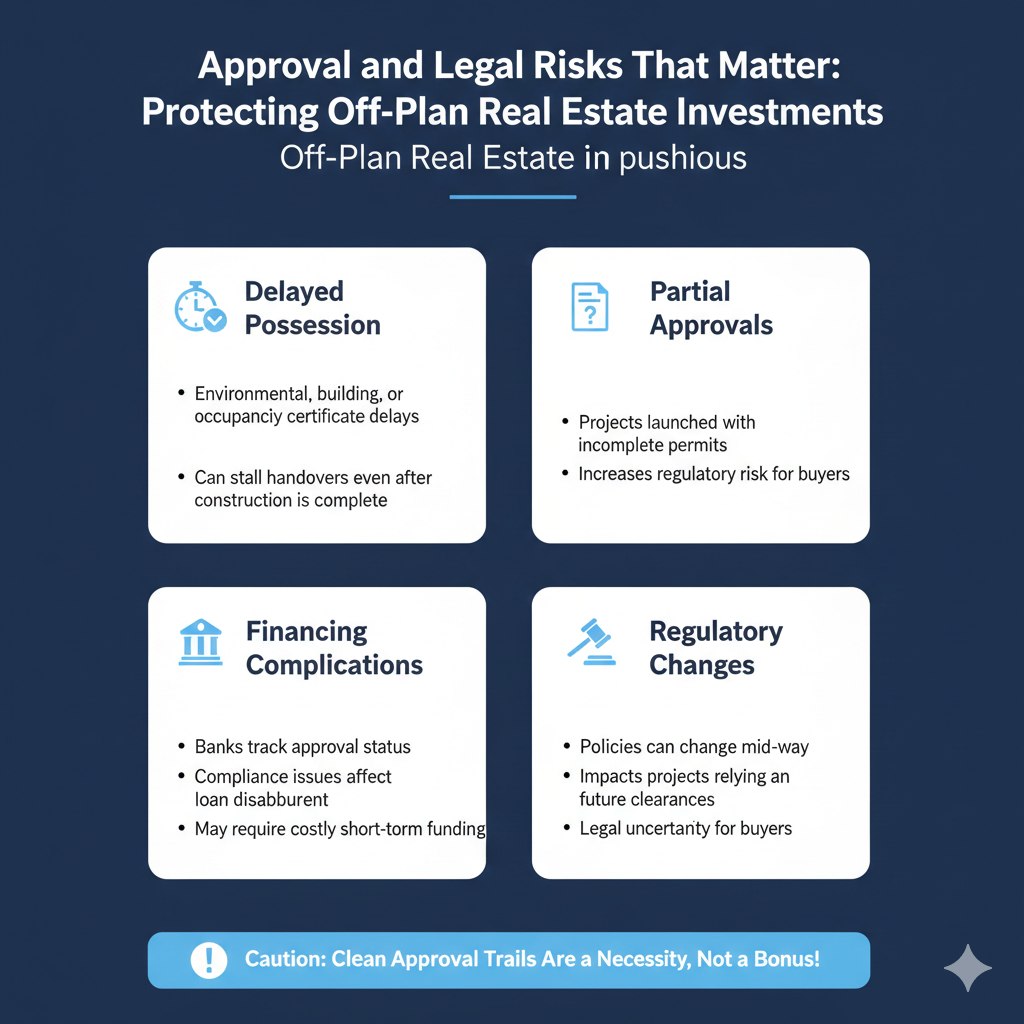
Off-plan projects depend heavily on timely approvals.
Delays in environmental clearance, building permissions, or occupancy certificates can stall handovers even after construction is complete.
Some projects are launched with partial approvals, relying on future clearances. This increases regulatory risk for buyers, especially if policies change mid-way.
Banks and lenders closely track approval status. Any compliance issue can affect loan disbursement schedules, forcing buyers to arrange short-term funding at higher costs.
A clean approval trail is not a bonus. It is a necessity.
Market Risk and Absorption Reality
Off-plan success assumes that market demand will remain strong at possession.
If large volumes of similar inventory are delivered simultaneously, resale and rental markets soften. This has been visible in parts of NCR, where mass handovers led to muted price growth for years (Anarock Residential Market Reports).
Off-plan buyers are exposed to future market cycles they cannot control.
Who Should Consider Off-Plan Investments
Off-plan investments suit a specific buyer profile.
They work for investors with surplus capital who can absorb delays without financial stress. Long investment horizons help smooth short-term volatility.
Buyers who thoroughly evaluate developer track record, financial strength, land ownership clarity, and approval status reduce downside risk significantly.
Those investing in micro-markets with strong end-user demand, not just future projections, improve the probability of healthy returns.
Who Should Avoid Off-Plan Properties
End-users with fixed move-in timelines should be cautious. Delays can disrupt personal and financial planning.
Buyers stretching budgets based on promised appreciation face higher risk. If markets stagnate, exit options become limited.
First-time buyers unfamiliar with legal due diligence may find off-plan transactions complex without professional guidance.
For these buyers, ready or near-completion properties often provide better risk-adjusted outcomes.
FAQ Section
Are off-plan properties riskier than ready homes?
Yes. Off-plan properties carry construction, approval, and market risks that ready homes do not. The potential return comes with higher uncertainty.
Can off-plan investments give high returns?
They can, especially in strong markets with reliable developers. However, returns are not guaranteed and depend heavily on execution and timing.
Does RERA eliminate off-plan risks?
RERA improves transparency and accountability but does not remove risks related to delays, market cycles, or developer execution.
Should first-time buyers invest in off-plan projects?
First-time buyers should be cautious. Without experience or advisory support, off-plan investments can be difficult to manage.
Conclusion
Off-plan property investments are neither inherently good nor bad. They amplify both opportunity and risk. While early entry pricing and phased payments look attractive, delays, approval challenges, and market cycles can erode expected returns.
For buyers with patience, surplus capital, and strong due diligence, off-plan projects can work. For others, the hidden risks may outweigh the projected upside.
The right decision is not about chasing returns, but about matching the investment to your financial resilience and time horizon.
Let’s Join Together to Bring Change to the World of Real Estate
Thinking about your next home?
relai scores every project on data, not paid placements, and it's free for buyers.