New Pre-Launch Projects in 2026: What Buyers Should Know Early

Pre-launch real estate projects attract buyers for one simple reason: early access at a lower price. In Hyderabad, 2026 is expected to see a fresh wave of pre-launch residential projects, especially in growth corridors around the Financial District, South Hyderabad, and the city’s eastern expansion zones.
However, pre-launch buying is also where buyers make the costliest mistakes. The line between a smart early investment and a risky commitment is thin. This guide explains what pre-launch really means, the risks most buyers overlook, how to verify approvals and pricing claims, and where pre-launch activity is expected in 2026.
What “Pre-Launch” Actually Means
In simple terms, a pre-launch project is one that is announced or informally marketed before all statutory approvals are fully in place.
This does not always mean the project is illegal. It usually means one of the following:
The land is acquired, but all permissions are still in progress
Master plan is ready, but RERA registration is pending
Initial pricing is being tested before official launch
Inventory is shown to a closed buyer group or channel partners
Developers do this to gauge demand, raise early capital, and lock in anchor buyers.
For buyers, this stage offers lower entry prices, flexible payment plans, and better unit choices. But it also comes with higher uncertainty compared to ready or launched projects.
Common Risks Buyers Ignore in Pre-Launch Deals
The biggest risk is not price fluctuation. It is timeline and approval uncertainty.
Many buyers assume that if a big developer is involved, approvals are guaranteed. That is not always true. Even strong brands can face delays due to zoning changes, infrastructure dependencies, or regulatory bottlenecks.
Another overlooked risk is design dilution. What is shown in pre-launch brochures is often a concept version. Layouts, amenities, tower density, and even open space percentages can change after approvals.
There is also the risk of price misrepresentation. Pre-launch prices are often positioned as “once-in-a-lifetime.” In reality, some projects launch officially at similar prices if market demand softens.
Finally, exit liquidity is weak during early construction. If your plan is short-term resale, pre-launch is not always ideal.
How to Check Approvals Before Committing
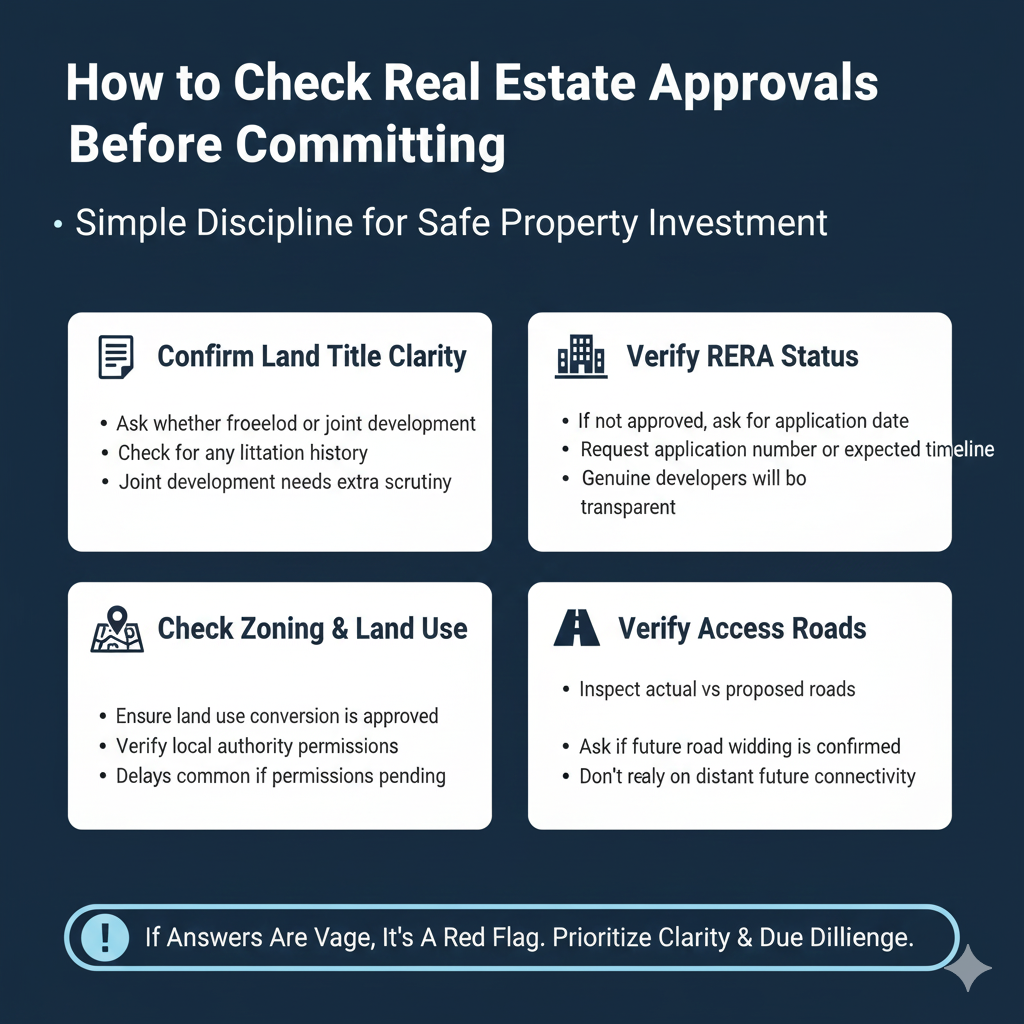
You do not need legal expertise, but you do need discipline.
First, confirm land title clarity. Ask whether the land is freehold, whether it has any litigation history, and whether it is a joint development. Joint development projects need extra scrutiny.
Second, ask clearly about RERA status. If RERA is not yet approved, ask when the application was filed. A genuine developer will share the application number or expected timeline.
Third, check zoning and land use. Many pre-launch projects are delayed because land use conversion or local authority permissions take longer than expected.
Fourth, verify access roads. Some projects look attractive on maps but rely on future road widening or proposed connectivity that may take years.
If these answers are vague, that itself is a signal.
Understanding Pre-Launch Pricing Logic
Pre-launch pricing works on expectation, not certainty.
Developers usually price early units 8–15 percent lower than expected launch pricing. This discount compensates buyers for waiting risk and capital lock-in.
However, buyers must understand why the discount exists. If pricing is low because approvals are incomplete, that is normal. If pricing is low because demand is weak, that is a warning sign.
Also look at price slabs. Some projects advertise a low base price but add premium charges later for floor rise, facing, clubhouse, or parking. Always calculate the all-inclusive cost.
Another red flag is aggressive “price increase next week” messaging without any formal launch milestone.
Delivery Promises vs Reality
Pre-launch timelines are often optimistic.
A project promising possession in 36 months may realistically take 48 to 60 months, especially if approvals are still in progress. This matters if you are planning home loan EMIs alongside rent.
Check the developer’s past delivery record in Hyderabad, not just nationally. Local execution matters more than brand size.
Also check whether construction will start only after RERA approval or whether groundwork has already begun. That gives a more realistic sense of intent.
Who Should Consider Pre-Launch Projects
Pre-launch is suitable for buyers who:
Are not in a hurry to move in
Have stable income and cash flow
Plan to hold the property long term
Understand construction-stage risk
Want better unit selection and pricing
It is not ideal for buyers who need possession certainty, depend heavily on loan timelines, or plan short-term resale.
Expected Pre-Launch Hotspots in Hyderabad for 2026
Instead of naming unverified projects, it is safer to track corridors where pre-launch activity is expected, based on land aggregation and infrastructure momentum.
West Hyderabad Growth Belt
Tellapur, Kollur, and Mokila are likely to see high-rise and villa pre-launches driven by Financial District spillover and ORR access.
South Hyderabad Expansion
Mucherla, Yacharam, and areas near proposed institutional hubs are expected to see plotted and mid-segment residential pre-launch activity.
East Hyderabad Infrastructure Corridor
Ghatkesar, Pocharam, and NH-163 belt may see early announcements linked to highway upgrades and institutional growth.
North-West Affordable Edge
Bachupally extension zones may see pre-launches targeting budget and mid-segment buyers priced below core west Hyderabad.
These zones attract pre-launch activity because land is still consolidating and future infrastructure is visible, not speculative.
How Buyers Should Approach Pre-Launch in 2026
Treat pre-launch as a measured decision, not an emotional one.
Do not book based on brochures alone
Do not rely only on verbal commitments
Do not assume approval is guaranteed
Do not rush because of artificial urgency
Instead, focus on developer credibility, land clarity, realistic timelines, and whether the project aligns with your holding period.
At Relai – For right home, we guide buyers through pre-launch decisions with structured checks, transparent comparisons, and risk-aware advice so early entry becomes an advantage, not a regret.
FAQ
Q1: What does “pre-launch” mean in real estate?
A1: Pre-launch refers to a property announced before official approvals or construction begins, often at early-stage pricing.
Q2: What are the common risks of pre-launch projects?
A2: Delays in approvals, extended delivery timelines, changes in project plan, or developer financial instability.
Q3: How can buyers verify pre-launch projects?
A3: Check builder credentials, RERA registration, land title, approvals from municipal authorities, and past delivery record.
Q4: Why is pricing logic important in pre-launch projects?
A4: Early-stage pricing may seem attractive but must be evaluated against construction quality, location, and future market value.
Q5: Should buyers consider pre-launch projects for investment or personal use?
A5: Pre-launch units are ideal for investors seeking appreciation and long-term gains; end-users should weigh delivery timelines and occupancy needs.
Conclusion

Pre-launch projects in Hyderabad in 2026 will offer real opportunities, but only for buyers who understand what they are signing up for. Early pricing and better unit choice can work in your favor, but only if approvals, timelines, and pricing logic are clearly verified.
Pre-launch is not about being first. It is about being informed early.
Let’s Join Together to Bring Change to the World of Real Estate.
Thinking about your next home?
relai scores every project on data, not paid placements, and it's free for buyers.