Musi Rejuvenation Progress: What It Means for Hyderabad’s Next Phase of Growth
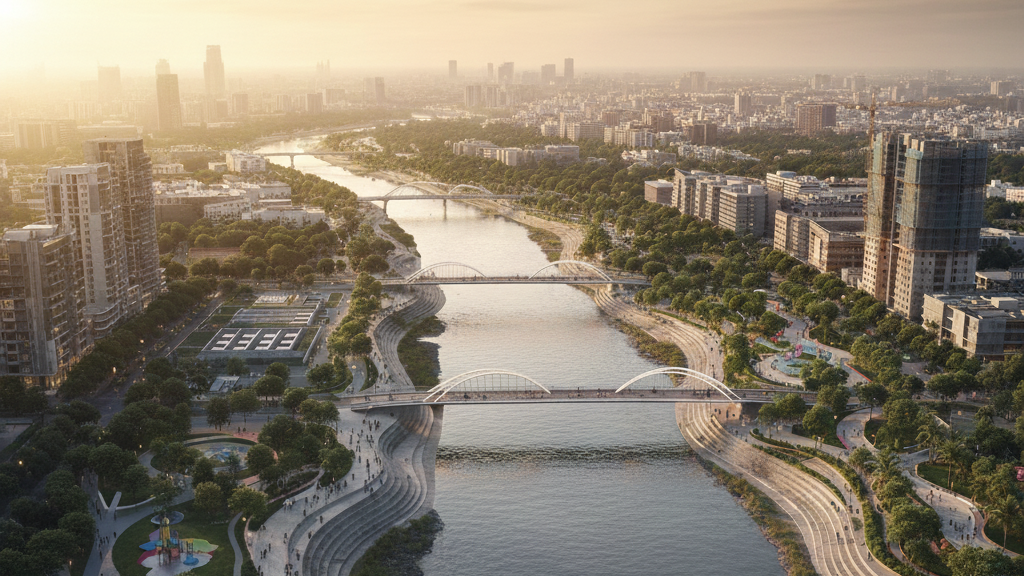
Hyderabad has spent years talking about the need to revive the Musi River. Today, that conversation is finally shifting from discussion to action. With rejuvenation works set to begin soon, the project is becoming a central part of the city’s long-term development vision. It links directly to Hyderabad’s clean-infrastructure goals, the CURE model for the Outer Ring Road (ORR) environs, and the demand for better air, mobility and public health in fast-growing eastern corridors like Uppal and LB Nagar.
The Musi project is also tied to the state’s $1-trillion economic ambition. Large-scale environmental upgrades, connectivity expansion, and the promise of Metro Phase 2 by March 2026 are together shaping a new phase of optimism. Many of these ideas stalled earlier due to slow approvals and shifting priorities. But the current political and civic push has brought the project back to the table with seriousness.
This blog looks at where the project stands, the impact on livability, and why the city’s eastern belt stands to gain the most.
Why the Musi Rejuvenation Matters Now
The Musi River runs through the heart of Hyderabad, touching old neighbourhoods, commercial zones and emerging eastern suburbs. For decades, poor sewage management, encroachment and industrial discharge turned it into a neglected stretch rather than an urban asset.
The upcoming works are aimed at changing this trajectory. According to recent updates reported in The Hindu and Times of India, the government is moving toward a structured implementation plan involving sewage treatment, riverbank cleanup, flood-control structures and long-term maintenance. These updates suggest a more systematic approach compared to past attempts.
This renewed push comes at a time when Hyderabad is trying to position itself as a clean, future-ready city. With sustained growth in IT, logistics, and housing demand, the city’s environmental systems need scaling. Musi’s revival is becoming symbolic of whether Hyderabad can pair growth with sustainability.
Linking Musi Revival with the CURE Model and ORR Clean Zones
The Hyderabad administration has been exploring a CURE (Clean, Urban, Resilient, Eco-friendly) framework for managing ORR-side zones. This includes improved waste handling, dust reduction, water-body protection, and greener public spaces.
Reviving the Musi complements this model in two ways:
Cleaner eastern corridors
Areas around LB Nagar, Nagole, Uppal and Ramanthapur have long dealt with polluted water channels and unplanned discharge points. As rejuvenation works stabilise the river and its feeder nalas, these neighbourhoods can expect cleaner surroundings and healthier public spaces.Better storm-water management
Improved river health reduces the risk of flooding during monsoons. The new infrastructure planned along Musi is expected to streamline water flow and prevent backlogs that often affect low-lying areas.
Reports from The New Indian Express and Deccan Chronicle have highlighted that integrating river restoration with urban-planning upgrades is now becoming a priority, rather than isolated civic works. This alignment increases the chances of the project being executed with consistency.
Boosting Livability in Uppal and LB Nagar
The eastern corridor has seen strong growth over the past decade. Residential clusters, the growing IT presence around Pocharam, and improved regional connectivity have pulled demand toward Uppal and LB Nagar. Yet livability issues have kept the region from achieving its full potential.
The Musi project can change several things:
Cleaner neighbourhoods
A large section of the river flows through eastern suburbs. As sewage interception, treatment plants and bank-cleanup works begin, local environments can improve significantly.
Better mobility
The riverbanks have long been cluttered with debris, waste and erosion. Once restored, they open opportunities for better road planning, pedestrian paths and new link routes.
Higher real-estate confidence
Cleaner surroundings and improved civic management raise confidence among homebuyers and NRIs looking for value-growth locations. Reports from the real-estate research community noted during industry discussions at GRI Hyderabad 2025 show rising investor interest in eastern pockets, especially if environmental upgrades proceed.
Supporting the larger metro ecosystem
The revival supports demand growth that aligns with the upcoming metro expansion plans. Better public environments generally translate to better station-area development and improved adoption of mass transit.
How This Fits Into the $1-Trillion Vision
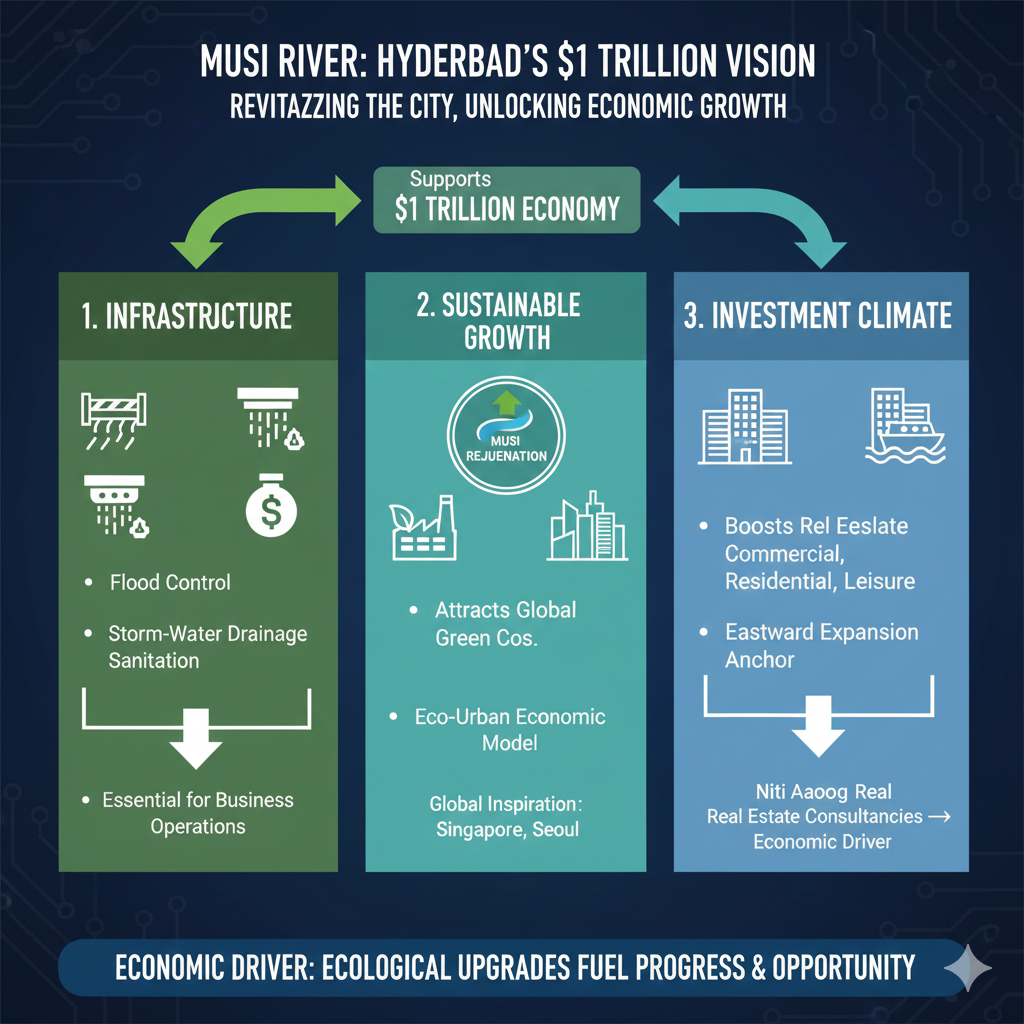
Hyderabad’s ambition of growing into a trillion-dollar economy depends on three major levers:
infrastructure capacity
sustainable urban growth
diversified investment
The Musi rejuvenation helps on all three fronts:
Infrastructure
A functioning river system supports flood control, storm-water drainage and sanitation. These are essential for long-term, uninterrupted business operations in a rapidly growing city.
Sustainable growth
Large investments in clean infrastructure attract global companies prioritising environmental standards. This is partly why cities like Singapore and Seoul built strong riverfront ecosystems as part of their economic expansion.
Investment climate
Cleaner public spaces increase the appeal for commercial, residential and leisure-sector investments. As Hyderabad continues to expand toward the east, the Musi corridor becomes a strong anchor.
These connections were echoed in multiple economic studies and city-growth reviews, including analysis from Niti Aayog and major real-estate consultancies that emphasise urban ecological upgrades as an economic driver.
Metro Phase 2: Why It Adds to the Optimism
The project’s timeline has shifted over the years. Earlier delays created uncertainty, especially for homebuyers and investors waiting for east-west integration. But recent government statements and tender updates suggest that Metro Phase 2 is being prioritised for completion by March 2026.
This matters because:
Metro expansion strengthens the value proposition of eastern corridors.
It reduces commute friction and increases the appeal for companies expanding in and around Pocharam, Nagole and LB Nagar.
It supports tourism, retail, and transit-oriented development along the Musi belt.
If both the metro and river works pick up pace together, Hyderabad could see one of its largest coordinated urban-upgrade cycles in a decade.
FAQ Section
Why is the Musi project gaining attention now?
Because works are finally moving forward, and the project is tied to the city’s broader environmental and infrastructure goals.
How will it affect residents near Uppal and LB Nagar?
Cleaner water, reduced odour, lower flooding risk and better civic systems can significantly improve daily living.
Does the project link to ORR or the CURE model?
Yes. The approach aligns with clean-infrastructure ideas applied along the ORR corridor, focusing on healthier, greener zones.
Will the project impact real-estate demand?
Improved riverfront conditions and better connectivity generally raise homebuyer confidence, especially in undervalued eastern pockets.
How does Metro Phase 2 fit into this?
Expected by March 2026, the metro strengthens mobility and makes the Musi corridor more accessible and attractive for long-term growth.
Conclusion

The Musi rejuvenation is more than an environmental project. It is a foundational shift in how Hyderabad plans its next decade. With work starting soon, the project signals cleaner neighbourhoods, stronger flood control and improved livability for eastern suburbs like Uppal and LB Nagar. As part of the city’s $1-trillion vision and complemented by Metro Phase 2, the Musi corridor is set to become a core urban asset rather than a neglected stretch.
Relai – For right home.
Let’s join together to bring change to the world of real
Thinking about your next home?
relai scores every project on data, not paid placements, and it's free for buyers.