Metro Land Auction Controversy: Revenue Boost or Risk to Public Infrastructure?
Metro Land Auction Controversy: Revenue Boost or Risk to Public Infrastructure?

Hyderabad is once again in the spotlight, this time for its large-scale metro and industrial land auctions. The Revanth Reddy–led government has announced the auction of nearly 300 acres spread across metro corridors, housing layouts, and industrial pockets. Officials say the goal is to strengthen government finances and restart stalled infrastructure. Critics argue it is an “asset sale frenzy” that could weaken long-term public ownership.
This debate has grown louder after the discovery of irregularities within earlier HMDA land records, raising questions about transparency, pricing, and the real purpose behind the sudden push. At the same time, the state is trying to revive stalled metro stretches such as the Uppal Corridor, which have remained incomplete for years due to funding gaps and earlier administrative delays.
To understand what this means for citizens, investors, and infrastructure, we need a closer look at the revenue context, political narrative, land-use implications, and economic reality.
1. What Triggered the Auctions?
The government has been facing a massive funding gap for both metro operations and ongoing public works.
Reports from The Hindu and Deccan Chronicle have highlighted concerns around delayed central funds, rising operating expenses, and stalled extensions that require new revenue streams to move forward.
Land monetization has historically been a tool used by multiple Telangana governments, but the scale today is larger and more urgent. The new administration sees auctions as a quick way to:
– unlock idle or disputed land
– generate immediate revenue
– restart metro and road projects
– clear liabilities from earlier regimes
Officials point out that large parcels lying unused near key metro lines could generate thousands of crores in auction value. The state argues this is better than borrowing at high interest.
2. Why Critics Call It an “Asset Sale Frenzy”
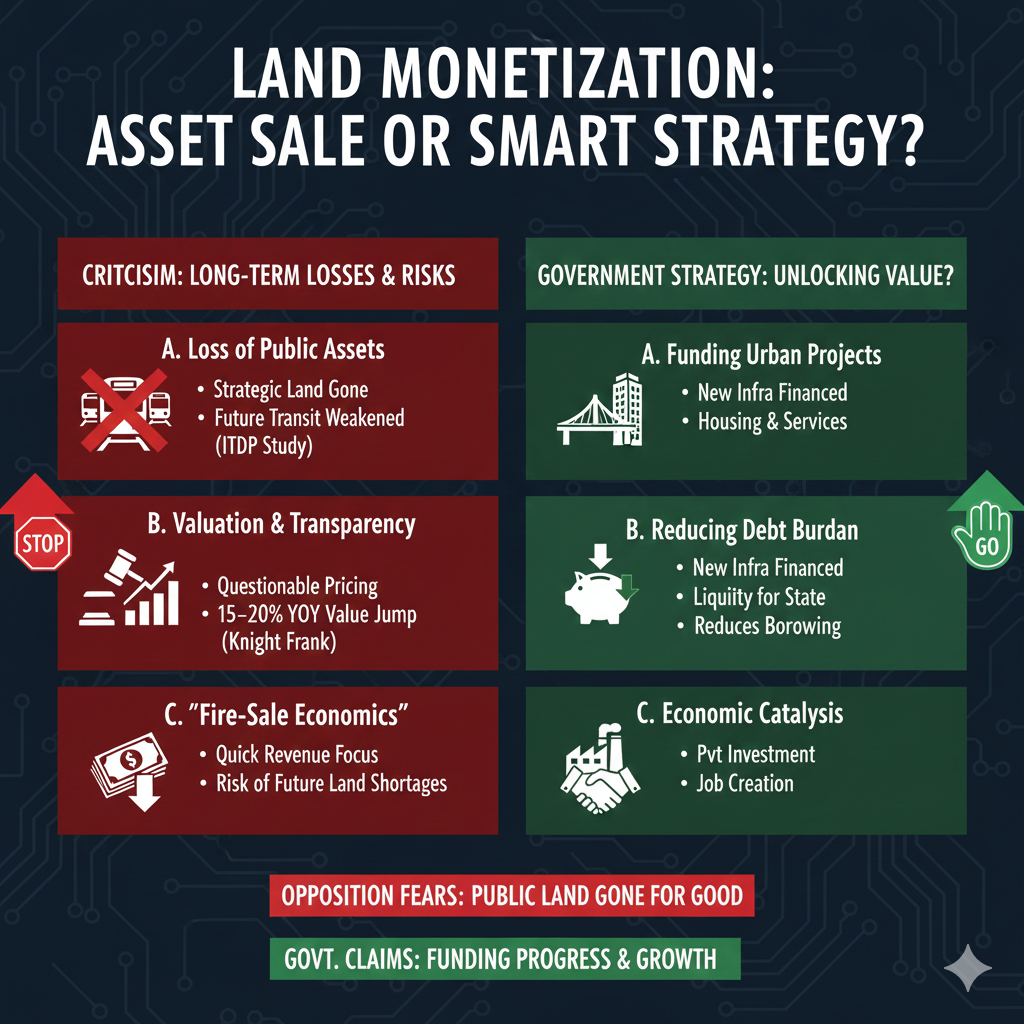
Opposition leaders argue that monetizing land meant for public transport, housing, or industrial development risks weakening future capacity. Their concerns fall into three broad ideas:
A. Long-term loss of public assets
Opposition groups say once core urban land is sold, getting it back is impossible. Land near metro corridors holds strategic value for parking hubs, future stations, bus-bay expansions, and commercial integration.
Studies from the Institute for Transportation and Development Policy (ITDP) show that land around transit corridors is crucial for long-term urban mobility planning. Selling these parcels removes government flexibility.
B. Questionable valuation and transparency
After irregularities surfaced in old HMDA records, opposition parties questioned whether auctions can guarantee clean titles and fair pricing.
With land values in prime pockets climbing 15–20% YoY (as noted by Knight Frank’s India Market Report), undervaluation is a major concern.
C. Fear of “fire-sale economics”
The political narrative revolves around whether the state is selling to raise quick revenue instead of building durable income streams. Previous governments in India that relied heavily on land monetization often struggled in later infrastructure cycles due to land shortages.
3. The Economic Reality: Revenue vs. Infrastructure
Hyderabad is one of the fastest-growing metros in India, with major infrastructure demand and limited fiscal space. The metro alone needs thousands of crores for:
– Uppal corridor revival
– last-mile connectivity
– feeder services
– station redevelopment
– rolling stock upgrades
A CII–Deloitte report on urban mobility states that Indian metros must rely on diverse funding sources, including land monetization, to remain operational.
With the government balancing salaries, welfare schemes, and infrastructure, auctions offer an immediate fix.
However, the challenge lies in balancing short-term revenue with long-term mobility needs.
4. Impact on Real Estate
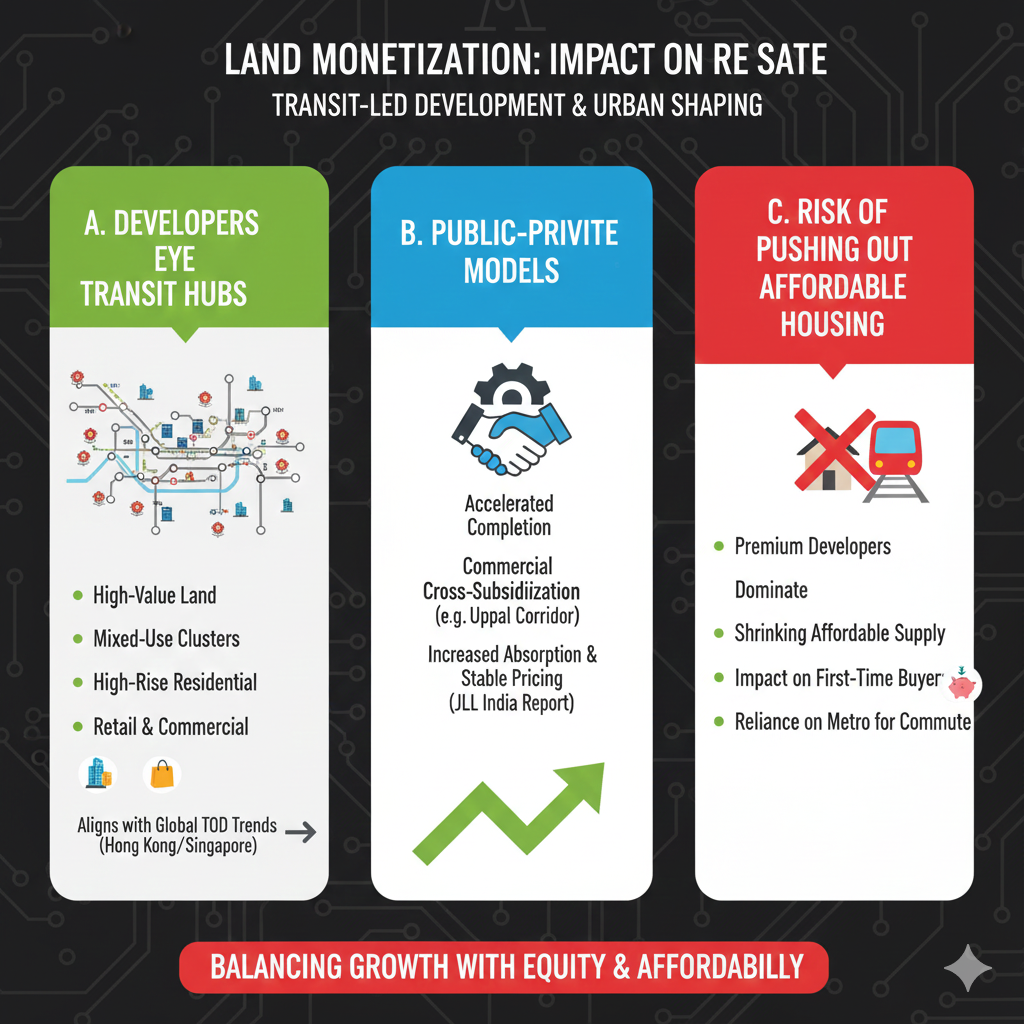
A. Developers eye land near transit hubs
Land around metro lines is naturally high-value due to connectivity.
When such land goes to private developers, it often results in:
– mixed-use clusters
– high-rise residential
– retail and commercial developments
This aligns with trends seen in Hong Kong and Singapore, where transit-led development has shaped real estate patterns.
B. Public-private models may accelerate completion
If portions of land around stations are commercially developed, they can cross-subsidize extensions like the Uppal corridor.
A JLL India report notes that transit-oriented development (TOD) increases absorption and creates more stable pricing.
C. Risk of pushing out affordable housing
If premium developers dominate the auctions, some fear that affordable housing near metro corridors will shrink.
This matters deeply for first-time buyers who rely on metro connectivity for work commutes.
FAQ Section
1. Does this mean metro expansion will speed up?
Possibly. The government aims to use auction proceeds to restart stalled corridors, especially the Uppal line. The pace depends on bidding outcomes and execution capacity.
2. Is this land originally meant for public infrastructure?
Many parcels were designated for future metro use, industrial parks, or housing layouts. While not all were in active use, they were reserved for long-term public projects.
3. Will this affect property prices near metro corridors?
Prices are likely to rise if private developers convert auctioned parcels into high-value projects. Transit-linked real estate usually sees stronger appreciation.
4. Are these auctions risky for buyers and investors?
Buyers must check clear titles and zoning classifications, especially in areas with recently updated HMDA records. Legal due diligence is essential.
5. How should homebuyers interpret this move?
Those looking near metro corridors should track which developers win bids. It affects future community planning, pricing trends, and infrastructure timelines.
Conclusion

The metro land auction controversy captures a larger question about how Hyderabad will fund its future growth. The state needs revenue to revive stalled infrastructure, but citizens also expect long-term planning that protects public assets. Whether this becomes a turning point or a cautionary tale depends on how transparently the auctions are conducted and how effectively the funds are used.
For homebuyers and investors, the outcome will shape the next wave of developments around key corridors. As urban expansion intensifies, staying informed and evaluating long-term implications matters more than ever.
Let’s Join Together to Bring Change to the World of Real Estate.
Relai – For right home.
Thinking about your next home?
relai scores every project on data, not paid placements, and it's free for buyers.