Major Deals & IPO Buzz: What’s Next for India’s Commercial Real Estate

Introduction
The Indian real estate sector is seeing renewed momentum: major corporate deals and IPO buzz signal a wave of consolidation and renewed investor interest. Recent developments — including a potential RMZ Corp IPO that could raise up to US$1 billion, and talk of significant acquisitions by Adani Group — suggest commercial real estate platforms are gearing up for large-scale transformation. These moves may reshape how investors access and value commercial property in India.
What’s Driving the Deal Activity
Strong capital-markets appetite and favourable timing
After several lean years, the real estate sector in India has regained investor confidence. According to a recent report, nearly ₹400 billion has been raised via IPOs since 2021 across the sector. ETRealty.com+1
This resurgence of capital-market activity creates favourable conditions for larger-scale public listings and institutional deals.
Developers seeking scale, diversification & liquidity
RMZ Corp historically a major office-space developer — has over the past few years diversified into mixed-use developments, industrial & logistics parks, hospitality and luxury residential projects. Business Standard+2Moneycontrol+2
The planned IPO (potentially raising US$1 billion) would help RMZ tap public markets to fund this diversification and expansion. ETRealty.com+1
For large developers, listing offers a path to unlock capital, reduce reliance on debt, and accelerate growth across asset classes.
Investor interest in institutional-quality commercial assets
Large financial investors are increasingly attracted to India’s commercial real estate — especially Grade A offices, logistics & warehousing, and mixed-use assets. For example, RMZ’s past joint ventures with global players like CPP Investments and Mitsui Fudosan (Asia) show strong global institutional interest in Indian commercial realty. Business Standard+2RMZ+2
This interest makes big-ticket IPOs or large M&A deals more viable.
Flagship Deals & IPOs in Focus
Entity / Developer | What’s Happening / Proposed | Significance |
RMZ Corp | Considering a US$ 1 billion IPO (potentially India’s largest real-estate listing) ETRealty.com+1 | Could unlock major new capital for diversified growth — office, mixed-use, logistics, hospitality. |
RMZ + CPP Investments / Mitsui Fudosan (Asia) | JV investments, mixed-use and office developments across major metros RMZ+2Business Standard+2 | Demonstrates global investor confidence and builds institutional-grade commercial inventory. |
Adani Group | Reported to be in advanced talks to acquire Emaar India — a deal that could be worth approx. US$ 1.4–1.5 billion. India Today+1 | Would significantly expand Adani’s footprint in residential and commercial real estate, signalling consolidation. |
Beyond these individual cases, the broader real estate IPO market has already seen significant activity: several listings and QIP (Qualified Institutional Placement) rounds — underscoring broader confidence. The Economic Times+2India Brand Equity Foundation+2
What It Means for Investors, Developers & Market Dynamics
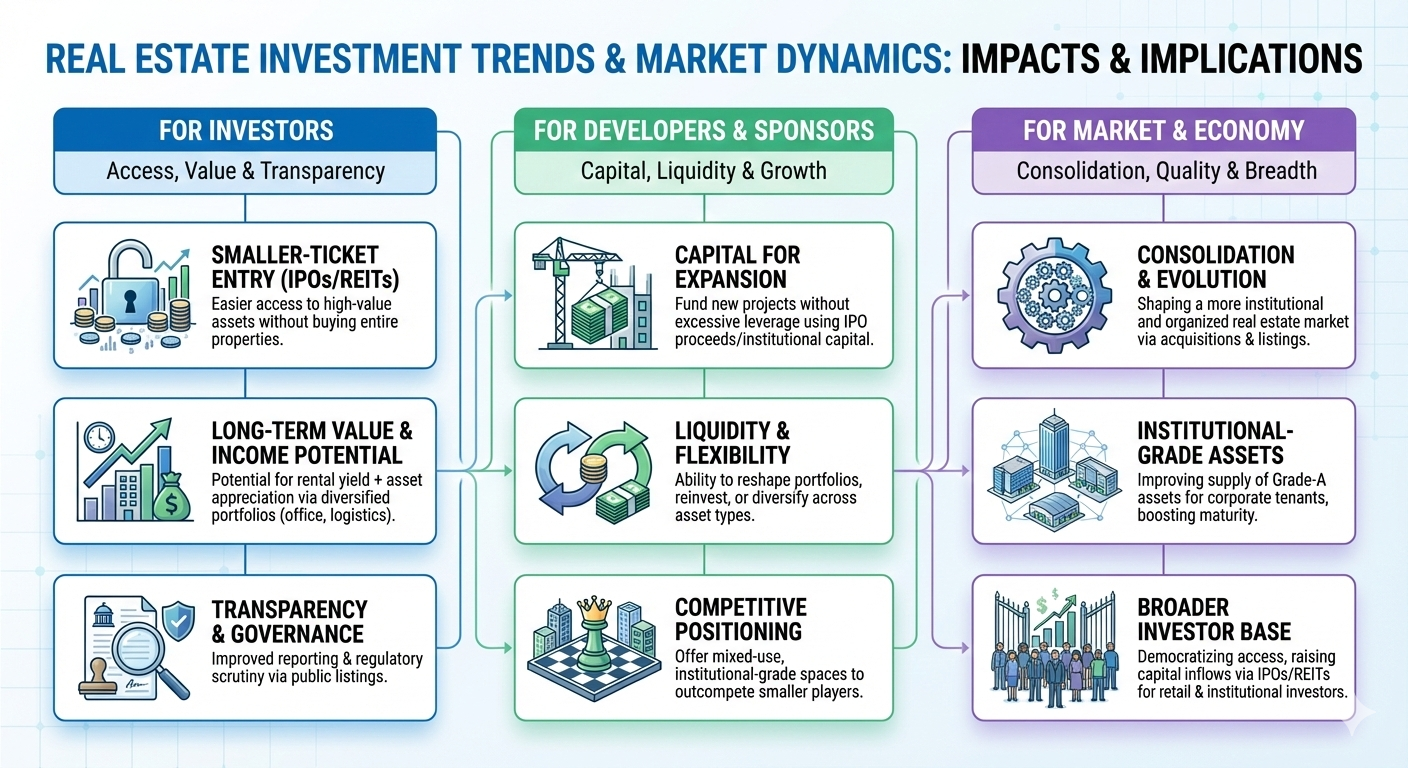
For Investors
Access to large-scale real estate via smaller-ticket entry: IPOs or REITs make it easier to invest in high-value commercial assets without buying entire properties.
Potential for long-term value and income: As developers diversify portfolios (office, logistics, mixed-use), long-term rental yield + asset appreciation opportunities increase.
Transparency & governance: Public listings bring regulatory scrutiny, reporting standards — improving transparency compared to off-market deals.
For Developers & Sponsors
Capital for expansion: IPO proceeds (or capital raised via institutions) can fund new projects without excessive leverage.
Liquidity & flexibility: Instead of holding long-term illiquid assets, developers get flexibility to reshape portfolios, reinvest, or diversify across asset types.
Competitive positioning: Larger, diversified developers may outcompete smaller players by offering mixed-use assets and institutional-grade spaces.
For the Real Estate Market & Economy
Consolidation & evolution: Big acquisitions and public listings may lead to consolidation — shaping a more institutional and organized real estate market.
Infrastructure of institutional-grade assets: More Grade-A commercial assets (offices, logistics parks, mixed-use) — improving supply for corporate tenants, boosting overall commercial maturity.
Broader investor base: Opening up high-value real estate investments to retail & institutional investors via IPOs/REITs — democratizing access and raising capital inflows into real estate sector.
What Could Go Wrong — Key Risks to Watch
Timing and execution risk for IPOs: While RMZ is reportedly evaluating a $1 billion IPO, details such as structure and timing remain uncertain. ETRealty.com+1 If market conditions turn volatile, IPO valuations could get hit.
Oversupply risk in commercial real estate: With many players entering mixed-use, office and logistics segments, supply could overshoot demand — risking vacancy and lower yields.
Regulatory and interest-rate risks: Rising interest rates or regulatory changes could impact leasing demand, project economics, and valuations in listed realty firms.
Complexity of diversified portfolios: As developers diversify across asset types (commercial, residential, hospitality, logistics), managing each vertical optimally becomes harder — potential execution risks.
What the Near Future Looks Like (2026–2028)
We may see the RMZ IPO go live — potentially reshaping how major real estate developers raise capital in India.
Institutional and global investors may increase stakes in Indian real estate assets — more JVs, acquisitions, and hybrid funding deals.
Real estate sector may see consolidation; larger firms with diversified verticals may emerge as market leaders, while smaller developers may struggle.
For investors, increased availability of publicly listed real estate firms and better liquidity will open up more options to participate in commercial real estate.
FAQ Section
Q: Why is RMZ Corp’s IPO being viewed as a big deal?
A: Because a $1 billion IPO would be among the largest real-estate listings in India — giving RMZ access to large new capital and giving investors a regulated, liquid entry point into a diversified real estate portfolio. ETRealty.com+1
Q: What kind of deals is the Adani Group involved in currently?
A: The Adani Group is reportedly in advanced discussions to acquire Emaar India — a deal that could be worth around $1.4–1.5 billion, which would significantly expand its real-estate footprint. India Today+1
Q: Is there investor appetite in real estate IPOs right now?
A: Yes, post-pandemic recovery, improved fundamentals and renewed confidence have driven a sharp uptick in real-estate IPOs — the sector raised nearly ₹400 billion via IPOs since 2021. ETRealty.com+2Hindustan Times+2
Q: What types of assets are developers focusing on now?
A: Developers like RMZ are diversifying across office, mixed-use, industrial & logistics, hospitality, and even high-end residential — rather than focusing only on one asset class. Business Standard+2Moneycontrol+2
Q: Should retail investors consider real-estate IPOs now?
A: If you're comfortable with long-term investment horizons and some market volatility, real-estate IPOs or listed developers can offer exposure to commercial real estate — along with liquidity and regulated disclosures compared to private property investments.
Conclusion

The current buzz around major deals and IPOs — led by players such as RMZ and Adani — suggests Indian commercial real estate is entering a new, more institutionalized phase. As developers diversify, capital markets reopen, and investor interest rises, the industry seems poised for consolidation and growth. For investors, this could mean access to large, professionally managed real-estate portfolios with better liquidity and transparency. For developers, it opens a path to scale without over-leveraging.
Thinking about your next home?
relai scores every project on data, not paid placements, and it's free for buyers.