Legal Checks You Must Do Before Buying in a Gated Community

Gated communities are often sold as the safest and most organized way to buy a home. Security, amenities, planned layouts, and long-term value make them attractive to both end users and investors. However, many buyers assume that a “gated community” automatically means legal safety. That assumption is where problems begin.
In reality, gated projects come with additional legal layers that do not apply to standalone buildings or individual houses. If these are not verified properly, buyers may face issues related to ownership rights, maintenance disputes, or even approval violations years after purchase.
This guide explains the critical legal checks you must do before buying in a gated community and why common-area ownership and maintenance clauses matter more than most buyers realise.
Why Gated Communities Need Extra Legal Attention
A gated community is not just a home purchase. It is a shared ownership structure involving land, roads, amenities, utilities, and future obligations. Unlike an independent house, you are buying into a system that will exist for decades.
Legal issues in gated communities usually do not surface immediately. They appear later in the form of:
Disputes with the association
Unexpected maintenance hikes
Restrictions on resale or usage
Approval violations flagged during resale
That is why legal verification must go beyond the individual flat or villa.
Title Verification: More Than Just Clear Ownership
In gated projects, title verification must be done at two levels.
First is the parent land title. Buyers must ensure that the entire land parcel on which the gated community is built has a clear, dispute-free ownership history. Even if your individual unit is registered properly, any defect in the parent title can affect the whole project.
Second is the developer’s right to develop. In joint development projects, confirm that the landowner has legally transferred development rights to the builder and that these rights cover the full project scope.
Buyers often rely on the developer’s word or bank loan approval as proof. While bank approvals help, they do not replace an independent legal title check.
Land Use and Zoning Approval
Gated communities must be developed on land that is approved for residential use.
You must verify:
That the land is classified as residential
That conversion from agricultural land, if applicable, is complete
That zoning regulations allow the proposed density and height
In some cases, parts of a gated layout may be approved while others are not. Buyers who do not check sanctioned plans may unknowingly purchase units in non-compliant blocks.
This becomes a serious issue during resale, registration disputes, or municipal scrutiny.
Layout and Building Approvals Specific to Gated Projects
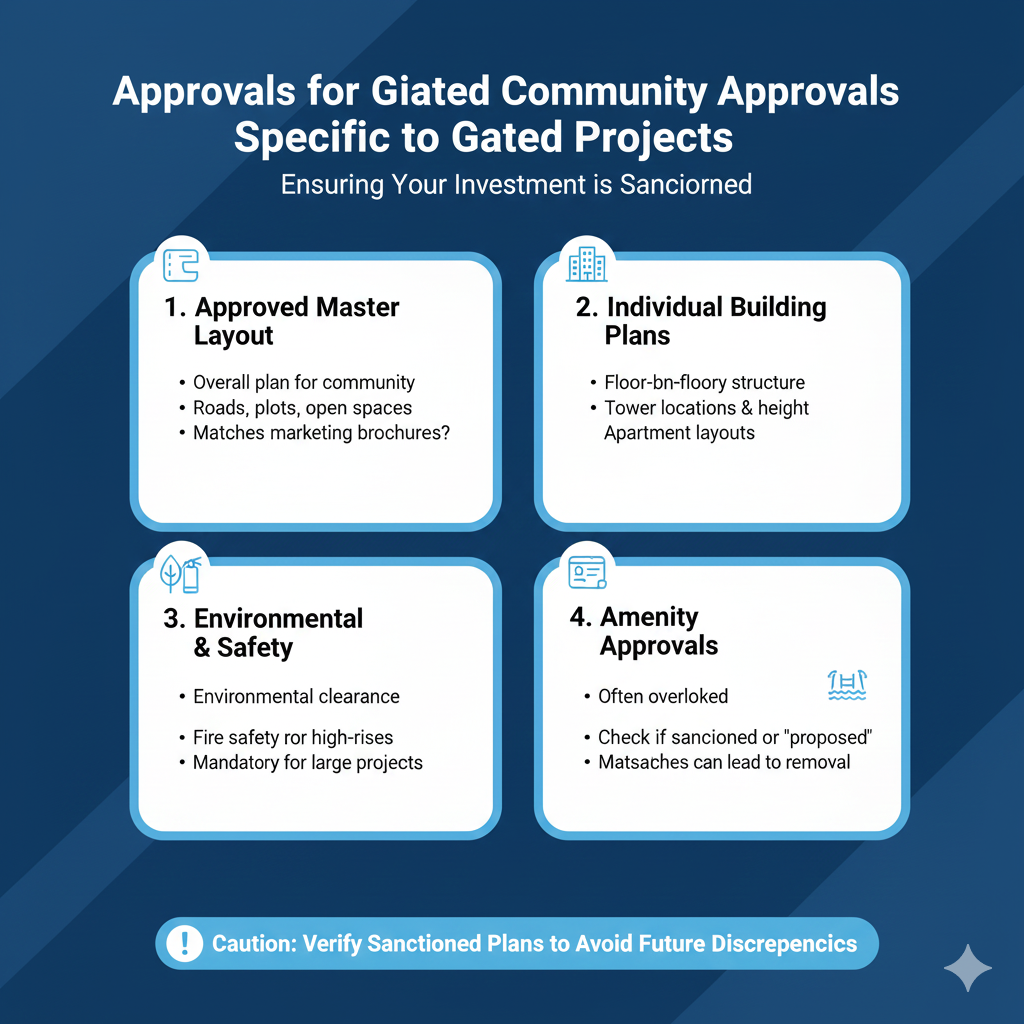
A gated community requires multiple approvals, not just one.
You must check:
Approved master layout
Approved building plans
Environmental clearance if applicable
Fire safety approvals for high-rises
Compare the sanctioned plans with what is being marketed. Any mismatch in towers, amenities, or open space allocation should raise questions.
Buyers often assume amenities shown in brochures are approved. In reality, some amenities are proposed but not sanctioned, making them vulnerable to removal later.
RERA Registration Is Necessary but Not Sufficient
RERA registration is mandatory, but buyers must read the registration details carefully.
Check:
Project phase coverage
Declared completion timeline
Number of units and towers registered
Common amenities listed
In phased developments, some amenities may belong to later phases. Early-phase buyers sometimes discover that promised facilities are delayed or altered because they were linked to future phases.
RERA improves transparency, but it does not replace due diligence.
Common Area Ownership: The Most Ignored Legal Aspect
One of the biggest misunderstandings in gated communities is who owns the common areas.
Buyers usually assume that all roads, parks, clubhouses, and amenities automatically belong to residents. That is not always true.
Legally, common areas can be:
Transferred to the association
Retained by the developer
Leased to the association under conditions
You must check the sale deed and declaration documents to understand whether common areas are being transferred and when.
If common areas remain under developer control, residents may have limited say in usage, access, or modification. This also affects future maintenance costs and governance.
Association Formation and Its Legal Importance
Every gated community is expected to form a residents’ association.
Buyers should check:
When the association will be formed
Whether control will be handed over fully
Whether corpus funds are clearly defined
Delays in association handover often lead to prolonged developer control over maintenance, contracts, and vendor selection. This can result in higher costs and lower transparency.
A properly formed association is essential for long-term governance and dispute resolution.
Maintenance Clauses: Where Long-Term Costs Hide
Maintenance terms are not just about monthly charges. They define your long-term financial commitment.
Check:
Who decides maintenance rates
How often they can be revised
Whether sinking or corpus funds are mandatory
What services are included and excluded
Some agreements allow developers or associations to revise maintenance without limits. Others impose mandatory corpus contributions that are not refundable.
Buyers should also understand whether maintenance responsibility shifts completely to the association or remains partly with the developer for a fixed period.
Undivided Share (UDS) and Its Impact
In apartment-based gated communities, buyers receive an undivided share of land.
This UDS is crucial because:
It represents your actual ownership stake
It impacts resale value
It matters in redevelopment scenarios
Verify that the UDS mentioned in your agreement matches the approved layout and is proportionate to your unit size.
Low or unclear UDS allocation weakens long-term ownership rights.
Access Roads and Civic Handovers
Some gated communities rely on external access roads that are not fully approved or handed over to local authorities.
You must check:
Whether approach roads are approved
Whether they are public or private
Whether future access is legally protected
Projects dependent on unofficial access routes can face issues if landowners or authorities restrict usage later.
Why Buyers Must Think Beyond Possession Day
Most legal issues in gated communities do not affect daily living immediately. They affect:
Resale
Rental permissions
Renovation rights
Dispute resolution
Redevelopment potential
Buying without legal clarity is like living comfortably on borrowed certainty.
FAQ
Q1: What are the key legal documents to verify?
A1: Title deed, land use approval, layout plan, RERA registration, and builder licenses.
Q2: Why is common-area ownership important?
A2: It determines maintenance responsibilities, usage rights, and disputes within gated communities.
Q3: How can maintenance clauses impact buyers?
A3: They define monthly charges, fund usage, and long-term cost obligations for amenities.
Q4: Should buyers check for pending dues in a gated community?
A4: Yes. Outstanding maintenance or property taxes can become the buyer’s responsibility post-purchase.
Q5: How do legal checks protect long-term investment?
A5: They ensure clear ownership, reduce disputes, and maintain resale value.
Conclusion

Gated communities offer structure, security, and lifestyle benefits, but they also demand higher legal awareness. Title clarity, land use approval, common-area ownership, and maintenance clauses are not technical details. They define your rights, costs, and peace of mind for decades.
A gated community is not just a home purchase. It is a long-term legal partnership with multiple stakeholders.
At Relai – For right home, we help buyers evaluate gated projects beyond brochures and price points, focusing on legal strength, ownership clarity, and future risk.
Let’s Join Together to Bring Change to the World of Real Estate.
Thinking about your next home?
relai scores every project on data, not paid placements, and it's free for buyers.