How to Estimate the Real Selling Price of a Home in Hyderabad

Selling a home can be stressful, especially when buyers expect a certain price and market realities tell a different story. Many homeowners in Hyderabad focus only on the listing price without understanding the factors that truly influence resale value. The result? Homes either stay unsold for months or sell at lower-than-expected prices.
This article explains how to estimate the real selling price, the factors that affect it, and why the final closing price often differs from the listing price.
Why the Listing Price Is Not the Real Price
The listing price is essentially a starting point set by the seller. Builders, brokers, or homeowners may quote it based on perceived market trends, location prestige, or recent transactions nearby. However, it does not guarantee the price you will receive.
In reality, the closing price—the amount a buyer pays—is influenced by multiple factors beyond initial expectations:
Market demand and supply
Property condition
Buyer urgency
Negotiation skills
Time on market
Understanding this distinction is critical to avoid overpricing or undervaluing a property.
Factors That Actually Affect Resale Value
Several elements determine the realistic selling price in Hyderabad:
1. Location and Micro-Market
The neighborhood remains the strongest factor. Homes near employment hubs, metro lines, schools, and retail centers hold higher value. Even within a locality, streets closer to main roads or with better infrastructure often command higher prices.
For example, a 2 BHK in Hitech City will sell for more than an identical apartment in a developing suburb, even if super built-up area and amenities are similar.
2. Apartment Size and Layout
Carpet area, number of bedrooms, orientation, and layout efficiency significantly affect value. Two units with the same super built-up area may differ in price if one has a practical layout and better natural light.
3. Age and Maintenance
Older buildings often sell at a discount unless maintenance is excellent. High-rise societies with well-managed elevators, clean common areas, and modern amenities retain value longer.
Poor maintenance, structural issues, or outdated interiors can reduce resale price by 5–15% or more.
4. Floor Level and View
In high-rises, floor level and view affect price. Top floors with premium views command a premium, while lower floors may be discounted slightly. Orientation relative to sun and ventilation also plays a role in buyer preference.
5. Amenities and Society Management
Functional amenities like gyms, play areas, and parking add to value. However, excessive luxury features with high maintenance can reduce buyer interest over time.
Effective society management improves resale prospects, as buyers often factor in long-term maintenance stability.
6. Market Conditions
Overall real estate trends in Hyderabad influence closing price. If demand is high and inventory is low, sellers can achieve prices closer to listing. Conversely, in a buyer-heavy market, negotiation discounts widen.
Macro factors such as interest rates, inflation, and upcoming infrastructure projects also play a role.
7. Legal and Documentation Clarity
Clear title, RERA registration, approved layouts, and no pending dues increase buyer confidence. Any ambiguity can reduce the real selling price, even if the property is otherwise attractive.
Why Closing Prices Often Differ from Listing Prices
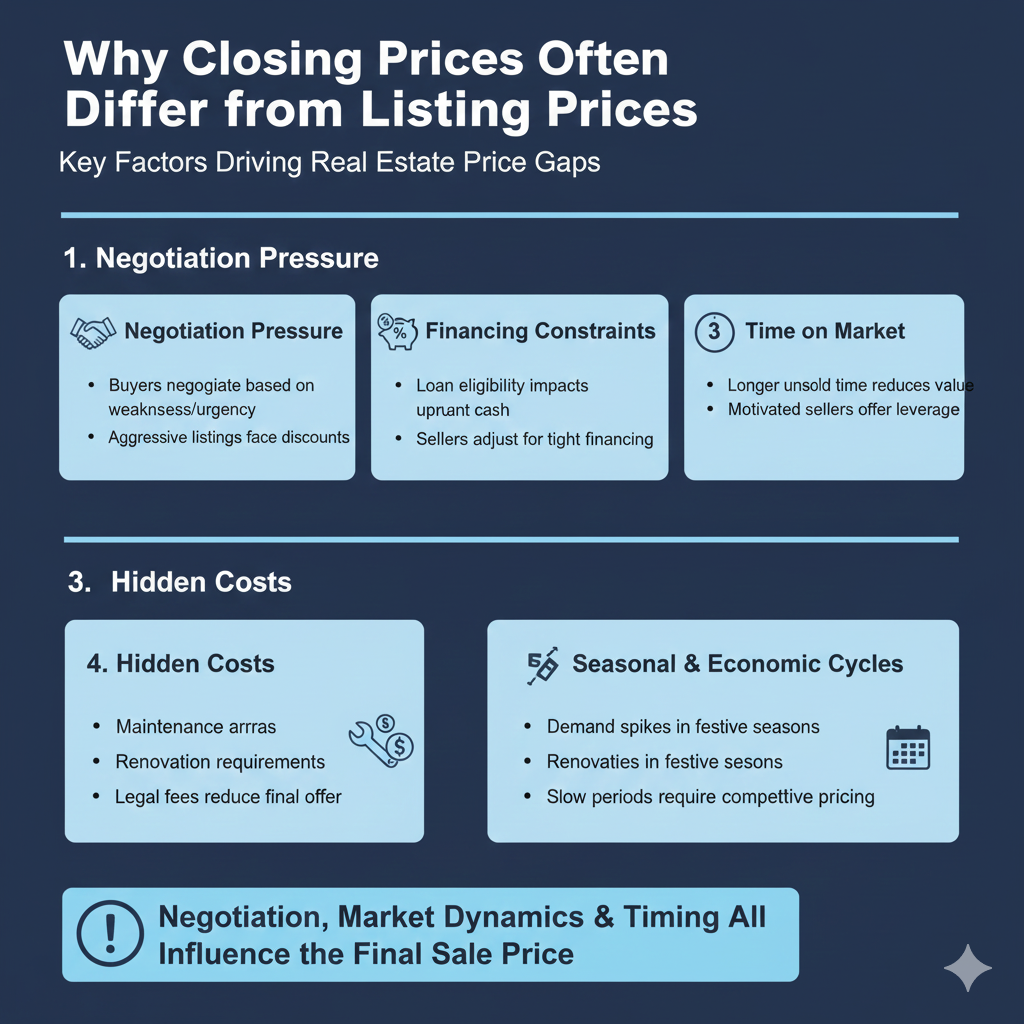
The gap between listing and closing prices arises for several reasons:
1. Negotiation Pressure
Buyers always negotiate based on perceived property weaknesses, market trends, or urgency. Sellers who list aggressively may face larger discounts.
2. Financing Constraints
Buyers’ loan eligibility or interest rate considerations affect how much they can pay upfront. If financing limits are tight, sellers may need to adjust price expectations.
3. Time on Market
Properties that remain unsold for long periods lose perceived value. Buyers assume the seller is motivated, giving them leverage to negotiate lower.
4. Hidden Costs
Maintenance arrears, renovation requirements, or legal fees often reduce the final amount a buyer is willing to pay.
5. Seasonal and Economic Cycles
Demand spikes during festival seasons or policy-driven incentives, while slow periods may require more competitive pricing.
Estimating Realistic Selling Price
To calculate the real selling price:
Compare Recent Sales: Look at actual closing prices for similar units in your locality, not just listing prices.
Adjust for Condition: Factor in age, maintenance, upgrades, and renovations.
Consider Floor and Layout: Premium floors or efficient layouts can justify slight increases.
Account for Market Dynamics: Current demand, inventory, interest rates, and upcoming infrastructure.
Include Transaction Costs: Factor in brokerage, registration, and taxes to understand net proceeds.
This approach gives a practical, data-backed estimate rather than relying on aspirational figures.
Tips for Sellers in Hyderabad
Price slightly below aspirational figures to attract interest and faster sales.
Highlight unique features like balconies, corner apartments, or updated interiors.
Ensure all legal documents are clear and up to date.
Maintain the property and common areas; buyers perceive well-kept homes as worth more.
Be transparent about maintenance charges, society rules, and any pending dues.
Sellers who focus on realistic pricing and presentation often achieve closer-to-listing prices with minimal negotiation friction.
Tips for Buyers
Check the closing prices of recent transactions in the building or micro-market.
Verify carpet area, layout efficiency, and actual usable space.
Review maintenance history and society rules.
Consider long-term growth potential based on location and infrastructure.
Understanding the real resale value helps buyers make offers that are both competitive and fair.
FAQ
Q1: Why do listing prices differ from closing prices?
A1: Negotiation, financing constraints, maintenance, time on market, and seasonal factors influence the final transaction.
Q2: What factors impact resale value the most?
A2: Location, layout, age, maintenance, floor level, amenities, market trends, and legal clarity.
Q3: How can sellers estimate a realistic selling price?
A3: Compare recent sales in the micro-market, adjust for condition and amenities, and account for market dynamics and transaction costs.
Q4: Does property age reduce resale value?
A4: Older properties may sell at a discount unless well-maintained and updated with modern interiors.
Q5: How do amenities affect selling price?
A5: Functional amenities add value, while luxury features with high maintenance may reduce buyer interest over time.
Conclusion

Estimating the real selling price of a home requires looking beyond listing prices. Location, layout, age, amenities, market conditions, and legal clarity all play vital roles in determining what a property will actually fetch. Closing prices differ from listings because of negotiation, financing, and market realities.
At Relai – For right home, we help buyers and sellers evaluate properties realistically, factoring in market trends, actual transaction data, and long-term value. By understanding real resale pricing, both parties can make confident, informed decisions.
Let’s Join Together to Bring Change to the World of Real Estate.
Thinking about your next home?
relai scores every project on data, not paid placements, and it's free for buyers.