How to Calculate the Right Price Per Sq Ft for Apartments

“Price per sq ft” is the most quoted number in real estate. It is also the most misunderstood.
Two apartments can both be priced at ₹8,000 per sq ft and still be very different deals. One may be fairly priced. The other may be quietly expensive. The problem is that most buyers calculate price per sq ft using incomplete numbers or builder-provided figures without questioning what is included.
This article explains how to calculate the real price per sq ft, what should be included or excluded, and how to compare apartments across locations and builders without getting misled.
What Price Per Sq Ft Actually Means
At its core, price per sq ft is:
Total payable amount ÷ usable apartment area
But in practice, builders often calculate it differently. Some use super built-up area, some exclude certain charges, and some add costs later that inflate the effective rate.
For buyers, the goal is not to accept the quoted price per sq ft, but to calculate the effective price per sq ft based on what you actually pay and what you actually get.
What Should Be Included in Price Calculations
To get the true picture, the following costs must be included in your calculation.
First, the base apartment cost. This is the starting price quoted by the builder.
Second, floor rise charges, if applicable. Higher floors usually come at a premium and are part of the apartment cost.
Third, amenity charges that are mandatory. Clubhouse, gym, swimming pool, and common facilities often carry separate charges, but they are not optional.
Fourth, car parking charges, especially when parking is compulsory. Even if charged separately, it affects your total cost.
Fifth, infrastructure and development charges collected by the builder.
Sixth, GST, if applicable, for under-construction properties.
When these are added together, you get the total acquisition cost, which is the number that matters.
What Should Be Excluded from Price Per Sq Ft
Some costs should not distort your price per sq ft calculation.
Stamp duty and registration charges should be excluded when comparing projects because these are government costs and vary slightly by value slab, not builder pricing.
Interior work, furniture, and custom upgrades should also be excluded unless you are comparing two fully finished homes with similar specifications.
Loan interest should never be included in price per sq ft calculations. That depends on individual financing choices, not property value.
The aim is to compare the property itself, not personal or statutory expenses.
Built-Up Area vs Super Built-Up Area
This is where most confusion begins.
Carpet area is the usable space inside your apartment. This is the area you live in.
Built-up area includes carpet area plus wall thickness and internal shafts.
Super built-up area includes built-up area plus a proportionate share of common areas like corridors, lobby, clubhouse, and staircases.
Most builders quote prices based on super built-up area. This inflates the denominator and makes the price per sq ft look lower.
To calculate fairly, always convert pricing to carpet-area-based price per sq ft. This gives a realistic comparison across projects.
How to Calculate the Effective Price Per Sq Ft
Follow this simple process.
Step one: Add all mandatory costs related to the apartment to get the total payable amount.
Step two: Take the carpet area mentioned in the agreement or RERA disclosure.
Step three: Divide total payable amount by carpet area.
The number you get is the true price per sq ft.
This method removes ambiguity and marketing tricks.
Comparing Projects Across Different Locations
Location-based comparisons require context.
A project in Tellapur priced at ₹7,500 per sq ft is not automatically cheaper than one in Kondapur at ₹9,000 per sq ft. Infrastructure readiness, social ecosystem, commute time, and rental demand all affect value.
Instead of comparing raw numbers, adjust expectations based on:
Road access and metro connectivity
Proximity to employment hubs
Existing social infrastructure
Future supply pipeline
Sometimes a higher price per sq ft in a mature area offers better long-term stability than a cheaper option in a developing zone.
Comparing Builders Fairly
Two builders quoting the same price per sq ft may offer very different value.
Look at construction quality, specification depth, reputation for timely delivery, and post-handover maintenance standards.
Also examine how transparent the pricing structure is. Builders who quote low base prices but load multiple add-ons later often end up more expensive than those with clean pricing.
Consistency and clarity matter more than headline numbers.
Amenities and Their Hidden Cost
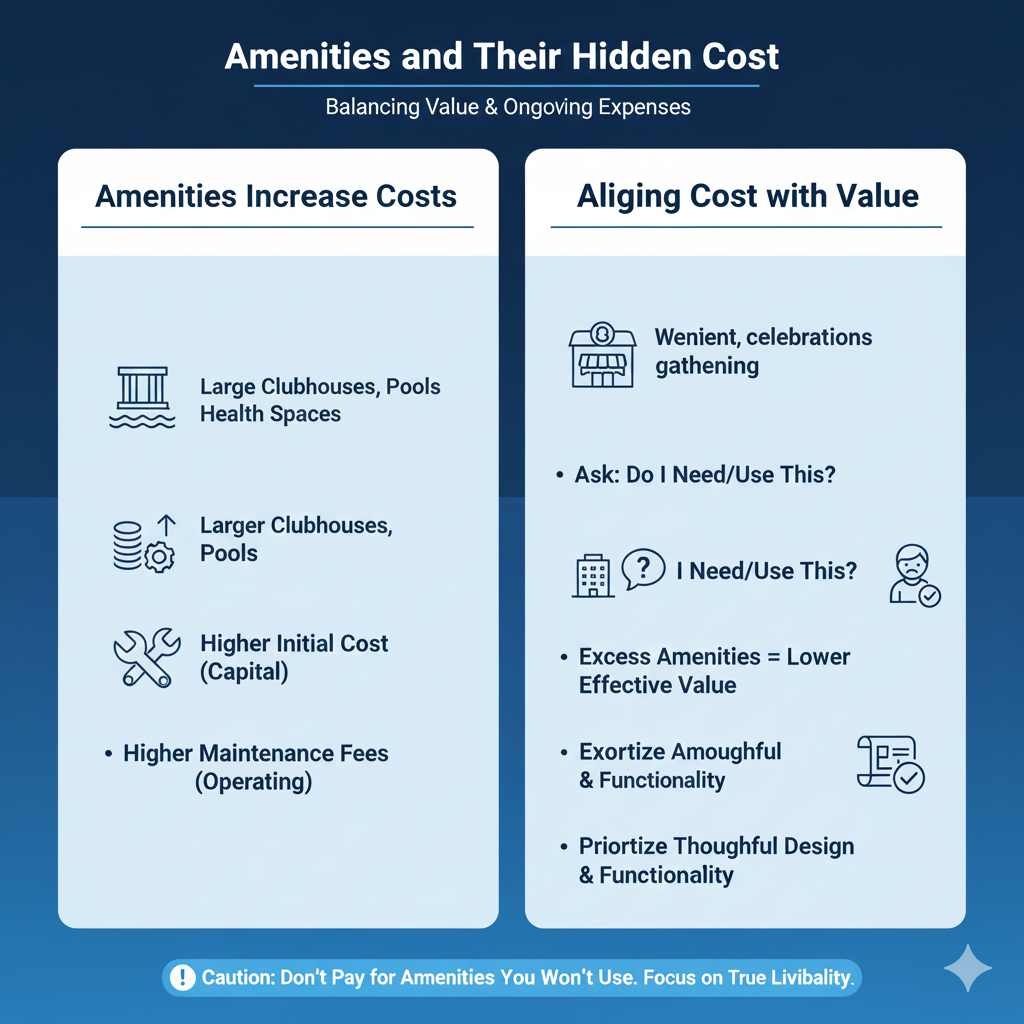
Amenities are not free.
Larger clubhouses, multiple pools, and premium facilities increase both initial cost and long-term maintenance charges.
When calculating price per sq ft, ask whether the amenity scale matches your actual usage. Paying for features you rarely use reduces effective value.
Peaceful, functional living often comes from thoughtful design, not excess amenities.
Red Flags Buyers Should Watch For
Be cautious if:
The builder refuses to share carpet area clearly
Charges are vaguely defined or adjustable later
Price comparisons avoid carpet-area discussion
Discounts are offered without clarity on base pricing
Transparency is a strong indicator of fair pricing.
Why Right Price Is Not Always Lowest Price
The right price per sq ft is the one that reflects:
Fair construction quality
Appropriate location premium
Clear legal status
Sustainable maintenance costs
Cheap pricing with compromised quality or unclear approvals often becomes expensive later.
The goal is value, not bargains.
FAQ
Q1: What should be included in price-per-sq-ft calculations?
A1: Super built-up or carpet area, registration, taxes, and maintenance deposits as relevant to the comparison.
Q2: What should be excluded?
A2: Temporary offers, amenities charges, or add-ons not part of standard property.
Q3: How to compare properties across builders fairly?
A3: Use the same measurement standard (carpet vs super built-up), check layout efficiency, and consider location differences.
Q4: Does higher sq-ft always mean better value?
A4: Not necessarily. Layout efficiency, orientation, and usable space matter more than total sq-ft.
Q5: How do market trends affect price per sq-ft?
A5: Micro-market demand, developer reputation, and infrastructure development influence price beyond area calculation.
Conclusion

Calculating the right price per sq ft requires moving beyond builder brochures and marketing numbers. By including all mandatory costs, excluding irrelevant expenses, and standardizing comparisons based on carpet area, buyers can make informed decisions.
Price per sq ft is a tool. Used correctly, it protects you. Used blindly, it misleads you.
At Relai – For right home, we help buyers evaluate pricing transparently, compare projects fairly, and understand what they are truly paying for before committing.
Let’s Join Together to Bring Change to the World of Real Estate.
Thinking about your next home?
relai scores every project on data, not paid placements, and it's free for buyers.