How the Economics of Hyderabad Real Estate Actually Works

Hyderabad’s real estate market often looks confusing from the outside. Prices rise in some locations even when the wider economy slows. Certain projects sell out quickly, while others struggle for years. For homebuyers, this creates one big question: what is actually driving property prices in Hyderabad, and why does growth feel uneven?
To understand this, you need to look beyond marketing claims and focus on the real economic forces at play. Hyderabad’s property market is not driven by speculation alone. It is shaped by jobs, infrastructure, migration, and how different buyer segments behave.
This article breaks down how Hyderabad real estate really works, which segments grow steadily, which stagnate, and what this means for long-term homebuyers.
1. The Real Demand Drivers Behind Price Growth
At its core, real estate prices grow when end-user demand consistently absorbs supply. In Hyderabad, this demand comes from three primary sources.
First is employment-led demand. Hyderabad has established itself as one of India’s strongest IT and services hubs. According to the Telangana IT & Industries Annual Report, the city employs over 9 lakh people directly in IT and related services, with steady annual additions. Each new job creates housing demand, not just for the employee, but also for rental housing and supporting services.
Second is household formation. As young professionals move from shared rentals to family homes, demand shifts from small apartments to larger units. This transition keeps mid-segment and upper-mid-segment housing active even during slower cycles.
Third is long-term confidence. Hyderabad has earned a reputation for policy stability and relatively predictable governance. This reduces uncertainty for buyers making long-term commitments, which supports price stability even when transaction volumes dip.
Price growth, therefore, is not uniform across the city. It follows where real demand is strongest and most sustainable.
2. Role of IT, Infrastructure, and Migration
IT as the Base Engine
Hyderabad’s IT sector acts as the foundation of the real estate ecosystem. Large employment clusters around Hitec City, Gachibowli, Financial District, and Nanakramguda have created continuous housing demand within commuting distance.
Importantly, this demand is not speculative. Most buyers here are salaried professionals purchasing homes for self-use. This is why prices in western corridors have shown steady appreciation rather than sharp spikes.
Infrastructure as the Growth Multiplier
Infrastructure does not create demand by itself, but it redirects and amplifies existing demand. Projects like the Outer Ring Road, metro expansion, and radial road connectivity have made previously distant areas livable.
For example, areas connected to employment hubs via the ORR have seen higher absorption because they reduce daily travel stress. Infrastructure works best when it shortens real commute time, not just distance.
Migration and Population Inflow
Hyderabad continues to attract migrants from Andhra Pradesh, Telangana districts, and other states. According to Census and urban development estimates, the city adds several lakhs of residents every decade due to migration alone.
This inflow sustains rental demand first, which later converts into ownership demand. Locations with strong rental markets tend to show better long-term resale liquidity.
3. Land Value vs Built Space: Why Prices Behave Differently
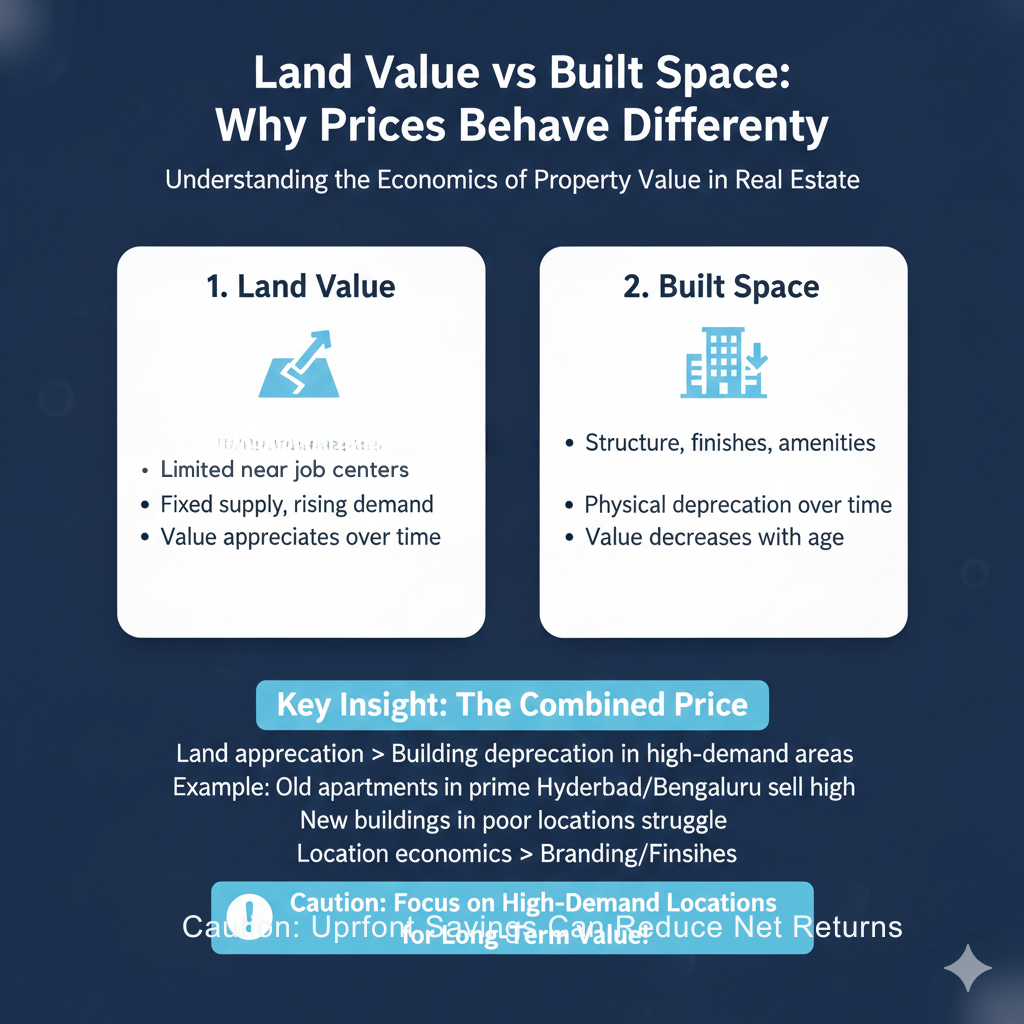
One key economic concept many buyers miss is that land appreciates differently from buildings.
Land near job centers and infrastructure corridors is limited. As demand rises and supply stays fixed, land values increase. Buildings, on the other hand, depreciate physically over time.
In Hyderabad, price growth in apartments largely comes from the underlying land value rather than the structure itself. This explains why:
• Older apartments in prime locations still command high prices
• Newer buildings in poorly connected areas struggle despite better amenities
For homebuyers, this means location economics matter more than project branding or interior finishes.
4. Which Segments Grow Consistently
Mid-Segment Apartments (₹70L–₹1.5Cr)
This is Hyderabad’s most resilient segment. It caters to end-users with stable incomes and genuine housing needs. Demand here remains active across cycles, supporting steady price growth.
Well-Located Gated Communities
Projects offering good connectivity, basic amenities, and reasonable density tend to perform well. Buyers value livability and resale liquidity more than luxury positioning.
Plotted Developments Near Growth Corridors
In select zones with clear infrastructure visibility and legal clarity, plots have shown strong appreciation due to land scarcity. However, this segment requires longer holding periods.
5. Which Segments Often Stagnate
Overpriced Luxury Apartments
Luxury projects without a strong end-user base often depend on investor demand. When sentiment weakens, absorption slows and prices stagnate.
Peripheral Projects Without Real Connectivity
Locations launched purely on future promises tend to struggle if infrastructure timelines slip. Without job access, demand remains weak.
High-Density Projects With Limited Livability
Excessive density impacts resale value. Buyers eventually discount projects that compromise light, ventilation, and open space.
6. What This Means for Long-Term Homebuyers
For end-users, Hyderabad’s real estate economics reward patience and clarity. The safest homes are those aligned with real demand drivers, not hype.
A practical approach includes:
• Prioritising commute time over future price predictions
• Choosing locations with existing job density
• Evaluating livability, not just amenities
• Understanding that slow and steady growth is healthier than sharp spikes
Homes bought with economic logic tend to age better in value and usability.
FAQ Section
Why do some Hyderabad localities appreciate faster than others?
Appreciation depends on job proximity, infrastructure access, and sustained end-user demand. Areas lacking these factors grow slower despite marketing claims.
Is IT the only driver of Hyderabad real estate?
IT is the primary driver, but supporting sectors, infrastructure investment, and migration also play critical roles in sustaining housing demand.
Do all apartments in Hyderabad appreciate over time?
No. Apartments in poorly connected or oversupplied locations may stagnate. Appreciation depends more on location economics than project age.
Is buying on the city outskirts risky?
It can be, unless there is clear infrastructure delivery and nearby employment hubs. Long holding periods are usually required for such locations.
Conclusion
Hyderabad’s real estate market is driven by fundamentals, not speculation alone. Jobs create demand, infrastructure channels it, and land economics determine long-term value. Buyers who understand these forces make better decisions and avoid common traps.
Instead of asking where prices will rise fastest, long-term homebuyers should ask where demand will remain strongest. That is where real value is built.
Let’s Join Together to Bring Change to the World of Real Estate.
Thinking about your next home?
relai scores every project on data, not paid placements, and it's free for buyers.