How Infrastructure Announcements Inflate Prices Before Real Progress

Infrastructure development is one of the biggest drivers of real estate prices in Hyderabad. News about new metro lines, road expansions, or flyovers often triggers an immediate surge in property interest and pricing. Buyers rush to book units “before prices go up,” while developers market the projects heavily, citing future connectivity advantages. However, there is often a significant gap between announcement and execution, and understanding this is critical to making informed decisions.
Announcement vs Execution: The Reality Gap
When a government body announces a new metro route, an Outer Ring Road (ORR) expansion, or a flyover project, it is natural for real estate around the proposed area to spike in price. This is largely speculative, driven by the promise of future convenience and improved connectivity.
The reality, however, is that actual execution often lags far behind announcements. Delays can occur due to land acquisition disputes, environmental clearances, contractor selection, or funding issues. For buyers, this means that paying a premium based on an announcement alone can be risky. Properties often see inflated prices years before the infrastructure materializes, and in some cases, projects may be modified or postponed indefinitely.
ORR, Metro, and Road Expansion Hype
Hyderabad has seen multiple examples of price spikes following infrastructure announcements. The Outer Ring Road has historically driven demand for areas like Narsingi, Kokapet, and Gachibowli. Similarly, metro expansions along the Green Line or Aqua Line immediately increase interest in neighborhoods they are planned to connect.
Developers often use these announcements to justify higher pricing, marketing projects as “future-ready” and “prime investment opportunities.” Buyers, fearing they will miss out, often overpay for units that may take years to see tangible benefits from the infrastructure.
How to Verify On-Ground Work
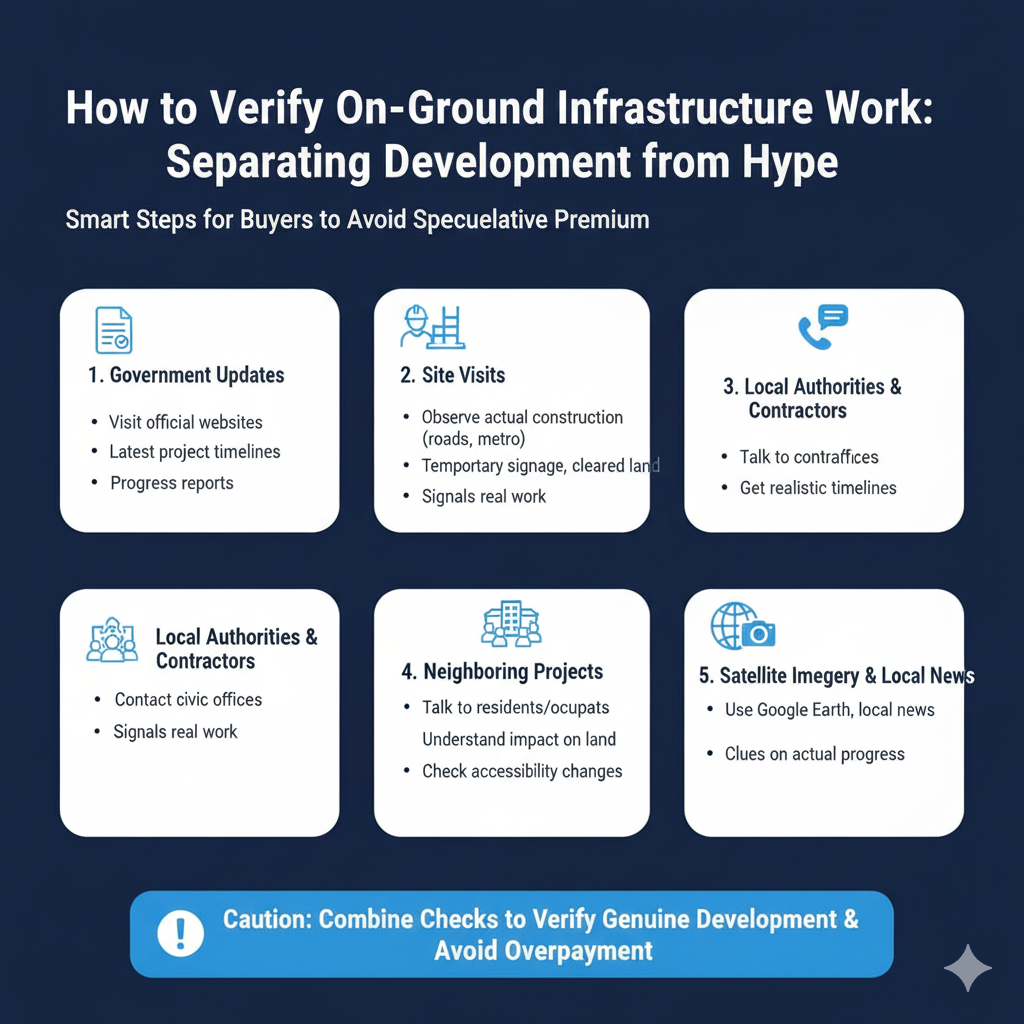
To avoid paying a speculative premium, buyers should verify the actual progress on infrastructure projects. This can be done by:
Checking government updates: Visit official municipal or state transport websites for the latest project timelines and progress reports.
Site visits: Observe whether construction has started on roads, metro stations, or flyovers. Temporary signage or cleared land often signals real work.
Local authorities and contractors: Contact local civic offices or even contractors for realistic timelines.
Neighboring projects: Talk to residents or commercial occupants in the area to understand if construction has impacted land or accessibility.
Satellite imagery and local news: Tools like Google Earth or local news coverage can give clues about actual progress versus announcements.
By combining these checks, buyers can separate genuine development from hype, avoiding overpaying based on speculation.
Risk of Overpaying
Overpaying for a property in anticipation of future infrastructure carries multiple risks. Even if the infrastructure is eventually completed, price appreciation is often already baked into the current rate, leaving little room for further gains. If a project is delayed, buyers may wait years before seeing the promised benefits, and rental demand in the area may remain limited until completion.
Investors and end-users alike need to critically assess whether a premium is justified or if it is mostly driven by hype.
Strategic Buying Decisions
Savvy buyers approach areas with pending infrastructure cautiously. They may choose to:
Wait for visible progress before making a purchase.
Buy units that are fairly priced relative to existing connectivity.
Prioritize areas with multiple supporting amenities or alternate transport options.
By evaluating infrastructure announcements with a practical lens, buyers can make more rational investment or home-buying decisions.
FAQ Section
Q1: Do all infrastructure announcements immediately increase property prices?
A1: Yes, announcements often trigger speculative demand, but the actual impact depends on execution speed and surrounding development.
Q2: How can buyers differentiate hype from real progress?
A2: Site visits, government updates, contractor contacts, and local news are key methods to verify actual infrastructure work.
Q3: Are price spikes always justified by infrastructure?
A3: Not necessarily. Many price increases occur before tangible benefits, and buyers risk overpaying if projects are delayed.
Q4: Should investors avoid areas with only announced infrastructure?
A4: Not entirely. Buying early can yield gains if projects progress on time, but caution and verification are crucial to reduce risk.
Q5: How long does it typically take for announced projects to impact real estate fully?
A5: It can take several years—from 2–5 years or more—for prices to reflect real benefits, depending on project scale and execution speed.
Conclusion

Infrastructure announcements are powerful tools that influence real estate prices, but buyers need to approach them with caution. The difference between hype and execution can lead to overpayment, delayed benefits, and suboptimal investment returns. Understanding the actual progress on ORR expansions, metro lines, and major roads allows buyers to make rational decisions rather than acting on speculative excitement.
At Relai – For right home, we guide buyers to distinguish genuine growth from marketing hype, ensuring every investment or home purchase aligns with real infrastructure development.
Let’s Join Together to Bring Change to the World of Real Estate.
Thinking about your next home?
relai scores every project on data, not paid placements, and it's free for buyers.