Homebuyers Don’t Lose Money on Price. They Lose It on Decisions.

Most homebuyers believe losses happen because they bought at the wrong price. Too expensive. Wrong timing. Missed the bottom.
In reality, price is rarely the real problem.
Across Indian cities, buyers lose money, time, and peace of mind because of poor decisions made before the price was even discussed. Emotional shortlisting, rushed comparisons, and overthinking the wrong variables quietly create regret — even in rising markets.
The biggest risks in real estate are not market risks. They are decision risks.
Emotional Buying vs Structured Decision-Making
Buying a home is emotional. That’s normal. It’s where life happens.
But problems start when emotion replaces structure.
Emotional buying usually looks like this:
Falling in love with a sample flat
Anchoring to a view, floor, or brand name
Rushing because “prices will go up”
Ignoring trade-offs because it feels right
Structured decision-making looks different:
Clear priorities before site visits
Defined budget comfort, not bank eligibility
Comparison across locations, not just projects
Time built in for verification, not impulse
Emotion should guide what you want.
Structure should guide what you choose.
When buyers skip structure, even a fairly priced home can become a bad decision.
Where Most Buyers Go Wrong While Shortlisting
The costliest mistakes usually happen during shortlisting, not negotiation.
1. Starting with Projects Instead of Constraints
Buyers often start by browsing listings or visiting sites before answering basic questions:
How long will I realistically live here?
What monthly outflow feels safe, not stretched?
What compromises am I unwilling to make?
Without constraints, every attractive option feels viable — until none truly fit.
2. Comparing Unlike Options
Buyers compare:
A premium project far away vs a mid project closer
A ready home vs an under-construction promise
A brand-name builder vs a stronger location
These comparisons feel logical but lack a common framework, leading to confusion and delay.
3. Overweighting Visual Appeal
Good lighting, staging, and amenities influence perception more than:
Daily usability
Maintenance burden
Noise, heat, or access issues
What looks perfect for 20 minutes can disappoint for 10 years.
Why Over-Optimisation Creates Regret
Many buyers believe that if they evaluate everything deeply enough, they’ll find the “perfect” home.
That belief causes harm.
Over-optimisation happens when buyers:
Keep expanding criteria endlessly
Delay decisions chasing marginal upgrades
Reject good options for tiny perceived flaws
Switch priorities midway through the process
Real estate doesn’t reward perfection. It rewards fit.
Every home involves trade-offs:
Space vs location
Price vs convenience
Ready vs future upside
Buyers who try to optimise every variable often end up:
Buying late at higher prices
Settling under pressure
Or not buying at all and losing opportunity
Regret usually comes from overthinking the wrong things, not missing the perfect deal.
The Hidden Cost of Unstructured Decisions
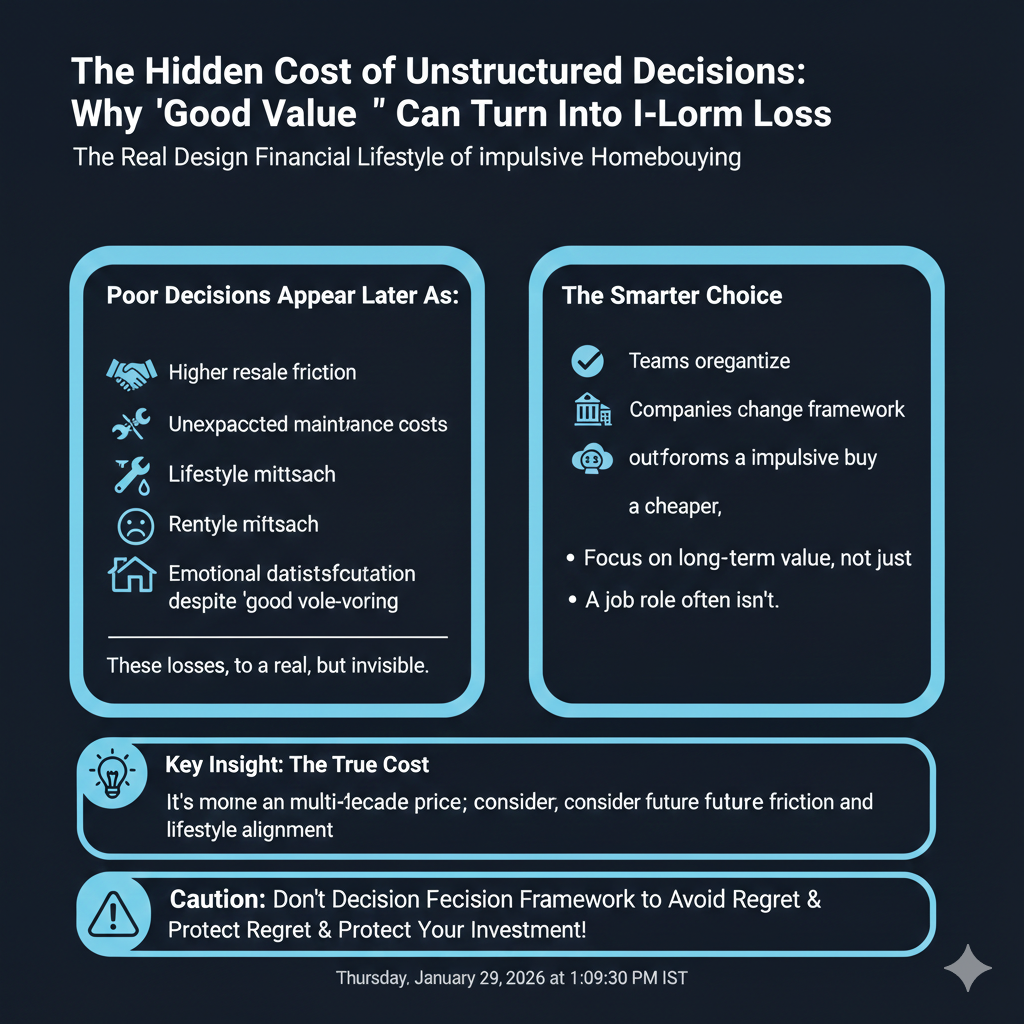
Poor decisions don’t always show up immediately. They surface later as:
Higher resale friction
Unexpected maintenance costs
Lifestyle mismatch
Rental difficulty
Emotional dissatisfaction despite “good value”
These losses rarely appear in price charts, but they are very real.
A home bought slightly higher with the right decision framework often outperforms a cheaper home bought impulsively.
How Decision Frameworks Reduce Risk
Smart buyers don’t rely on instinct alone. They use simple decision frameworks.
1. Separate Needs, Wants, and Nice-to-Haves
Needs are non-negotiable.
Wants are flexible.
Nice-to-haves are bonuses.
Most regret happens when buyers treat wants as needs.
2. Fix the Exit Lens Early
Ask:
Who would buy or rent this after me?
Does this location have multiple demand drivers?
Is resale dependent on one office, one builder, or one phase?
A home with a clear future audience reduces downside risk.
3. Evaluate Location Before Project
Projects age. Locations don’t.
Decision frameworks always start with:
Connectivity
Livability
Demand stability
Infrastructure reality, not announcements
A good project in a weak location rarely recovers.
4. Limit Options Intentionally
Too many choices increase anxiety and reduce decision quality.
Strong frameworks narrow options early so energy is spent deciding well, not browsing endlessly.
Why Price Feels Like the Villain
Price becomes the villain because it’s the easiest thing to blame.
It’s harder to admit:
I rushed
I ignored red flags
I changed priorities midway
I didn’t define my decision rules clearly
Markets move. Prices fluctuate. That’s normal.
But bad decisions compound. Even in a rising market, a poorly chosen home underperforms expectations.
What This Means for Today’s Buyers
In cities like Hyderabad and Bengaluru:
Multiple micro-markets compete simultaneously
Hybrid work has changed location logic
Supply quality varies widely within the same price band
This environment rewards buyers who decide systematically, not emotionally.
The winners are not those who buy cheapest, but those who buy right for their situation.
FAQ Section
Does this mean price doesn’t matter at all?
Price matters, but it’s a consequence of decisions, not the starting point.
Can structured decisions remove all risk?
No. But they significantly reduce avoidable risk and regret.
Is emotional buying always bad?
No. Emotion should guide intent, not override evaluation.
What’s the biggest mistake buyers make?
Confusing excitement with suitability.
Conclusion

Homebuyers don’t lose money because prices move. They lose money because decisions are rushed, unstructured, or emotionally overloaded.
The safest real estate purchases are not the cheapest or the most popular. They are the ones made with clear priorities, realistic trade-offs, and simple decision frameworks.
When buyers decide well, price becomes manageable.
When buyers decide poorly, no price feels right.
In real estate, decisions create outcomes — price only reflects them.
Let’s Join Together to Bring Change to the World of Real Estate.
Thinking about your next home?
relai scores every project on data, not paid placements, and it's free for buyers.