Homebuyer Protection Laws in India: How Safe Are You Really?

Buying a home in India is often the biggest financial decision a person makes. Over the years, several laws have been introduced to protect homebuyers from delays, fraud, and unfair practices. On paper, these laws look strong. In reality, many buyers still struggle with delayed possession, unclear agreements, and weak enforcement.
So how safe are you really as a homebuyer in 2026? This article breaks down what protections buyers actually get, where the gaps exist, and what loopholes you must watch out for before committing your money.
Why Homebuyer Protection Laws Were Introduced
For decades, Indian real estate functioned largely in favor of developers. Buyers paid large amounts upfront, timelines were flexible, and accountability was weak. Disputes dragged on for years, and most buyers had little bargaining power.
To correct this imbalance, the government introduced reforms to bring transparency, discipline, and buyer confidence into the sector. The most important of these is RERA, supported by existing contract and consumer protection laws.
However, laws alone do not guarantee safety. How they are applied matters more.
What Legal Protection Buyers Actually Get
At a broad level, homebuyers are protected under multiple laws that work together.
RERA gives buyers the right to clear project information, defined possession timelines, and penalties for delays. Developers must register projects, disclose approvals, layouts, and timelines publicly. Changes to plans cannot be made without buyer consent.
Under the Consumer Protection Act, homebuyers are considered consumers. This allows buyers to approach consumer courts for deficiency of service, unfair trade practices, and misleading advertisements.
The Indian Contract Act ensures that agreements must be fair, lawful, and not one-sided. Clauses that are excessively biased can be challenged in court.
On paper, this framework gives buyers strong rights. In theory, a delayed or misleading project should result in compensation or refunds.
The Gap Between Law and Reality
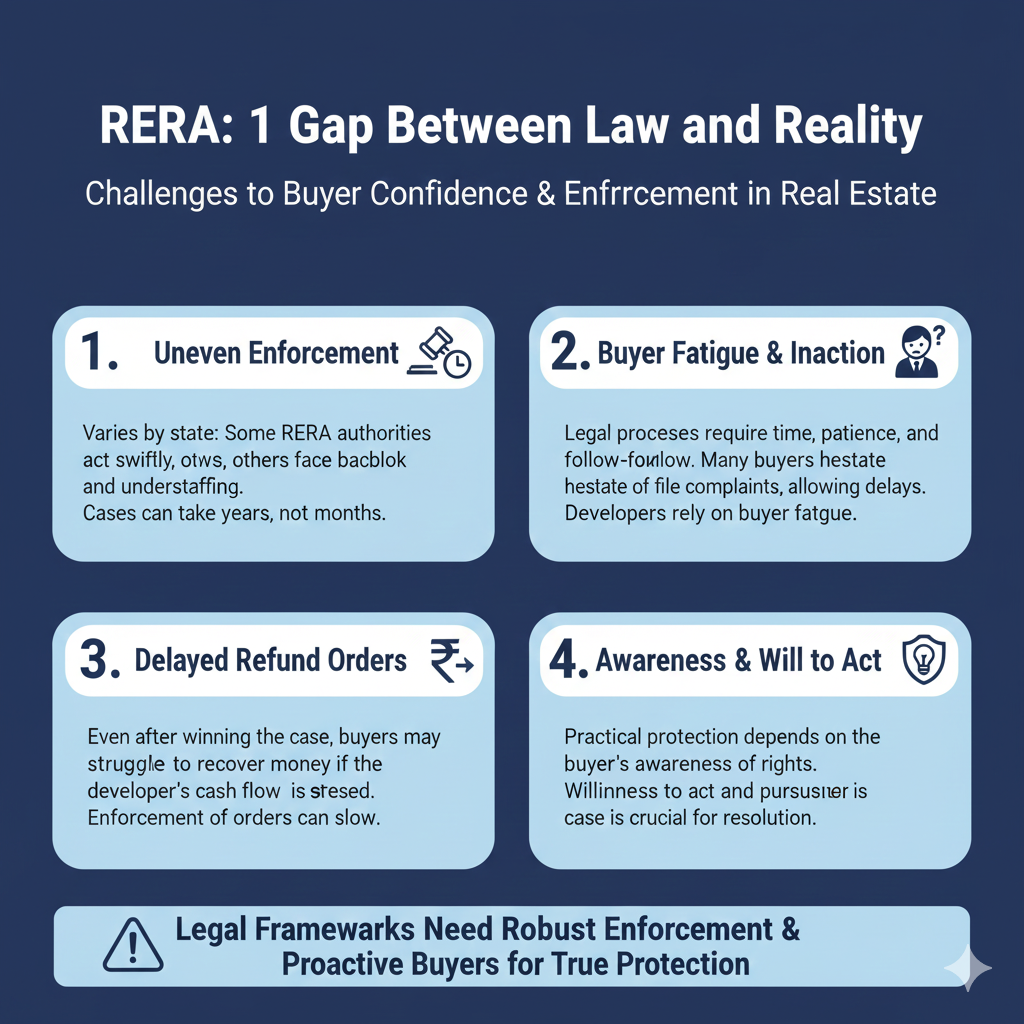
This is where buyer confidence often breaks down.
While RERA mandates timelines, enforcement varies across states. Some RERA authorities act swiftly, while others face backlog, understaffing, or slow adjudication. Cases that should take months sometimes take years.
Another reality is that many buyers hesitate to file complaints. Legal processes, even under RERA, require time, patience, and follow-up. Developers often rely on this fatigue, knowing many buyers will wait rather than fight.
Refund orders also face delays. Even after winning a case, buyers may struggle to actually recover money if the developer’s cash flow is stressed.
So while the law exists, the practical protection depends on the buyer’s awareness and willingness to act.
Common Loopholes Buyers Must Watch Out For
One major loophole is pre-RERA or partially compliant projects. Some developers launch marketing or accept bookings before full registration. Buyers assume protection applies automatically, but legal coverage becomes weaker if the project is not properly registered at the time of booking.
Another issue is ambiguous possession clauses. Agreements may mention possession timelines with flexible language like “subject to approvals” or “subject to force majeure.” These clauses are often used to justify long delays.
Buyers also overlook carpet area definitions. While RERA standardizes carpet area, some agreements still use confusing terminology during sales discussions. Final handover may feel smaller than expected if buyers did not verify sanctioned plans.
There is also the issue of exit penalties. Many agreements penalize buyers heavily for cancellation, while developer delays attract minimal compensation. Although courts increasingly strike down such imbalance, buyers still face practical difficulty enforcing fairness.
Another loophole lies in amenity dilution. Clubhouses, open spaces, and features promised at launch may be modified later under the excuse of regulatory or design changes. Buyers often realize this only at possession.
How Delays Are Justified Legally
Most developers rely on force majeure clauses to justify delays. While genuine events like natural disasters or policy bans qualify, the term is often stretched to cover internal mismanagement or funding issues.
Buyers should understand that not every delay is legally acceptable. Courts have repeatedly ruled that routine approval delays or contractor issues are not force majeure.
However, unless buyers challenge these claims formally, such delays go uncontested.
Are Refunds Really Easy Under RERA?
RERA allows buyers to seek refunds with interest for delayed possession. This sounds reassuring, but execution is not always smooth.
If a project is financially stressed, refund orders may remain unpaid for long periods. Buyers then have to pursue recovery proceedings, which again take time.
In practice, RERA works best as a pressure tool rather than a quick exit route. Buyers who engage early and collectively often see better outcomes than isolated complainants.
What Buyers Can Do to Actually Stay Safe
Legal protection works best when combined with buyer discipline.
Before booking, always check whether the project is RERA registered and verify details directly on the official portal. Do not rely on brochures or verbal assurances.
Read the agreement carefully, especially possession timelines, exit clauses, and penalty sections. If terms feel heavily tilted, that is a signal, not a coincidence.
Track construction progress and approvals periodically instead of waiting passively. Delays caught early are easier to address.
Avoid over-leveraging. Buyers under financial pressure are more likely to accept delays quietly.
Finally, remember that brand reputation matters. Developers with consistent delivery records face fewer disputes not because laws favor them, but because their systems are stronger.
The Psychological Trap Buyers Fall Into
Many buyers hesitate to confront developers because they fear confrontation or believe delays are normal. This mindset weakens buyer protection more than any legal loophole.
Protection laws are not automatic shields. They work only when buyers assert them.
Being informed is not about becoming aggressive. It is about being prepared.
The Real Answer: How Safe Are You?
Homebuyers in India today are safer than they were a decade ago. Transparency has improved, information is accessible, and legal options exist.
But safety is not absolute.
Laws reduce risk. They do not eliminate it.
Your real safety depends on:
• choosing the right project
• understanding agreements
• monitoring progress
• acting early when issues arise
At Relai – For right home, we help buyers evaluate projects not just on price or promises, but on legal strength, execution history, and real-world risk. Because true protection comes from clarity, not assumptions.
FAQ
Q1: What protections does a homebuyer have under Indian law?
A1: RERA registration, builder accountability, timely possession, clear titles, and disclosure of project details.
Q2: Are all protections equally effective in practice?
A2: No. Enforcement can vary, and buyers may still face delays or legal challenges despite protections.
Q3: What common loopholes should buyers watch for?
A3: Undisclosed floor plans, extra charges, incomplete approvals, and ambiguous handover clauses.
Q4: How can buyers reduce legal risk?
A4: Verify RERA registration, legal titles, approvals, and builder history before booking.
Q5: Does legal protection cover resale or rental disputes?
A5: Not fully. Legal protections primarily cover developer-buyer obligations during the initial purchase.
Conclusion

Homebuyer protection laws in India are strong on paper, improving every year. But the gap between rights and results still exists. Buyers who rely blindly on the law often face disappointment, while those who understand both protection and loopholes make safer decisions.
The safest homebuyer is not the one who trusts the system blindly, but the one who understands how it actually works.
Let’s Join Together to Bring Change to the World of Real Estate.
Thinking about your next home?
relai scores every project on data, not paid placements, and it's free for buyers.