Growth of SM REITs: How Small and Medium Real Estate Investment Trusts Are Unlocking Commercial Real Estate
Introduction
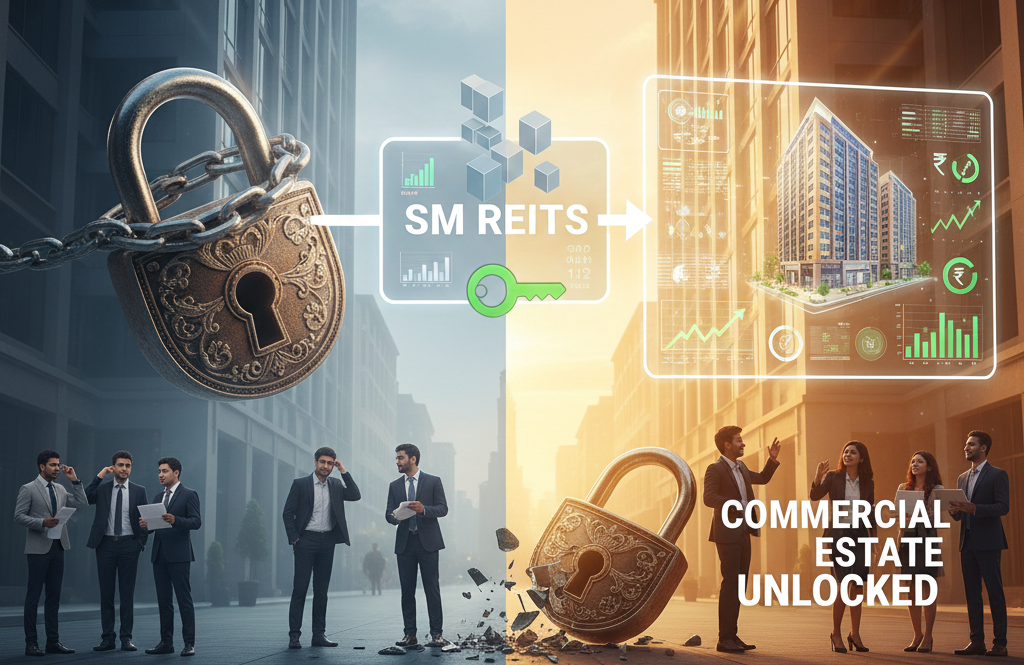
Small and Medium Real Estate Investment Trusts (SM REITs) are emerging as a powerful engine reshaping commercial real estate investment in India. With the SM REIT market projected to exceed USD 75 billion, supported by 500+ million sq ft of office, logistics and retail assets, this model is enabling fractional ownership — bringing institutional-grade real estate within reach of a broader investor base.Economic Times
In this blog, we examine the drivers behind the growth of SM REITs, their benefits, and what this means for investors and the broader real estate ecosystem.
Why SM REITs Are Gaining Momentum
1. Large asset base unlocking potential value
According to a recent report by CBRE South Asia, SM REIT-eligible assets already exceed 500 million sq ft, covering office, logistics and retail properties. Hindustan Times+1
This stock — previously illiquid or confined to private ownership — is now poised for monetisation under a regulated, transparent framework.
Earlier estimates by CBRE had placed the potential at USD 60 billion by 2026, covering over 300 million sq ft of completed commercial office space, with additional space expected to come online. CBRE+2CBRE+2
The upward revision to USD 75 billion reflects accelerating interest and growing supply readiness.
2. Fractional ownership democratizing real estate investment
SM REITs allow investors to buy units rather than entire properties — enabling fractional ownership of mid-sized commercial assets. This means smaller investors can access institutional-grade real estate without needing huge capital. India Brand Equity Foundation+2The Economic Times+2
This democratization could significantly broaden the investor base and bring greater liquidity and transparency to commercial real estate.
3. Regulatory support and formalization under REIT framework
With guidelines for SM REITs in place, previously unstructured assets — such as strata-sold offices and logistics/retail buildings — can now enter a regulated REIT structure. This helps in institution-style governance, standard lease practices, and regular distributions to unitholders. CBRE+2Colliers+2
This formalization increases investor confidence, reduces risk, and aligns real estate investment with broader capital markets.
What SM REIT Growth Means for Investors and the Market
Benefits for Investors
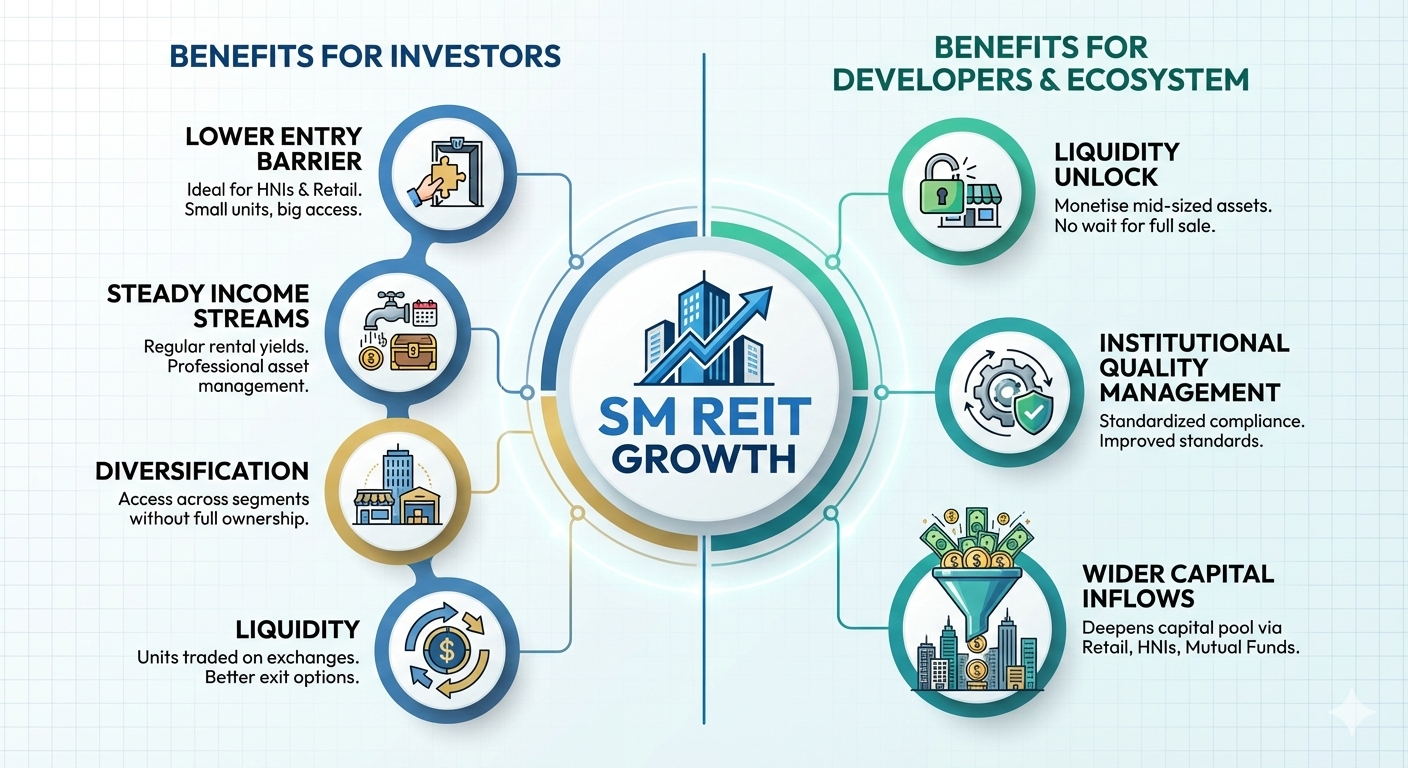
Lower entry barrier: Instead of large capital outlays, investors can buy units — ideal for HNIs and retail investors.
Steady income streams: Income-generating commercial assets, with regular rental yields and professional asset management.
Diversification: Access to different real estate segments — office, retail, logistics — without owning entire property.
Liquidity: Units traded on exchanges allow better liquidity compared to traditional direct real estate ownership.
Benefits for Developers and the Real Estate Ecosystem
Liquidity unlock for under-leveraged assets: Developers can monetise mid-sized assets without waiting for full sale or long-term leases.
Institutional quality management: With REIT compliance, assets get standardized and better managed — improving overall real estate standards.
Wider capital inflows: Entry of retail, HNIs and possibly mutual funds (over time) increases depth of capital in commercial real estate.
Market-level Impact: Formalization & Growth of Commercial Real Estate
The large pipeline of eligible assets — over 500 million sq ft — suggests that SM REITs could significantly raise the institutional fraction of India’s commercial real estate. This could lead to better transparency, improved asset efficiency, and more stable returns across the sector.
Additionally, by distributing ownership broadly and introducing regulated structures, SM REITs may reduce reliance on opaque, high-leverage real estate deals, making commercial real estate more resilient and investible.
Key Challenges and Considerations
# | Challenge / Risk | Notes |
1 | Asset quality & lease stability | For REITs to work well, assets need stable tenants, good occupancy, and standard lease agreements. Poor-quality or highly vacated assets may underperform. |
2 | Regulatory and compliance requirements | SM REIT regulations demand transparency, periodic disclosures, and compliance — which can increase operational costs. |
3 | Market understanding and investor education | Many retail investors may not yet understand REITs or fractional ownership in real estate; need education and trust-building. |
4 | Liquidity risk | While REIT units are tradable, trading volumes may be lower initially compared to traditional equity markets. |
These challenges are not insignificant — but the structural advantages of SM REITs make them a compelling, long-term proposition for many stakeholders.
Current and Future Outlook (2025–2030)
With the latest projection of USD 75 billion market value and 500 million+ sq ft eligible assets, SM REITs are no longer niche — they are becoming a cornerstone of India’s commercial real estate future. Hindustan Times+1
As more strata-owned offices, logistics parks, and mid-sized retail assets transition into REIT format, expect increased participation from retail investors, HNIs, and possibly institutions.
Over the mid-term, this could lead to improved real estate liquidity, better governance, and a more mature capital-market link between real estate and financial investors.
Investors looking for stable, income-generating assets with moderate risk and reasonable capital may find SM REITs a very attractive addition to their portfolio.
FAQ Section
Q: What exactly qualifies as an “SM REIT” asset?
A: SM REIT assets are generally mid-sized commercial properties — such as office buildings, logistics/warehouse facilities, or retail spaces — often in the range of ₹50 crore to ₹500 crore in asset value. SM REITs allow fractional ownership of these assets. The Economic Times+1
Q: How big is the SM REIT market expected to get in India?
A: According to CBRE South Asia, the SM REIT market in India is projected to exceed USD 75 billion, supported by over 500 million sq ft of eligible commercial assets across office, logistics and retail sectors. Hindustan Times+1
Q: What kind of investors can participate in SM REITs?
A: Because of fractional ownership and lower entry barriers, SM REITs enable a wide range of investors — retail investors, high-net-worth individuals (HNIs), and institutional investors — to invest in commercial real estate assets that were earlier accessible only to large players.
Q: What are the main risks associated with investing in SM REITs?
A: Key risks include asset-level risks (tenant vacancy, lease instability), regulatory/compliance burden, potential low trading liquidity of REIT units initially, and the need for investor understanding about REIT structure.
Q: How is SM REIT different from traditional REITs or direct property investment?
A: SM REITs focus on mid-sized commercial assets with fractional ownership — unlike traditional REITs that typically deal with large-scale properties. Compared to direct property investment, SM REITs offer lower capital requirement, better liquidity, professional asset management and regulatory oversight.
Conclusion

The rise of SM REITs marks a pivotal shift in how commercial real estate is owned, funded, and managed in India. With projections of USD 75 billion market value and over 500 million sq ft of eligible assets, SM REITs are opening doors for retail and institutional investors alike to participate in income-generating commercial assets. The democratization of ownership, improved liquidity, and regulated structure make SM REITs an attractive, future-ready option for real estate investment.
As India’s real estate market matures, SM REITs could play a key role in formalizing and institutionalizing mid-sized commercial assets — making them accessible beyond large developers or corporates. For investors seeking stable yield, diversification, and exposure to real estate without the burdens of direct property management, SM REITs offer a compelling path forward.
If you’re curious about how such opportunities can fit into your investment strategy — or want to understand REIT fundamentals more deeply — check out resources on our site atrelai.world. Let’s Join Together to Bring Change to the World of Real Estate
Thinking about your next home?
relai scores every project on data, not paid placements, and it's free for buyers.