Fractional Real Estate Investing in India: Worth the Hype?

Over the last few years, fractional real estate investing has gained attention in India. It promises access to commercial properties with small ticket sizes, professional management, and passive income. For many first-time and retail investors, it sounds like a shortcut into high-quality real estate.
But real estate rewards clarity more than convenience. Before treating fractional ownership as the next big opportunity, it is important to understand how it actually works, where returns come from, and what risks often remain underplayed.
This article breaks down fractional real estate investing in simple terms and helps you decide whether it fits your financial goals.
1. How Fractional Ownership Actually Works
Fractional real estate investing allows multiple investors to collectively own a single commercial property. Instead of buying the entire asset, each investor purchases a fraction, usually through a special purpose vehicle (SPV).
Here is how the structure typically works:
• A platform identifies and acquires a commercial property, usually office space or warehouses
• The asset is placed under an SPV
• Investors buy units of the SPV, representing proportional ownership
• Rental income is distributed based on ownership share
• The property is sold after a fixed or flexible holding period
On paper, this looks similar to owning commercial real estate without the operational burden. In reality, investors are buying a financial structure backed by real estate, not direct ownership in the traditional sense.
2. Why Fractional Investing Looks Attractive
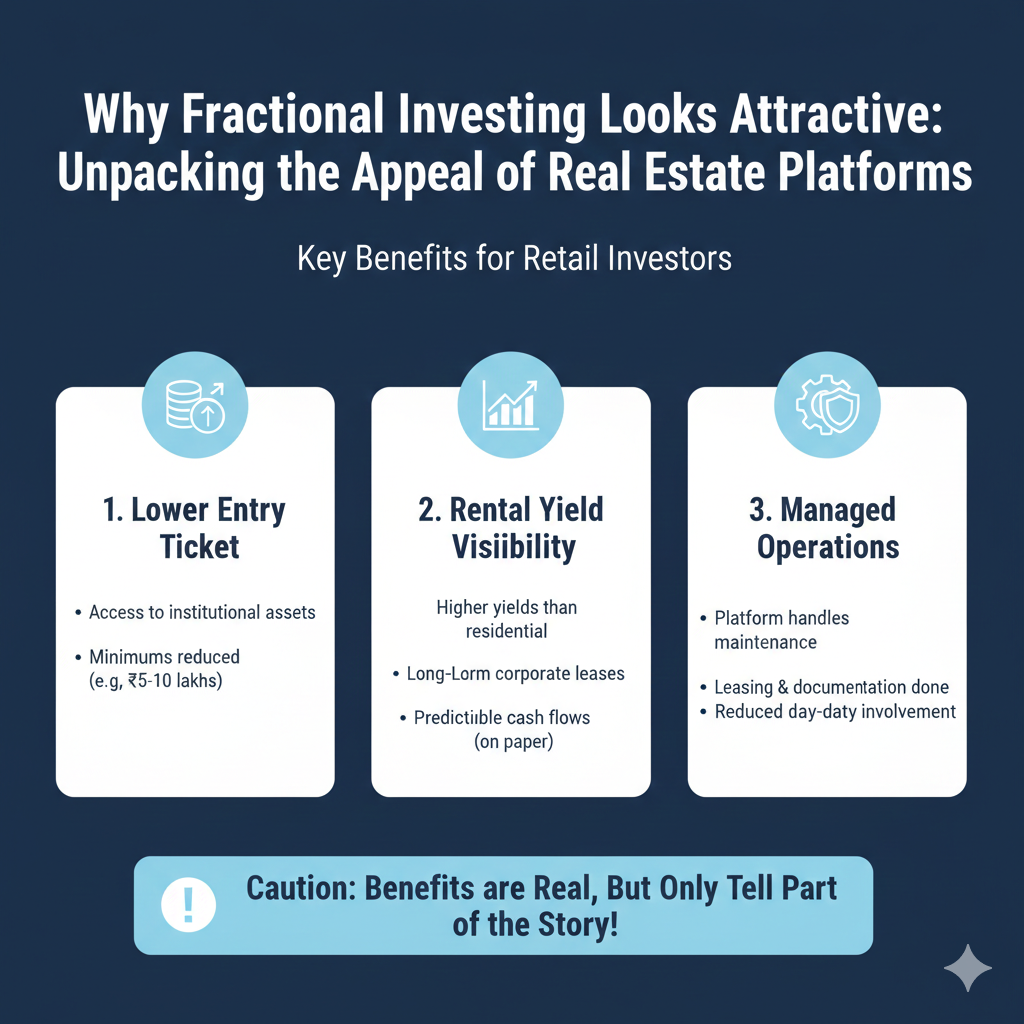
Fractional platforms position themselves as a bridge between retail investors and institutional-grade assets. The appeal usually comes from three factors.
Lower Entry Ticket
Traditional commercial real estate often requires large capital outlays. Fractional investing reduces this barrier, with minimum investments ranging from a few lakhs to a few tens of lakhs.
Rental Yield Visibility
Commercial properties generally offer higher rental yields than residential assets. Long-term leases with corporate tenants create predictable cash flows, at least on paper.
Managed Operations
Maintenance, leasing, and documentation are handled by the platform, reducing day-to-day involvement for investors.
These benefits are real, but they only tell part of the story.
3. Returns: What Investors Actually Earn
Fractional real estate returns come from two sources: rental income and capital appreciation.
Rental yields in Indian fractional deals typically range between 6% and 9% annually, depending on asset quality, tenant strength, and lease terms. Capital appreciation depends on market cycles, demand for commercial assets, and exit timing.
However, net returns are often lower than headline numbers due to:
• Platform management fees
• Asset management and legal costs
• Vacancy risk between lease renewals
• Exit-related expenses
Unlike residential real estate, commercial assets are more sensitive to economic slowdowns. When businesses cut costs, leasing demand weakens, directly affecting rental income.
4. Exit Options and Liquidity Reality
Liquidity is one of the most misunderstood aspects of fractional ownership.
Most platforms offer exits through:
• Sale of the entire property after a defined period
• Secondary sale of fractions to other investors
In practice, exits depend heavily on market conditions. Secondary markets are still shallow in India, and finding buyers at expected valuations is not guaranteed.
Unlike listed financial products, fractional units cannot be exited instantly. Investors should be prepared for longer holding periods and delayed exits, especially during market downturns.
5. Risks That Often Get Underplayed
Structure and Control Risk
Investors do not have full control over asset decisions. Key actions such as refinancing, leasing terms, or sale timing are platform-driven.
Tenant Concentration Risk
Many fractional deals rely on a single large tenant. If the tenant exits or renegotiates aggressively, returns can drop sharply.
Regulatory and Legal Complexity
Fractional ownership structures are still evolving in India. Regulatory clarity continues to improve, but investors must rely heavily on platform governance and compliance standards.
Market Cycle Risk
Commercial real estate values fluctuate with business confidence. Unlike residential homes, recovery periods can be longer after downturns.
6. Who Should Consider Fractional Investing
Fractional real estate may suit investors who:
• Already own residential property
• Want exposure to commercial real estate without large capital commitments
• Are comfortable with medium-to-long-term lock-ins
• Understand that returns are not guaranteed
It works best as a portfolio diversifier, not a core investment.
7. Who Should Avoid It
Fractional investing may not be suitable for:
• First-time investors with limited savings
• Buyers seeking guaranteed liquidity
• Investors uncomfortable with complex structures
• Those relying on steady monthly income for expenses
For such investors, simpler and more transparent assets often offer better peace of mind.
FAQ Section
Is fractional real estate investing safe in India?
It carries risks like any investment. Safety depends on asset quality, tenant strength, platform governance, and market conditions.
Can I exit fractional investments anytime?
Exits are possible but not always immediate. Liquidity depends on buyer availability and market sentiment.
Are returns from fractional real estate guaranteed?
No. Rental income and appreciation depend on tenant performance and commercial real estate cycles.
Is fractional investing better than buying a home?
They serve different purposes. Homes offer utility and emotional security, while fractional investing is purely financial.
Conclusion
Fractional real estate investing is neither a shortcut to wealth nor a trap by default. It is a structured way to access commercial property with shared ownership, accompanied by shared risks.
For investors who understand the trade-offs, it can play a supporting role in a diversified portfolio. For others, especially those new to real estate, traditional ownership remains simpler and more transparent.
The real question is not whether fractional investing is popular, but whether it aligns with your risk tolerance and long-term goals.
Let’s Join Together to Bring Change to the World of Real Estate.
Thinking about your next home?
relai scores every project on data, not paid placements, and it's free for buyers.