Emerging Cities as Commercial Hotspots: India’s Next Wave of High-Growth Markets
Emerging Cities as Commercial Hotspots: India’s Next Wave of High-Growth Markets
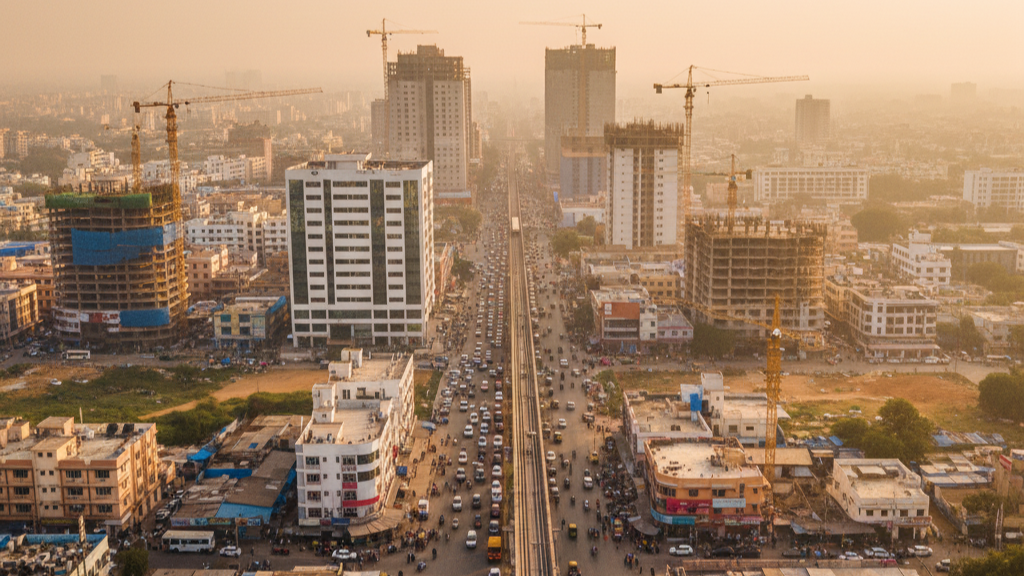
India’s commercial real estate landscape is shifting rapidly. For decades, Bengaluru, Hyderabad, Delhi NCR, Mumbai, Pune, and Chennai dominated office absorption, technology hiring, and corporate expansion. But in the last few years, a major transition has begun—Tier-2 and Tier-3 cities are becoming powerful commercial hubs, attracting both domestic and global companies.
Cities such as Chandigarh Tricity, Jaipur, Lucknow, Indore, Nagpur, Kochi, Coimbatore, Surat, and Bhubaneswar are now shaping the future of India’s balanced economic growth. This shift is driven by infrastructure improvements, strong talent supply, reduced costs, and nationwide digital connectivity.
According to the Knight Frank India Commercial Market Update 2024, India’s non-metro cities recorded a 12% year-on-year expansion in commercial activity, outpacing several major metros in relative growth. These emerging markets are collectively contributing to nearly ₹10 lakh crore of economic output, showing how deeply commercial activity is spreading across the country.
Why Tier-2 and Tier-3 Cities Are Growing Faster
Corporate India is no longer focused only on the largest metros. Several forces are pushing businesses to diversify into emerging cities:
– Lower operating costs
– Strong talent pools from regional engineering and management colleges
– Renewed demand for distributed offices after the pandemic
– Growth of hybrid and hub-and-spoke workplace models
– High-quality infrastructure created under the Smart Cities Mission
– Government incentives for industries, logistics, and IT services
This combination is creating a new landscape where growth is more evenly distributed across regions, not concentrated in six large metros.
Grade A Office Supply Is Expanding Rapidly
One of the biggest indicators of commercial confidence is the supply of Grade A office stock. Emerging cities are seeing major increases, driven by both national developers and regional groups.
As per Colliers India Office Market Insights 2024, Tier-2 and Tier-3 cities are expected to add:
– 70 million sq ft of Grade A office space over the next 4–5 years
– 80 million sq ft of logistics and warehousing capacity, boosted by e-commerce and manufacturing
This is unprecedented scale. These numbers reflect how both tech and non-tech companies are planning long-term expansion into new geographies.
Cost Advantages Are Attracting Corporates
Large companies are increasingly evaluating emerging cities due to significant cost benefits:
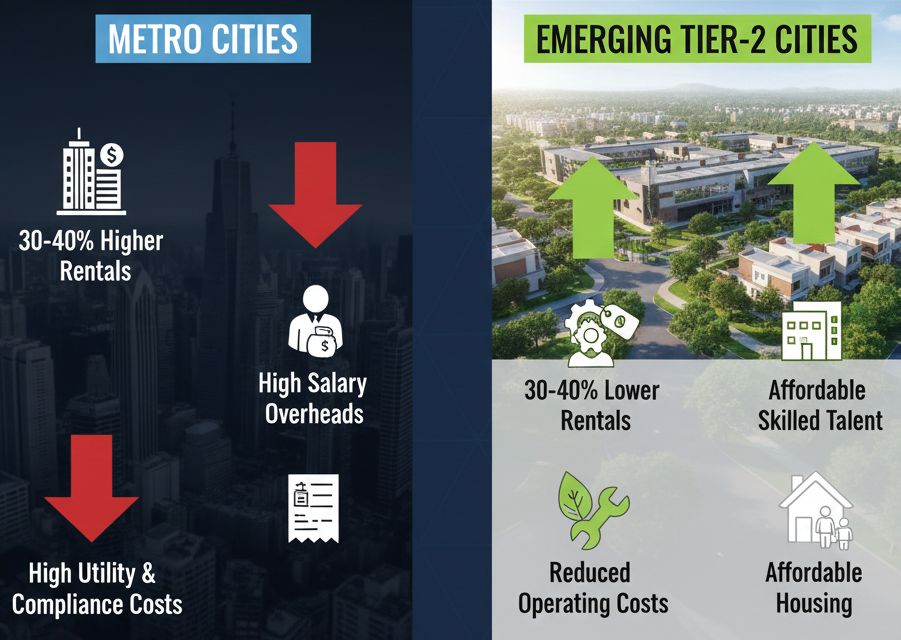
– 30–40% lower rentals compared to metros
– Lower salary overheads, without compromising on skilled talent
– Reduced utility and compliance costs
– Affordable housing, making it easier to attract and retain employees
These financial advantages help companies expand operations without the high burden of metro-level costs.
Talent Availability Is a Key Driver
India’s educational network is one of its biggest strengths. Engineering, IT, management, and design colleges across Uttar Pradesh, Rajasthan, Punjab, Madhya Pradesh, Tamil Nadu, and Kerala are producing high-quality talent that no longer wants to migrate to metro cities.
Cities like Indore, Lucknow, Jaipur, and Coimbatore are seeing strong retention because:
– Salaries go further
– Commute times are shorter
– Quality of life is higher
– Housing is more affordable
This talent advantage is encouraging companies to build offices closer to where the workforce already lives.
Chandigarh, Jaipur, Lucknow, and Nagpur Are Leading the Charge
These cities have emerged as front-runners due to their infrastructure and business readiness:
Chandigarh Tricity
A strong services economy, high literacy rates, planned infrastructure, and proximity to Punjab, Haryana, and Himachal Pradesh make it ideal for IT, consulting, and back-office operations.
Jaipur
Massive road connectivity, booming tourism, and increasing interest from tech and BPO firms make Jaipur one of the most dynamic emerging commercial markets.
Lucknow
Supported by the Purvanchal region’s growing economy, Lucknow is becoming a major IT/ITeS and services hub with strong government support.
Nagpur
Central location, multimodal logistics hub status, and rapid warehousing expansion under the NADP (Nagpur Airport Development Plan) make Nagpur a major logistics and industrial centre.
These cities represent the broader pattern of growth now visible across India.
Logistics and Industrial Growth Are Fueling Commercial Demand

Beyond office markets, India’s industrial and logistics landscape is expanding heavily into emerging cities. The rise of e-commerce, D2C brands, domestic manufacturing, and FMCG distribution is increasing demand for warehousing and last-mile delivery hubs.
Under the National Logistics Policy 2022 and Smart Cities programme, several cities now host modern logistics parks with:
– Grade A warehouses
– Multimodal transport nodes
– High-capacity road networks
– Technology-enabled supply chain systems
This combination is creating jobs, attracting investments, and accelerating overall commercial activity.
The Smart Cities Mission Is a Major Enabler
The Smart Cities Mission, launched in 2015, has upgraded dozens of emerging cities with:
– Better drainage and water systems
– Intelligent traffic and mobility solutions
– Digital command centres
– Revamped city cores
– Transit-oriented planning
These upgrades directly contribute to commercial readiness. Businesses choose locations with reliable infrastructure, safety, responsiveness, and long-term planning—areas where Smart Cities are showing clear improvement.
Distributed Work Models Are Supporting Growth
Companies are adopting hybrid and distributed models where smaller satellite offices support broader national teams. This makes it easier to:
– Hire local talent
– Expand across regions
– Reduce dependence on expensive metro hubs
– Provide better work-life balance
Flexible workspaces and co-working operators are also expanding into emerging cities, offering professional-grade offices without long-term leases.
FAQ Section
1. Why are emerging cities becoming commercial hotspots?
Due to lower operating costs, strong talent supply, better infrastructure, and government support.
2. Which cities are leading this growth?
Chandigarh Tricity, Jaipur, Lucknow, Indore, Coimbatore, Kochi, and Nagpur.
3. How big is the commercial potential?
Tier-2/3 cities collectively support nearly ₹10 lakh crore of economic output and are growing at 12% YoY.
4. What kind of office supply is being added?
Around 70 million sq ft of Grade A offices and nearly 80 million sq ft of logistics capacity are planned.
5. Will this trend continue?
Yes. With digitalization, hybrid work, and better infrastructure, emerging cities will remain major growth drivers.
Conclusion

India’s commercial real estate map is expanding beyond metros. With ₹10 lakh crore in economic output, a 12% rise in activity, and strong corporate interest, emerging cities are becoming essential business centres. Their talent pools, lower costs, and improved Smart Cities infrastructure create a balanced and sustainable growth path for the country. As companies diversify operations, these locations will define the next decade of India’s commercial evolution.
Relai – For right home.
Let’s join together to bring change to the world of real estate.
Thinking about your next home?
relai scores every project on data, not paid placements, and it's free for buyers.