Commercial Property Investment: Risks, Returns, and Reality Check

Commercial real estate is often marketed as the smarter cousin of residential property. Higher rental yields, long leases, and “professional tenants” make it sound like a stable, high-return asset class. In cities like Hyderabad, growing office hubs and retail clusters have pushed many investors toward commercial properties with expectations of superior returns.
But commercial property investing is not automatically better. It is different, and misunderstanding that difference is where investors lose money. This article offers a reality check by breaking down how returns actually work, what risks are underestimated, and why exit planning matters more in commercial real estate than anywhere else.
Why Commercial Property Looks Attractive on Paper
The biggest attraction is rental yield. Commercial properties often advertise yields of 7–10 percent, compared to 2–4 percent in residential housing. On the surface, this makes commercial investments look far more efficient.
Another attraction is lease tenure. Commercial leases usually run longer, with lock-in periods and escalation clauses. This gives investors the comfort of predictable cash flow.
There is also a perception that commercial tenants are more reliable because they are businesses rather than individuals.
All of this is true to an extent. But these benefits exist only when the property is leased, the tenant stays solvent, and costs are controlled.
Rental Yield vs Actual Net Returns
This is where most investors get misled.
Rental yield is usually calculated as annual rent divided by purchase price. What it does not include are the costs that reduce your real income.
Actual net returns are what remain after:
Maintenance charges
Property tax
Vacancy periods
Brokerage and leasing costs
Fit-out contributions
Legal and compliance expenses
For example, a commercial unit showing a 9 percent rental yield may realistically deliver 6–6.5 percent after all expenses. If vacancy occurs even once in a few years, the average drops further.
Unlike residential property, where vacancy periods are often shorter, commercial spaces can remain vacant for months if market conditions soften or tenant demand shifts.
Net returns matter more than headline yields.
Vacancy Risk Is Higher Than Most Investors Expect
Vacancy is the single biggest risk in commercial real estate.
Commercial demand is cyclical. It depends on business expansion, economic sentiment, sector health, and location relevance. When companies downsize or relocate, commercial spaces do not get absorbed quickly.
Unlike residential tenants, businesses are highly selective. A small mismatch in location, floor plate, parking, or compliance can eliminate demand entirely.
Many investors underestimate this because they assume “commercial always rents faster.” In reality, a vacant commercial property earns zero, while expenses continue.
This makes emergency funds and long holding capacity critical for commercial investors.
Lease Terms Can Work For or Against You
Lease agreements in commercial real estate are more complex than residential ones.
While long leases offer stability, they also lock you into:
Fixed rent structures
Specific escalation schedules
Limited flexibility to reprice during strong markets
Some leases favor tenants heavily, especially in soft markets. Rent-free fit-out periods, early exit clauses, or tenant improvement costs may reduce your effective returns.
Another risk is tenant concentration. A single tenant occupies the entire space. If they leave, income drops to zero instantly. Residential properties usually spread this risk across smaller units or faster replacement cycles.
Understanding lease structure matters as much as choosing the property itself.
Maintenance and Operational Reality
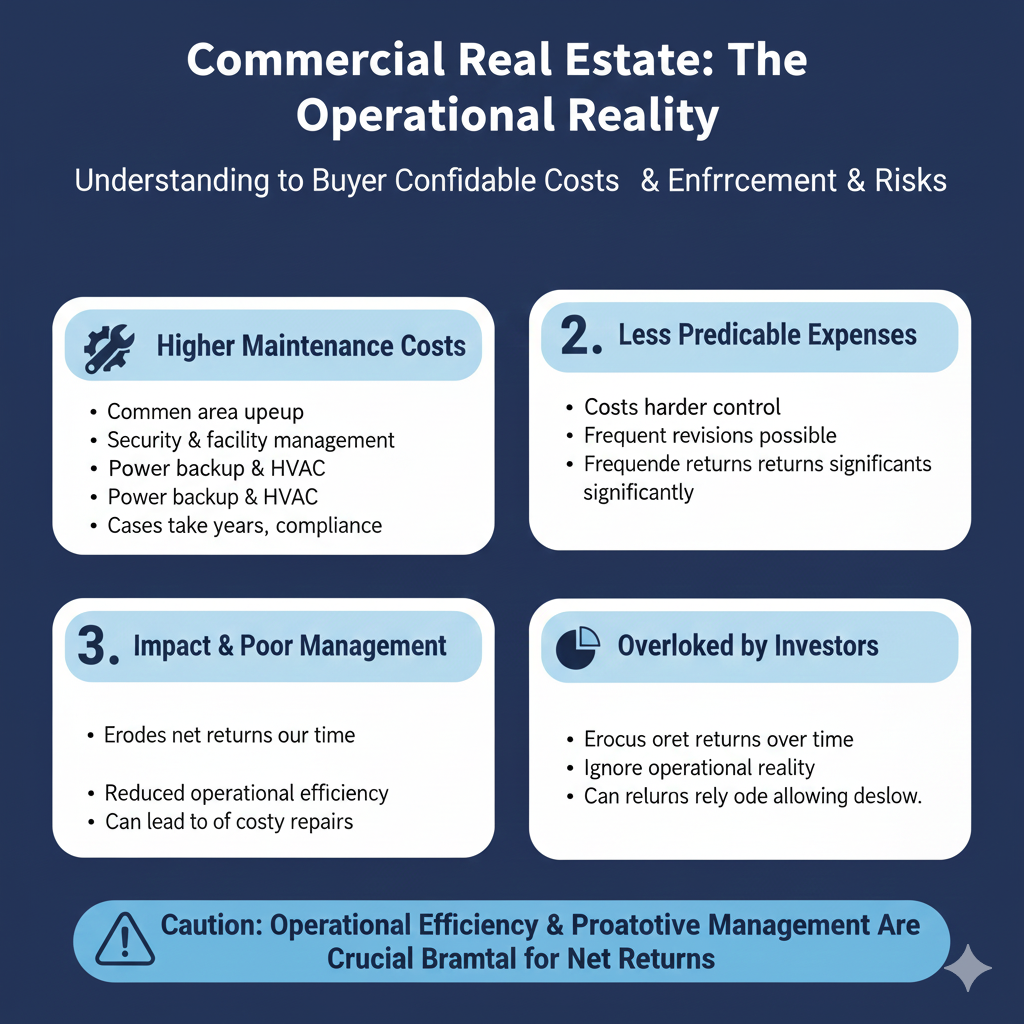
Commercial properties often come with higher and less predictable maintenance costs.
These can include:
Common area maintenance
Security and facility management
Power backup and HVAC upkeep
Compliance with fire and safety norms
Unlike residential projects, these costs are harder to control and are sometimes revised frequently. In poorly managed buildings, maintenance escalation can erode returns significantly.
Investors who ignore operational efficiency often discover that net returns shrink over time.
Exit Is the Most Ignored Risk
Selling commercial property is far harder than selling residential property.
The buyer pool is smaller. Buyers are usually investors, not end users. That means:
Higher negotiation pressure
Longer selling timelines
Stronger scrutiny of lease quality
If your property is vacant at the time of sale, valuation drops sharply. A leased property sells at a premium, while an empty one is often discounted heavily.
This makes exit timing critical. Commercial property should be bought with a clear holding horizon and exit logic, not as a casual investment.
Liquidity risk is real and must be planned for.
Market Sensitivity Is Higher
Commercial real estate responds faster to economic changes than residential housing.
During growth phases, rents and demand rise quickly. During slowdowns, vacancy spikes and renegotiations increase.
Sectors like IT, startups, co-working, and retail are especially sensitive to policy changes, funding cycles, and consumer demand.
Residential housing tends to be more emotionally driven and slower to react. Commercial property behaves more like a business asset than a shelter.
Investors must be comfortable with this volatility.
Who Commercial Property Is Actually Suitable For
Commercial property works best for investors who:
Have surplus capital
Can absorb vacancy periods
Understand lease structures
Plan for long-term holding
Do not rely on the income for survival
It is not ideal for first-time investors, highly leveraged buyers, or those depending on regular monthly cash flow without buffers.
Commercial real estate rewards patience and discipline, not urgency.
The Myth of “Guaranteed Returns”
Many investors are attracted by offers promising assured returns during the pre-lease phase. These returns are usually funded by the developer, not by real tenant income.
Once the assured period ends, returns depend entirely on actual leasing success.
If demand is weak or the tenant exits, income drops. Assured returns should never be treated as proof of asset strength.
The real test begins after guarantees end.
Reality Check: Residential vs Commercial
Residential property offers lower yields but higher liquidity, emotional demand, and easier exits. Commercial property offers higher potential returns but demands stronger risk tolerance and deeper understanding.
There is no better or worse category. There is only fit versus mismatch.
Problems arise when investors choose commercial property expecting residential-style stability.
FAQ
Q1: What is the difference between rental yield and net returns?
A1: Rental yield is gross rent divided by property value, while net returns factor in maintenance, taxes, vacancies, and loan interest.
Q2: What is vacancy risk?
A2: The risk that the property remains unoccupied for a period, reducing expected rental income.
Q3: How do lease terms affect returns?
A3: Longer leases provide stable income, while short-term or fluctuating leases can reduce predictability.
Q4: Why is exit strategy important in commercial property?
A4: Resale or subletting may be slower than residential, affecting liquidity and overall returns.
Q5: Should investors prioritize location or property size?
A5: Location is more critical for long-term appreciation and tenant demand, though size affects immediate rental income.
Conclusion

Commercial property investment can be rewarding, but only when approached with realistic expectations. Rental yield numbers tell only half the story. Vacancy risk, lease structure, operational costs, and exit challenges determine the other half.
Commercial real estate is not passive income. It is active asset management.
Let’s Join Together to Bring Change to the World of Real Estate.
Thinking about your next home?
relai scores every project on data, not paid placements, and it's free for buyers.