Circle Rate vs Builder Price: What Homebuyers Should Register At

One of the most confusing moments during a property purchase comes at registration. Buyers are often told, “You can register at circle rate and save stamp duty.” On paper, it sounds like a smart move. In reality, this decision can create legal, tax, and resale complications that surface years later.
This article explains what circle rate really means, the real risks of under-registering a property, and how this decision impacts you in the long term. The aim is to help buyers make a clear, informed choice rather than a short-term saving.
What Circle Rate Really Means
Circle rate, also called guidance value or ready reckoner rate, is the minimum property value fixed by the state government for stamp duty and registration purposes. Every locality has a predefined rate per square foot or square yard.
The government uses circle rates to prevent large-scale undervaluation during registration and to ensure a baseline tax collection. This rate is revised periodically based on market trends, infrastructure growth, and transaction data.
However, circle rate is not the market price.
Market price, often referred to as builder price or agreement value, reflects actual demand, location premium, amenities, brand value, and future growth expectations. In most active urban markets, builder prices are significantly higher than circle rates.
For example, in Hyderabad, many western corridor micro-markets have circle rates that are 30–50% lower than prevailing transaction values, even after recent revisions by the Telangana government (Telangana Registration & Stamps Department).
This gap is where confusion begins.
Why Under-Registration Looks Attractive
Registering at circle rate reduces stamp duty and registration charges, which are calculated as a percentage of the registered value. For a buyer, this can mean immediate savings of several lakhs.
Builders or intermediaries may also encourage under-registration to close deals faster or accommodate buyer budget constraints.
But what looks like a harmless adjustment is legally considered undervaluation.
Legal and Tax Risks of Under-Registration
Under-registering a property exposes buyers to multiple risks that often go unnoticed at the time of purchase.
From a legal standpoint, registration authorities have the power to question transactions where the declared value is significantly lower than market benchmarks. If the registrar believes undervaluation has occurred, the case can be referred for scrutiny, leading to additional stamp duty, penalties, and interest (Indian Stamp Act, 1899 – Valuation Provisions).
From a tax perspective, the Income Tax Act treats large gaps between transaction value and circle rate as potential tax avoidance. Under Section 56(2)(x), if a buyer purchases property below the circle rate beyond the permissible margin, the difference can be taxed as income in the buyer’s hands (Income Tax Act – Section 56).
Sellers are not immune either. Capital gains calculations are often based on deemed values linked to circle rates, not just actual consideration received. This can trigger disputes and future tax notices.
In short, under-registration does not eliminate liability; it only postpones it.
Long-Term Impact During Resale
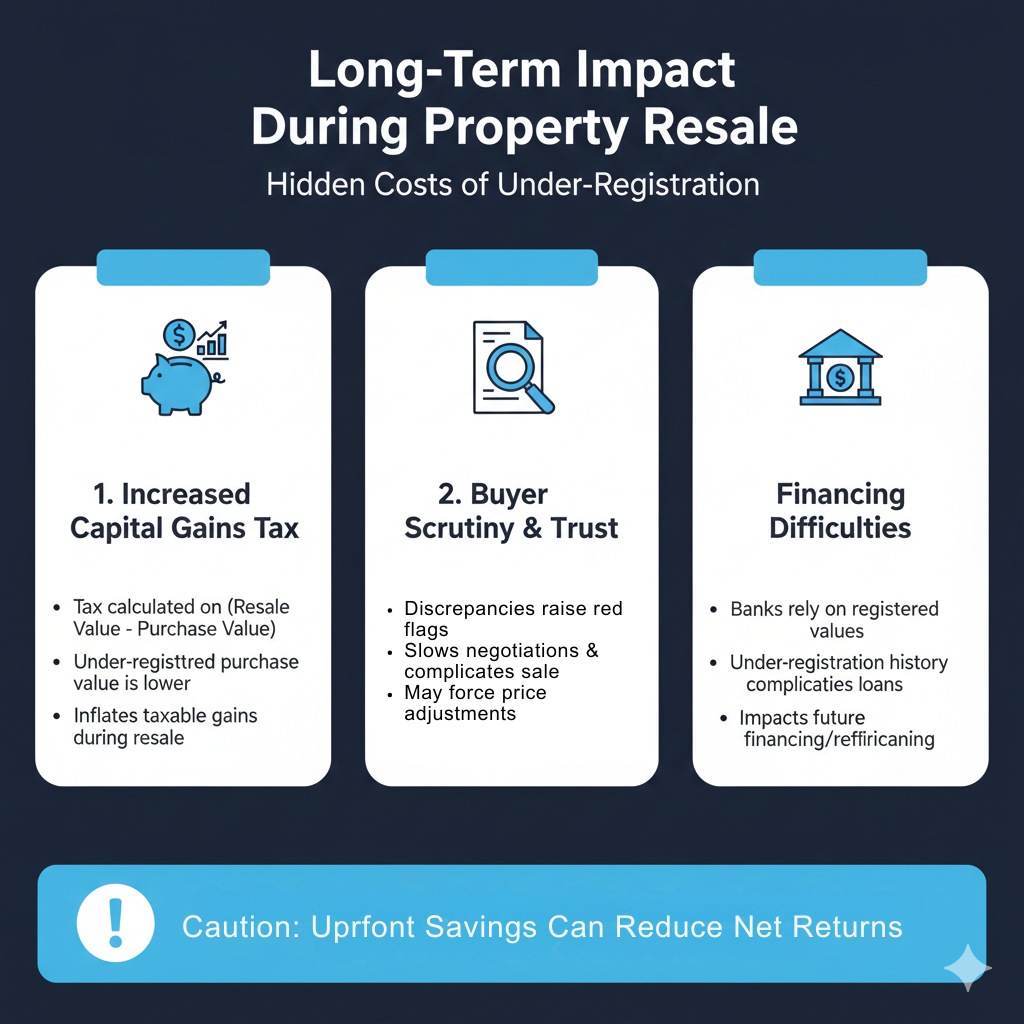
The biggest downside of registering at a lower value becomes visible when you sell the property.
Capital gains tax is calculated based on the difference between your purchase value and resale value. If your purchase was under-registered, your official acquisition cost is lower. This inflates taxable gains during resale, even if your actual profit is modest.
Additionally, buyers today are more cautious. Discrepancies between past registration value and current asking price raise red flags. This can slow negotiations, invite additional scrutiny, or force price adjustments.
Banks and financial institutions also rely on registered values during loan evaluations. A history of under-registration can complicate future financing or refinancing options.
What saved you money upfront can quietly reduce your net returns later.
How the Market Views Registered Value
In mature real estate markets, clean documentation is a premium.
Properties with full-value registration are easier to sell, attract serious end-users, and face fewer legal or tax questions. This is especially true in cities where compliance standards are improving and digital records are becoming more transparent.
According to Anarock Research, buyers in top Indian cities increasingly prioritise clear titles and compliant transactions over marginal price savings (Anarock Property Research).
This shift is structural, not temporary.
What Homebuyers Should Ideally Do
For long-term safety and flexibility, registering closer to the actual transaction value is generally the wiser choice.
If the gap between circle rate and builder price is large, buyers should seek clarity on prevailing market transactions, understand local registration practices, and consult a professional before proceeding.
Short-term savings should never outweigh long-term risk, especially for an asset as significant as a home.
FAQ Section
Is it legal to register a property at circle rate?
Yes. Registration at circle rate is legally allowed. However, it must reflect a fair valuation. Artificial undervaluation can attract scrutiny and penalties.
Will under-registration affect resale value?
Yes. Lower registered value increases capital gains tax liability and can raise concerns for future buyers and lenders.
Does registering at full value increase safety?
Registering closer to the actual transaction value improves legal clarity, tax transparency, and resale liquidity.
Why do circle rates differ from market prices?
Circle rates are administrative benchmarks updated periodically, while market prices change dynamically based on demand, supply, and location factors.
Conclusion
Circle rate and builder price serve different purposes, but treating circle rate as a shortcut to save money can backfire. While registering at circle rate may be legally permissible, under-registration carries long-term legal, tax, and resale risks that buyers often underestimate.
For most homebuyers, especially end-users, clarity and compliance matter far more than short-term savings. A clean transaction protects not just your investment, but your peace of mind.
Let’s Join Together to Bring Change to the World of Real Estate
Thinking about your next home?
relai scores every project on data, not paid placements, and it's free for buyers.