AI-Driven Predictive Analytics & Valuation Models in Real Estate

For decades, real estate decisions have relied on past transactions, gut feel, and broad market averages. While experience still matters, it struggles to keep up with fast-changing, hyper-local markets. This gap is where AI-driven predictive analytics and valuation models are changing how decisions are made.
The conversation around AI in real estate often sounds futuristic. But the real shift is practical. Advanced AI is now being used to forecast trends, price assets more accurately, assess risk, and identify opportunities with measurable returns.
This blog explains how predictive analytics and AI valuation models actually work, where they add real value, and how the industry is moving from hype to operational ROI.
What Predictive Analytics Means in Real Estate
Predictive analytics uses historical data combined with real-time inputs to estimate future outcomes.
In real estate, this includes:
Past transaction prices
Rental performance and vacancy data
Infrastructure development timelines
Economic and employment indicators
Micro-market supply pipelines
AI models process thousands of variables simultaneously, something traditional analysis cannot do at scale. The output is not a single prediction, but a range of probabilities that help decision-makers prepare for multiple scenarios.
AI-Driven Property Valuation Models
Traditional valuation relies heavily on comparable sales and subjective adjustments.
AI valuation models go deeper by:
Analysing large volumes of transaction data
Adjusting for micro-location differences
Accounting for building age, layout efficiency, and maintenance quality
Factoring in rental demand and liquidity signals
Instead of broad price bands, AI produces more precise valuation ranges with confidence levels. This reduces overpaying during acquisition and improves pricing discipline during resale.
Forecasting Market Trends More Accurately
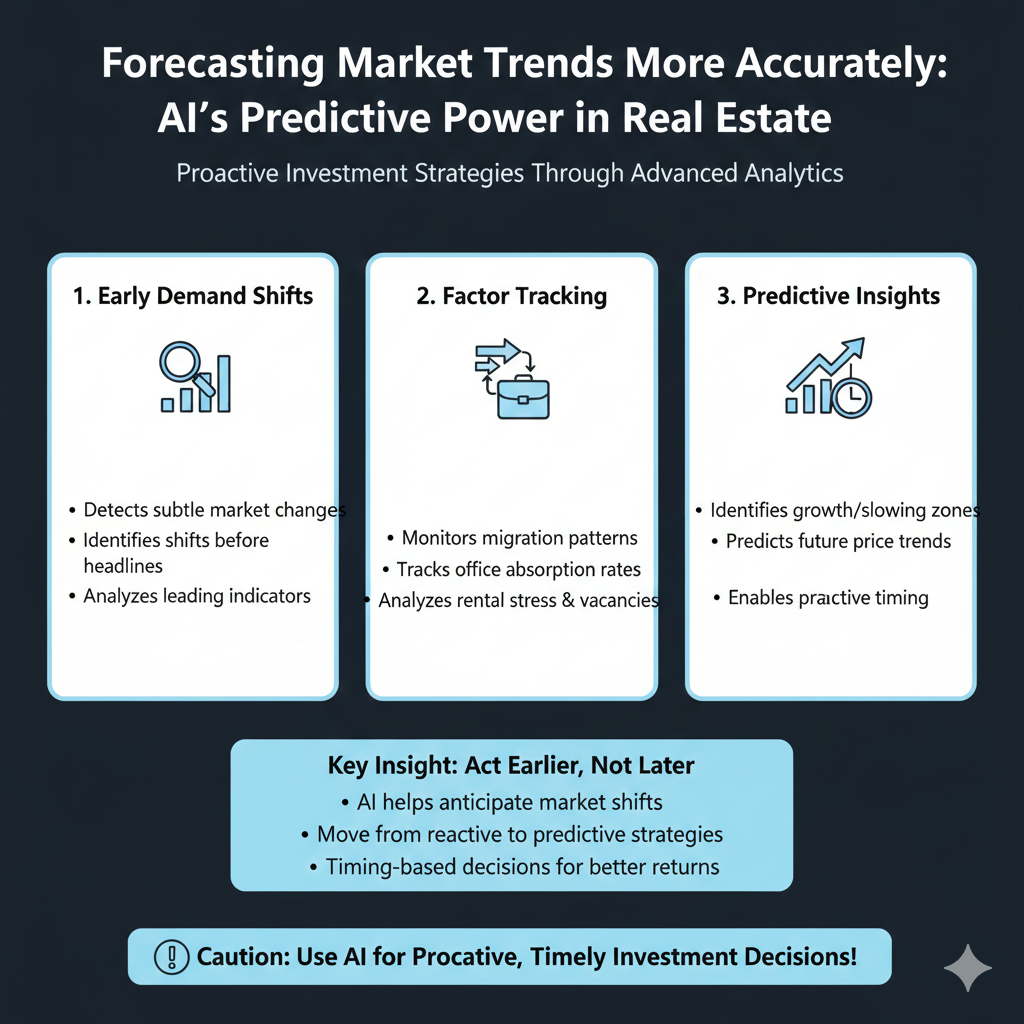
Market cycles are influenced by many overlapping factors.
AI helps by:
Detecting early demand shifts before they show up in headlines
Tracking migration, office absorption, and rental stress
Identifying zones where price growth is slowing or accelerating
Rather than reacting to trends after they become obvious, predictive models allow investors and operators to act earlier with better timing.
Identifying Investment Opportunities
One of the strongest use cases for AI is opportunity discovery.
AI systems can:
Scan multiple markets simultaneously
Compare risk-adjusted returns across asset types
Highlight underpriced pockets with improving fundamentals
Filter out locations where prices have run ahead of reality
This helps investors focus attention where probabilities are favourable, not where noise is loudest.
Risk Assessment and Downside Protection
Risk is often underestimated during strong markets.
AI-driven risk models evaluate:
Supply overhang and launch pipelines
Tenant concentration risks
Infrastructure dependency risks
Price sensitivity to interest rate changes
By quantifying downside scenarios, AI improves capital protection, not just upside chasing.
Hyper-Local Insights Using Big Data
The biggest advantage of AI is granularity.
Instead of city-wide averages, AI models analyse:
Street-level price behaviour
Project-specific resale performance
Floor-plan and orientation impact
Maintenance quality and occupancy mix
This micro-market intelligence explains why two properties in the same locality can perform very differently over time.
Moving from Hype to Measurable ROI
The real value of AI lies in outcomes, not dashboards.
AI delivers ROI when it:
Reduces acquisition mistakes
Improves pricing accuracy
Shortens vacancy periods
Enhances portfolio risk control
Organisations that integrate AI into daily workflows see operational efficiency gains and better capital allocation, not just better reports.
FAQ Section
Are AI valuation models better than human valuers?
They complement human judgment by reducing bias and improving consistency.
Is predictive analytics useful for end users or only investors?
It benefits both by improving pricing fairness and location selection.
Does AI eliminate market uncertainty?
No. It helps quantify uncertainty and prepare for multiple outcomes.
Is this technology already reliable in India?
Yes, especially in data-rich urban markets where transaction and rental data are available.
Conclusion

AI-driven predictive analytics and valuation models are shifting real estate from reactive decisions to probability-based planning.
The advantage no longer comes from having more data, but from interpreting it better and faster. When applied with discipline, AI reduces risk, improves accuracy, and delivers measurable returns across operations and acquisitions.
In real estate, informed foresight is replacing hindsight.
Let’s Join Together to Bring Change to the World of Real Estate.
Thinking about your next home?
relai scores every project on data, not paid placements, and it's free for buyers.