Why Data Centres Are the New IT Parks And Why Homebuyers Should Care
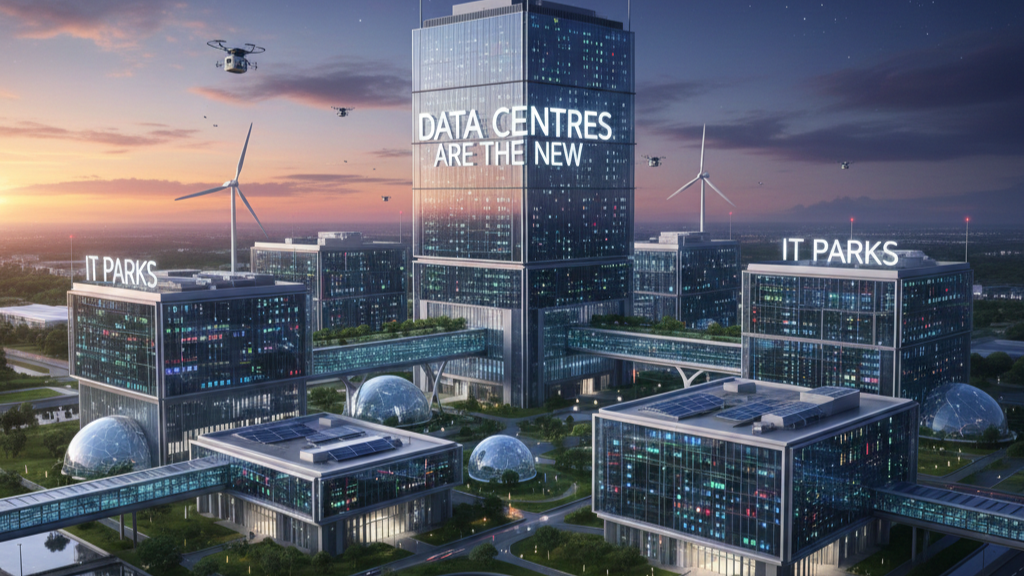
What was once a quiet part of the technology stack — large, windowless buildings full of servers — is now one of the fastest‑growing real estate segments. In India, data centres are beginning to reshape urban development in much the same way IT parks did a decade ago. But this time, the impact isn’t just on office landlords and cloud providers — it’s filtering all the way down to where people live. From Frankfurt to Hyderabad, global capital and corporate demand are turning data centres into a new kind of commercial and urban anchor, and that drives new residential demand patterns too.
1. Data Centres Are Expanding Rapidly in India
India’s data centre industry is growing at a blistering pace. Projections show that by 2026 the sector could add nearly 791 MW of capacity and spur about 10 million sq ft of real estate demand, attracting roughly $5.7 billion in investment. This surge is driven by the rise of AI, cloud services, digital adoption, and economic growth.
Multiple major cities — including Mumbai, Bengaluru, Delhi NCR, and Hyderabad — are expanding their data centre footprints. Continued digital transformation, 5G rollouts, and data localisation regulations are major catalysts.
Data centres already occupy millions of square feet and, in some markets, are among the most resilient asset classes compared with offices or retails. They are less cyclical and generate long‑term demand for land and infrastructure.
2. Why Data Centres Attract Capital Like IT Parks Used To
Investors and global corporations are pouring money into data centre projects for many of the same reasons they backed IT parks in the early 2000s — plus some new ones:
Long‑Term Leases
Data centres often come with 10–20 year contracts from cloud providers, hyperscalers, and large corporations. These long leases provide stable, predictable cash flow, which is highly attractive to institutional capital.
Diversified Tenant Base
Major global tech firms like AWS, Microsoft, Google, and local players all compete for space, spreading risk and increasing occupancy stability.
Strategic Importance
Unlike office buildings whose value depends on foot traffic and day‑to‑day work patterns, data centres are essential to digital infrastructure — powering everything from cloud apps to streaming, e‑commerce, and financial systems. This gives them resilience even during economic downturns.
Investors see these facilities as digital infrastructure rather than ordinary property, similar to how highways and utilities were treated historically.
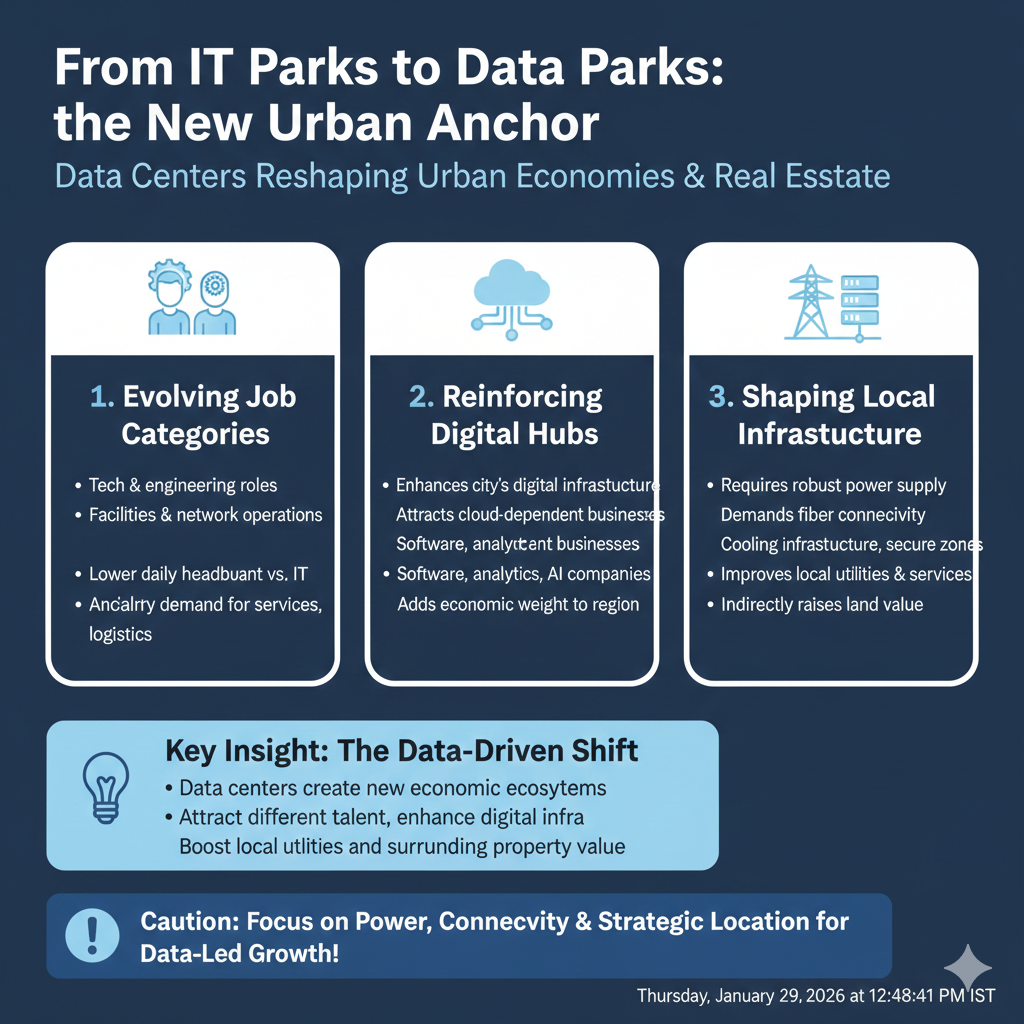
3. From IT Parks to Data Parks: The New Urban Anchor
IT parks once defined the growth of cities like Bengaluru and Hyderabad. They clustered knowledge workers, stimulated business services, and led to commute‑friendly residential hubs around them.
Data centres are now beginning to play a similar role, but with a twist:
a. They draw different categories of jobs
Most of the operational staff for data centres are on the tech and engineering side — from facilities maintenance to network operations — and while daily operational headcounts may be lower than IT parks, the ancillary demand for services, logistics, and support functions grows.
b. They reinforce digital hubs
Data centres enhance a city’s digital infrastructure, making it more attractive for cloud‑dependent businesses like software firms, analytics teams, and next‑generation AI companies. This connectivity adds economic weight to the region beyond the data centre itself.
c. They shape local infrastructure
Large data centre campuses require robust power supply, fibre connectivity, cooling infrastructure, and secure zones — all of which improve local utilities and services, indirectly raising the value of nearby residential and commercial land.
4. Why Homebuyers Should Pay Attention
At first glance, data centres may seem distant from where people live. But like IT parks before them, they influence housing demand subtly and over time.
Job Creation and Income Growth Near Data Hubs
Although data centres don’t employ as many people directly as offices, they anchor related businesses — IT services, security firms, energy contractors, logistics providers — that do generate jobs. Markets with faster infrastructure growth often see higher household formation rates, which translate into housing demand.
Infrastructure Spillover
Areas that attract data centres often see improvements in power grids, fibre infrastructure, and road access — partly to meet the technical needs of the facilities, and partly because investors and governments prioritise growth corridors. These infrastructure upgrades improve livability and attract renters and buyers alike.
Residential Markets Near Digital Nodes Strengthen
Just as office clusters made areas like Whitefield or HITEC City desirable residential locations because of job proximity and reduced commute costs, neighbourhoods near data hubs can see appreciation as secondary demand grows — especially if the city consolidates as a digital hub.
For cities like Hyderabad, which recently saw a major data centre announcement with an estimated ₹5,000 crore investment and several thousand jobs connected to its development, this pattern is already forming.
5. New Patterns vs Old Patterns
There are some important differences between data‑centre–driven growth and traditional IT park growth:
Slow but steady residential demand:
While an office park triggers immediate relocation demand, data centre demand for housing is more gradual and diffuse — tied to broader economic expansion rather than location‑specific job moves.
Stronger infrastructure baseline:
Data centres demand stronger utilities and connectivity — creating a better foundation for future residential growth before visible demand appears.
Global capital flows:
Unlike older cycles where capital was mostly domestic or regional, today data centres attract global funds, sovereign investors, and hyperscale provider capital, bringing with them a longer time horizon and deeper pockets.
FAQ Section
Do data centres directly create housing demand?
Not usually in the short term like offices. But they create ancillary economic activity and infrastructure improvements that stimulate housing demand over years.
Are data centres concentrated in specific cities?
Yes, major hubs include Mumbai, Bengaluru, Hyderabad, Chennai, and Delhi NCR, though edge data centres are expanding into tier‑2 markets.
Is the demand for data centres sustainable?
Yes. Digital services, cloud computing, AI, and 5G all rely on data centre capacity, and demand is expected to rise sharply through the decade.
Does this benefit renters as much as buyers?
Yes. Rising infrastructure quality, jobs, and services typically improve both rental demand and long‑term housing value.
Conclusion

Data centres are more than buildings full of servers. They are digital infrastructure assets reshaping real estate patterns much like IT parks did a generation ago. Global capital is increasingly betting on this trend because data centre investment offers long leases, stable income, and strategic importance in the digital economy.
For homebuyers, the lesson is clear: proximity to strong digital infrastructure and the corridors that host it will matter more over time. As digital demand expands — and India’s data centre capacity is projected to grow dramatically in the years ahead — residential markets near these new digital nodes are likely to see stronger, more resilient demand, improved infrastructure, and better long‑term value.
Let’s Join Together to Bring Change to the World of Real Estate.
Thinking about your next home?
relai scores every project on data, not paid placements, and it's free for buyers.