Immigration, Migration, and the Housing Affordability Debate: What’s Really Driving Costs?
Immigration, Migration, and the Housing Affordability Debate: What’s Really Driving Costs?

Housing affordability has become one of the most debated global issues, with many conversations pointing to immigration as a major reason for rising prices. Viral posts on X argue that mass immigration is pushing rents up by absorbing available supply. Some posts even claim that recent deportations in the US helped rents fall for the fourth straight month. Others go further, suggesting that up to 20 million undocumented immigrants have “nuked” affordability.
The reality is more nuanced. Immigration affects demand, but housing costs rise due to a wide mix of economic, policy, and supply-side pressures. Political uncertainty—especially with more than 70 countries facing elections in 2025—has added fuel to the topic, making it a global flashpoint rather than a regional one.
In India, the conversation plays out differently. Internal migration, urbanization, and job-driven movement into cities like Hyderabad, Bengaluru, Pune, and Mumbai are much bigger drivers of affordability than international immigration. Understanding this distinction is essential to decoding what is happening in housing markets worldwide.
This blog breaks down the global narrative, the Indian reality, and what truly shapes affordability.
Why Immigration Became the Trending Explanation
Across the US and parts of Europe, rent spikes since 2021 have been linked to multiple factors—stimulus-driven demand, low supply, investor buying, and rising construction costs. Yet the explanation that went viral was simpler: immigration increases population, more people compete for limited homes, so prices rise.
A few reasons made this narrative spread fast:
1. Viral posts created easy, compelling cause-and-effect stories
X posts with 6,000+ likes tied lower rents to deportations, suggesting supply has finally opened up for citizens. Other posts argued that 6% of non-citizens accessing housing aid strains public systems.
2. Election cycles amplified the conversation
Political voices, including US Senator JD Vance, positioned immigration as a key issue for the 2026 election cycle, giving the narrative a larger platform.
3. Rising rents made people look for simple answers
After years of rent escalation, many are eager to identify a clear culprit.
However, economic data shows that affordability is influenced by far more than immigration alone.
What the Data Actually Says Globally
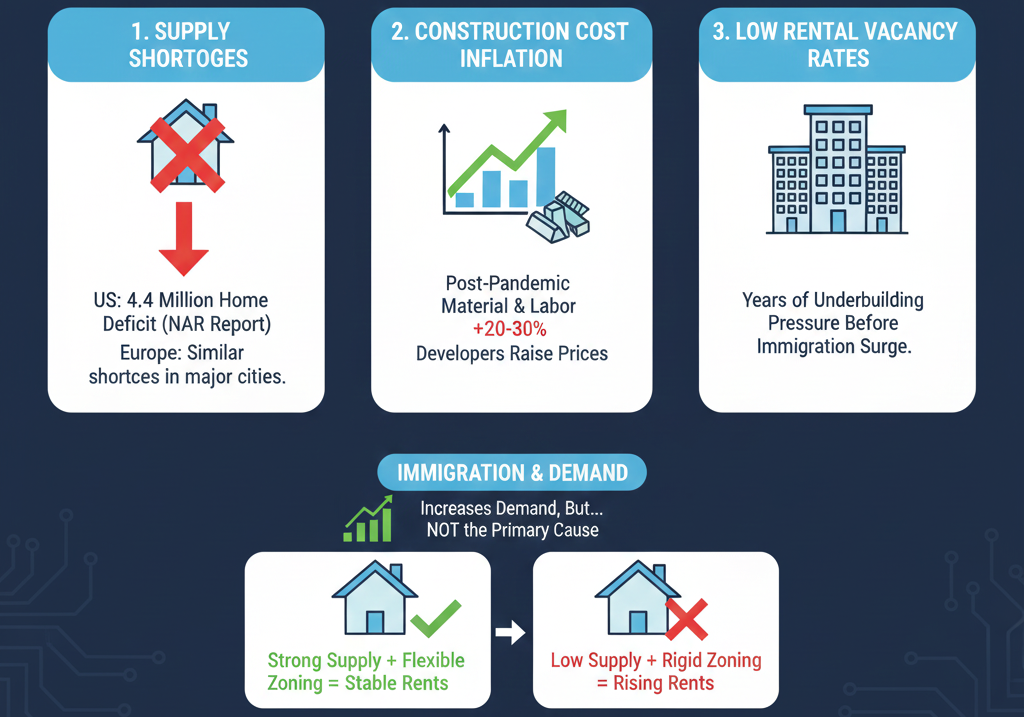
Housing economists consistently point to three primary drivers of rising home prices:
1. Supply shortages
The US has a 4.4 million home deficit, according to the National Association of Realtors (NAR Housing Shortage Report).
Europe faces similar shortages in major cities.
2. Construction cost inflation
Post-pandemic material and labour costs jumped more than 20–30%, pushing developers to raise prices.
3. Low rental vacancy rates
Years of underbuilding created pressure long before immigration surged.
Immigration does increase demand, but it does not single-handedly create affordability problems. Where supply is strong and zoning is flexible, rents remain stable even with population growth.
The Indian Reality: Migration Matters, But in a Different Way
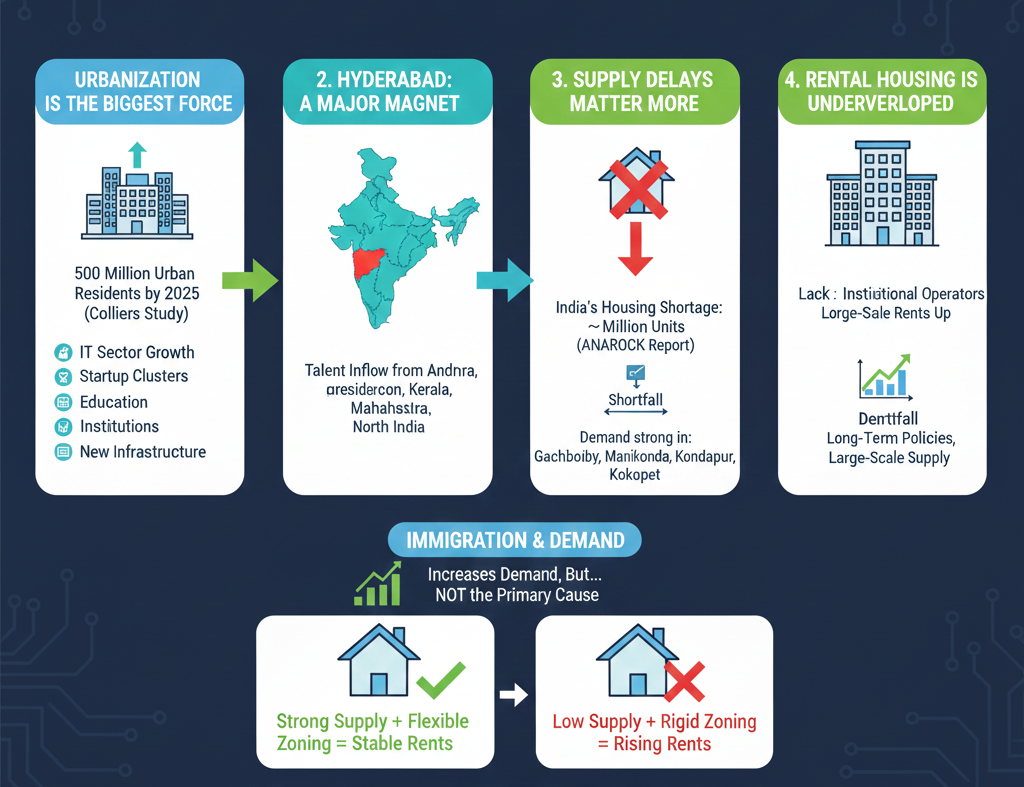
India’s housing affordability debates rarely center on international immigration. Instead, they focus on internal migration—people moving from small cities and rural areas to major job hubs.
1. Urbanization is the biggest force shaping demand
India is moving toward 500 million urban residents by 2025, according to the CREDAI–Colliers Urbanization Insights (Colliers Urban India Study).
Cities like Hyderabad, Bengaluru, and Pune attract hundreds of thousands of new residents annually due to:
IT sector growth
startup clusters
educational institutions
new infrastructure
This migration drives demand far more than global immigration flows.
2. Hyderabad is a major magnet for interstate migration
The city’s talent inflow from Andhra Pradesh, Kerala, Maharashtra, and North Indian states has reshaped its housing market. Demand remains strong in areas like:
Gachibowli
Kukatpally
Manikonda
Kondapur
Kokapet
In these hubs, supply often struggles to catch up.
3. Supply delays matter more than population growth
India’s housing shortage is nearly 30 million units, according to ANAROCK (ANAROCK Housing Shortage Report).
This shortfall creates affordability pressure even when demand rises slowly.
4. Rental housing is underdeveloped
Most Indian cities lack:
institutional rental operators
long-term rental policies
large-scale rental supply projects
This pushes rents up during periods of demand surge.
Global Politics and India’s Housing Market: Indirect but Real Effects
While immigration debates abroad don’t directly shape Indian housing, global political uncertainty does influence:
1. Capital flows
Investors look for stable markets when other regions turn volatile. India’s residential sector accounted for 45% of real estate investments in recent years, reflecting this shift.
2. Construction supply chains
Global elections affect commodity prices, which influence construction expenses.
3. Technology adoption
Stricter immigration policies in some countries increase remote work, pushing Indian cities to build more remote-work-friendly homes.
Why Affordability Needs a Broader Lens
Blaming immigration alone oversimplifies the issue. India, which has very low immigration relative to the West, still faces steep housing inflation. This proves the core pressures come from:
urban land scarcity
high construction costs
complex approvals
infrastructure delays
lifestyle shifts
rising incomes in tech corridors
limited rental supply
Migration—whether internal or international—is only one piece of the broader affordability puzzle.
FAQ Section
1. Is immigration the main reason housing costs rise globally?
No. Immigration affects demand, but supply shortages, construction costs, investor activity, and zoning rules are the bigger drivers.
2. Does immigration impact India’s housing prices?
Not significantly. India’s challenge stems from internal migration and urbanization rather than international immigration.
3. Why is housing unaffordable in Indian metros?
Limited land in core areas, high construction costs, and strong demand from IT corridors create upward pressure.
4. Will affordability improve in India soon?
Affordability may improve as new supply enters the market, but rising costs and strong migration patterns keep pressure high.
5. What can help ease affordability?
Faster approvals, better rental ecosystems, suburban infrastructure, and increased mid-income housing supply.
Conclusion

The idea that immigration alone makes homes unaffordable has gone viral, but real housing challenges run deeper. Global markets are dealing with supply shortages, high construction costs, and shifting demographic patterns. In India, internal migration and rapid urbanization—especially toward cities like Hyderabad—are the true drivers of rising demand and prices. As cities grow, the focus must remain on predictable supply, efficient approvals, and stable policies that support both affordability and long-term development.
A balanced understanding helps buyers make informed decisions rather than reacting to narratives that oversimplify a complex issue.
Thinking about your next home?
relai scores every project on data, not paid placements, and it's free for buyers.