Traffic Revamp in Hyderabad’s IT Corridors: Can New Commute Rules Ease the Real Estate Pressure?
Traffic Revamp in Hyderabad’s IT Corridors: Can New Commute Rules Ease the Real Estate Pressure?
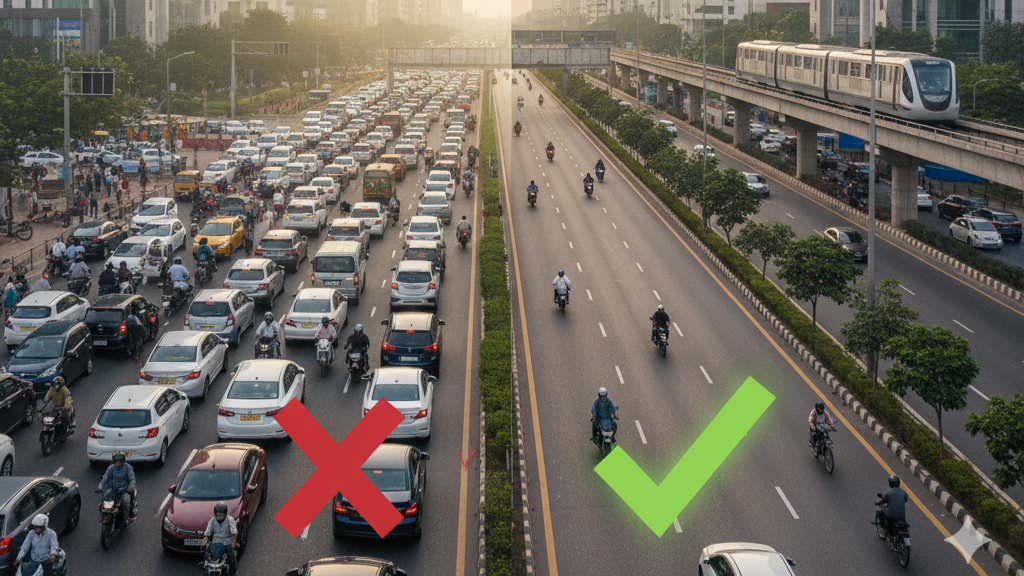
Hyderabad’s IT corridors—Madhapur, Gachibowli, and the Financial District—are not just the heart of India’s tech industry but also a living case study in urban strain. The region that once symbolized seamless connectivity and cutting-edge infrastructure is now grappling with a problem every working professional knows too well: traffic.
As real estate in these corridors continues to boom, the daily gridlock is becoming a defining factor in both commercial and residential property decisions. The Cyberabad Police recently announced an ambitious new plan aimed at cutting congestion by 20%, and it’s already sparking a city-wide debate.
The Plan: One Bus, Less Chaos
Under the new proposal, the Cyberabad Police plan to replace 250 private cars with 50 company-run buses at the Mindspace IT hub. Companies are being urged to adopt a “One Bus Per Company” policy and promote carpooling among employees. The goal is clear—reduce single-occupancy car usage, improve traffic flow, and reduce emissions in the area (The Hindu).
According to officials, this policy could free up several kilometers of road space during peak hours. The traffic police also propose synchronized entry-exit times for major firms, staggered shifts, and stricter parking controls near office campuses.
On paper, the plan makes perfect sense. But the public reaction paints a more complicated picture.
The Backlash: “Don’t School Us, Enable Us”
The initiative drew mixed reactions from employees and residents in Madhapur and Gachibowli. Critics argue that the burden of decongestion is being shifted entirely onto the workforce, while the government has yet to improve public transport options.
Many argue that corporate bus mandates can’t substitute for better metro and TSRTC coverage in the area. Others demand removal of U-turn bottlenecks, enforcement against single-occupancy VIP convoys, and even suggest relocating large companies to Tier-2 cities to balance growth (Times of India).
There’s also growing frustration over the perceived lack of accountability from those in power. “If the government wants us to carpool, why not start with ministers’ convoys?” one tech professional commented on social media, echoing a sentiment many share.
The Real Estate Angle: Traffic is the New Amenity
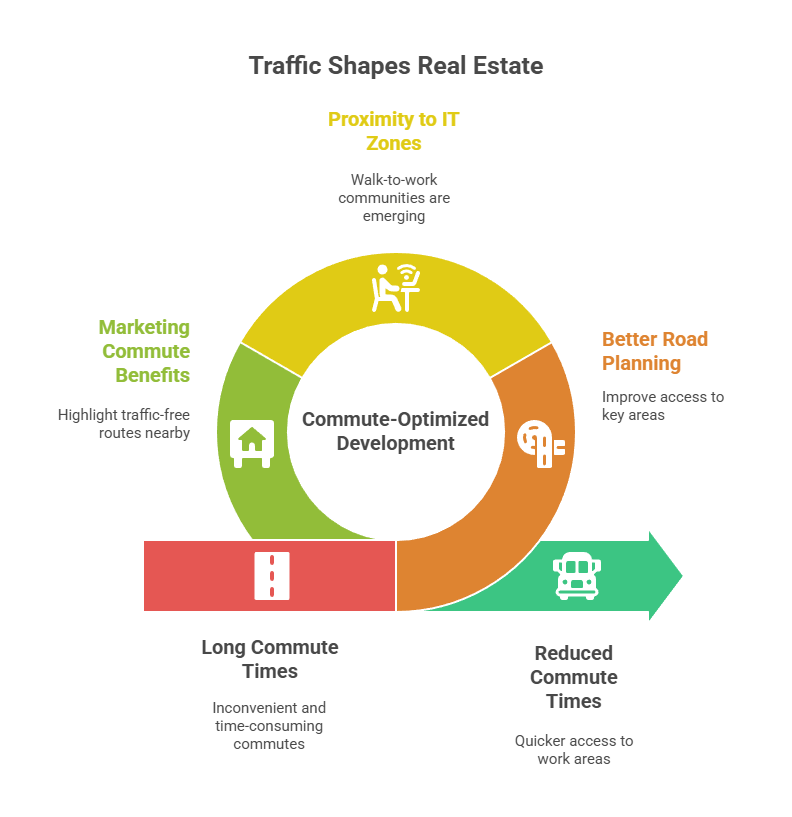
Hyderabad’s real estate boom has long been anchored around its IT corridors, where infrastructure and convenience dictate property values. But today, commute time is emerging as a key determinant of real estate worth.
Areas like Kokapet, Nanakramguda, and Narsingi—just a few kilometers away from Gachibowli—are witnessing a surge in demand precisely because they offer better road planning and quicker access to ORR and IT zones.
Developers are already taking note. Several new projects are marketing themselves as “commute-optimized” or “walk-to-work communities”, highlighting their proximity to major tech parks and traffic-free routes (Moneycontrol).
In simple terms, traffic has evolved from an inconvenience to a market signal. The worse it gets, the more it reshapes buyer preferences and developer strategies.
Lessons from Other Cities
Hyderabad isn’t the first tech hub to tackle traffic-induced infrastructure stress. Bengaluru experimented with “Bus Priority Lanes” and “Work-from-Anywhere Fridays”, while Gurgaon piloted corporate mobility pacts to reduce congestion.
Globally, cities like Singapore and Tokyo combine transit-linked real estate zoning with heavy parking penalties to curb private car dependency. Hyderabad’s challenge lies in adapting such measures without alienating its workforce or slowing down its real estate-driven economic momentum.
The success of the “One Company, One Bus” initiative will depend heavily on corporate cooperation, government support, and citizen participation—a triad that rarely aligns perfectly in practice.
FAQ Section
1. What is the “One Company, One Bus” rule in Hyderabad’s IT corridors?
It’s an initiative by the Cyberabad Police encouraging each company in the Mindspace–Gachibowli area to operate at least one employee bus to reduce car usage and traffic congestion.
2. How will this policy impact employees and companies?
Employees may see fewer parking options and stricter carpooling mandates, while companies will need to arrange or subsidize transport. However, it could also lead to shorter commute times and reduced stress in the long run.
3. How does this traffic plan affect real estate prices?
Areas with smoother commutes and public transport access are likely to see higher property demand and appreciation, as buyers increasingly value connectivity over location alone.
4. What alternatives are being proposed by citizens?
Suggestions include expanding public bus services, improving metro connectivity, banning VIP single-vehicle usage, and decongesting roads through better junction design.
5. Can similar plans work in other Indian cities?
Yes, if paired with reliable public transport and strict enforcement. Cities like Bengaluru and Pune are already exploring hybrid versions of this model.
Conclusion

The traffic debate in Hyderabad’s IT corridors is more than an urban planning story—it’s a mirror of how infrastructure, policy, and real estate interact. The push for fewer cars and more collective mobility is a step in the right direction, but it needs balance.
Real estate thrives where cities move efficiently. If Hyderabad can find that balance—between private convenience and public good—it won’t just ease congestion; it will future-proof its position as India’s most livable tech hub.
At Relai, we believe that smarter cities begin with informed decisions—whether it’s choosing the right property, understanding infrastructure trends, or aligning investments with long-term urban growth.
Let’s Join Together to Bring Change to the World of Real Estate.
Thinking about your next home?
relai scores every project on data, not paid placements, and it's free for buyers.