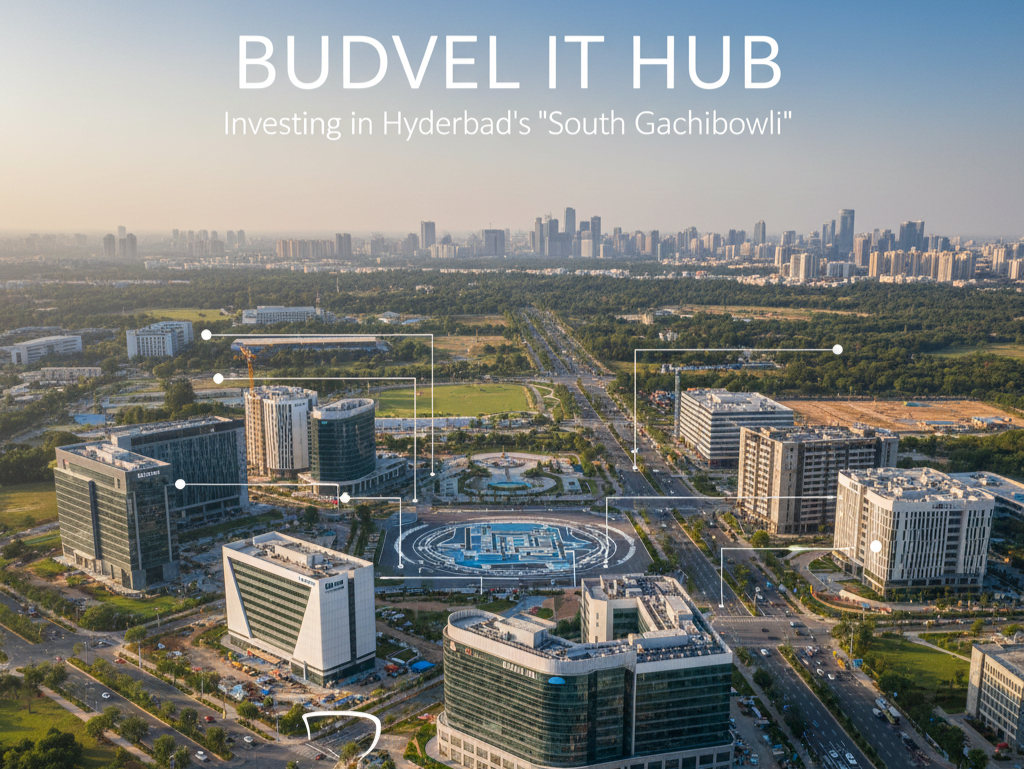
The Budvel IT Hub: Investing in Hyderabad’s “South Gachibowli”
Introduction
Every real estate cycle has a moment when attention shifts from where growth has already happened to where it is structurally guaranteed. In Hyderabad, 2026 is shaping up to be that moment for Budvel and Rajendra Nagar.
The Telangana government’s decision to auction over 300 acres for a fully integrated IT corridor in Budvel has fundamentally changed how South Hyderabad is viewed. What was once seen as peripheral is now being positioned as a master-planned alternative to Gachibowli, but with advantages that West Hyderabad no longer offers.
Budvel is not competing with the Financial District on hype. It is competing on planning, connectivity, and long-term livability. For HNIs and C-suite executives seeking ultra-luxury high-rises above ₹2 crore, Budvel is emerging as the rare combination of proximity, scale, and certainty.
Why Budvel Is Being Called “South Gachibowli”
Gachibowli became what it is today because of three factors:
Concentrated IT employment
Planned road infrastructure
Early government-led zoning
Budvel now checks all three — but in a more evolved form.
The government-planned IT corridor at Budvel is not a patchwork of private layouts. It is a single, integrated cluster, designed with:
Wide internal roads
Dedicated commercial and residential zones
Infrastructure planned before habitation
This level of foresight is difficult to replicate in already saturated markets like the Financial District.
The Master Planning Advantage Over Gachibowli
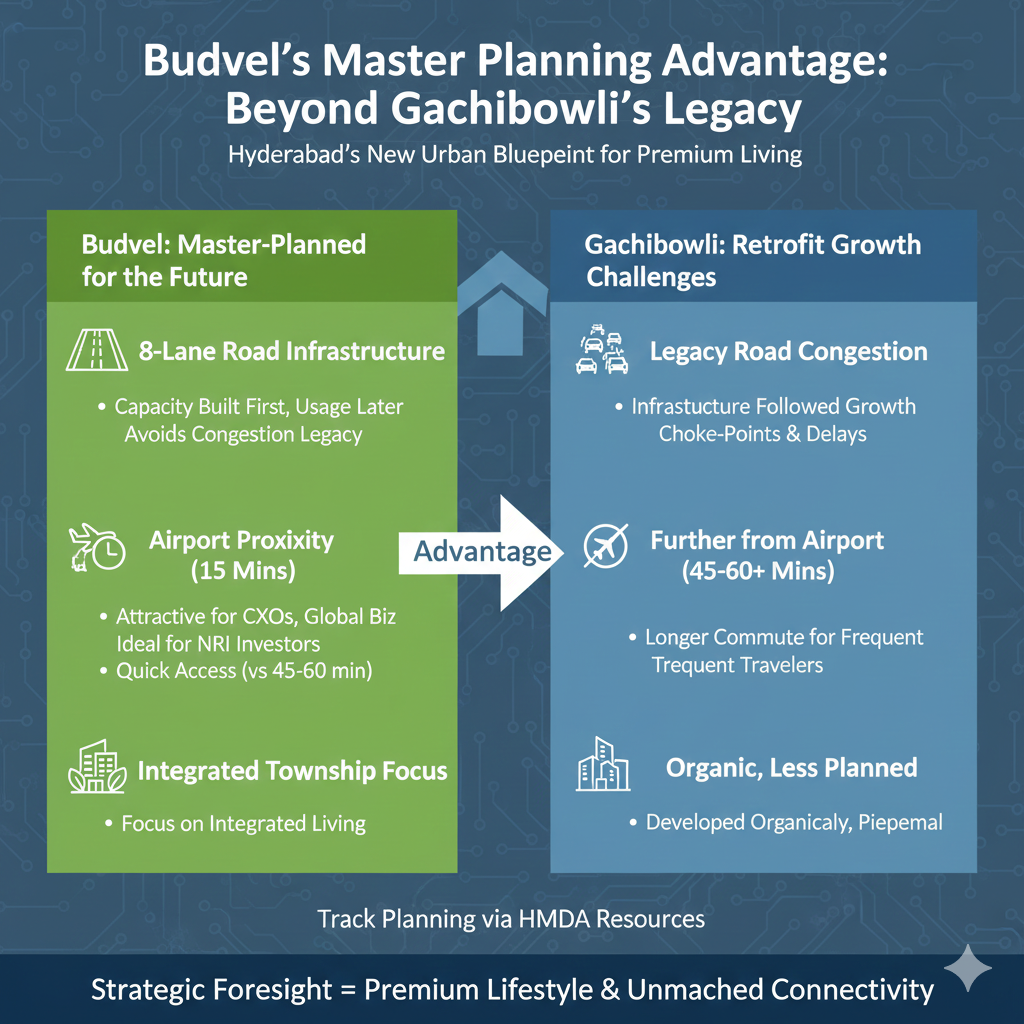
One of Budvel’s strongest advantages is master planning at scale.
8-Lane Road Infrastructure
Budvel benefits from 8-lane arterial road access, a feature that most parts of West Hyderabad developed after congestion became a problem. Here, capacity is built first, usage comes later.
You can track Hyderabad’s planned infrastructure corridors via the official HMDA planning resources.
Airport Proximity
Budvel is approximately 15 minutes from Rajiv Gandhi International Airport, making it significantly more attractive for:
CXOs with frequent travel
Global business leaders
NRI investors seeking quick airport access
In contrast, most of West Hyderabad requires 45–60 minutes during peak hours.
Government-Planned Clusters Create Predictability
The Rajendra Nagar–Budvel layout carries a crucial distinction: it is a government-planned cluster.
This matters because it implies:
Assured road widths
Pre-approved zoning
Coordinated drainage and utilities
Faster infrastructure execution
Historically, government-planned layouts in Hyderabad have shown lower regulatory risk and better long-term value retention compared to fragmented private developments.
This is not speculative planning. The land auction itself signals intent and timeline clarity.
Price Per Sq. Ft.: Budvel vs. Financial District
The Financial District today reflects pricing maturity. While exact numbers vary by project, premium high-rises there already command prices that bake in future growth.
Budvel, on the other hand, is still in the price discovery phase.
What this means for buyers:
Entry prices are lower relative to future infrastructure
Upside is linked to execution, not assumptions
Risk is reduced because planning is already defined
For HNIs, this is a classic early-stage institutional corridor entry, similar to Financial District investments made a decade ago.
Why Ultra-Luxury High-Rises Fit Budvel Best
Budvel’s buyer profile is different from mid-segment residential zones.
This corridor naturally attracts:
Senior corporate leadership
Business owners with airport-centric travel needs
Global professionals seeking privacy and scale
Ultra-luxury high-rises make sense here because:
Land parcels support vertical development
Views and low density enhance exclusivity
Proximity to IT + airport aligns with executive lifestyles
Projects in the ₹2 crore and above range are not outliers here — they are the intended product.
Infrastructure First, Demand Second: Why This Matters
Many real estate corridors grow in reverse order — demand appears first, infrastructure follows slowly. Budvel is doing the opposite.
This infrastructure-first approach reduces:
Traffic uncertainty
Livability compromises
Regulatory surprises
It also shortens the time between investment and actual usability, which is critical for end-users rather than pure investors.
Who Should Consider Investing in Budvel
Budvel is not for short-term flippers.
It is ideal for:
HNIs seeking capital preservation with upside
CXOs prioritizing airport proximity
Buyers who value planning over hype
Investors comfortable entering before mass retail attention
If Gachibowli represents stability, Budvel represents structured growth.
FAQ Section
Q: Why is Budvel preferred over Gachibowli for 2026 buyers?
A: Better master planning, wider roads, faster airport access, and lower congestion risk.
Q: Is the Budvel IT hub confirmed or speculative?
A: The government’s large-scale land auction confirms intent and execution planning.
Q: What type of properties make sense here?
A: Ultra-luxury high-rises and premium residences above ₹2 crore.
Q: Does government planning reduce risk?
A: Yes. It improves infrastructure certainty and lowers regulatory unpredictability.
Q: Is this suitable for NRIs?
A: Yes, especially for those prioritizing airport connectivity and long-term value.
Conclusion

Budvel is not trying to replace Gachibowli. It is building on its lessons — with better planning, cleaner execution, and future-ready infrastructure.
For buyers who missed the early Financial District phase or are unwilling to pay peak prices there, Budvel offers a rare second entry point into a government-backed IT corridor with luxury residential upside.
This is how new prime markets are born — not overnight, but by design.
Let’s Join Together to Bring Change to the World of Real Estate.
Relai – For right home.
Thinking about your next home?
relai scores every project on data, not paid placements, and it's free for buyers.