Tellapur (High-Rise) vs. Mokila (Villa): The ₹3 Crore Dilemma
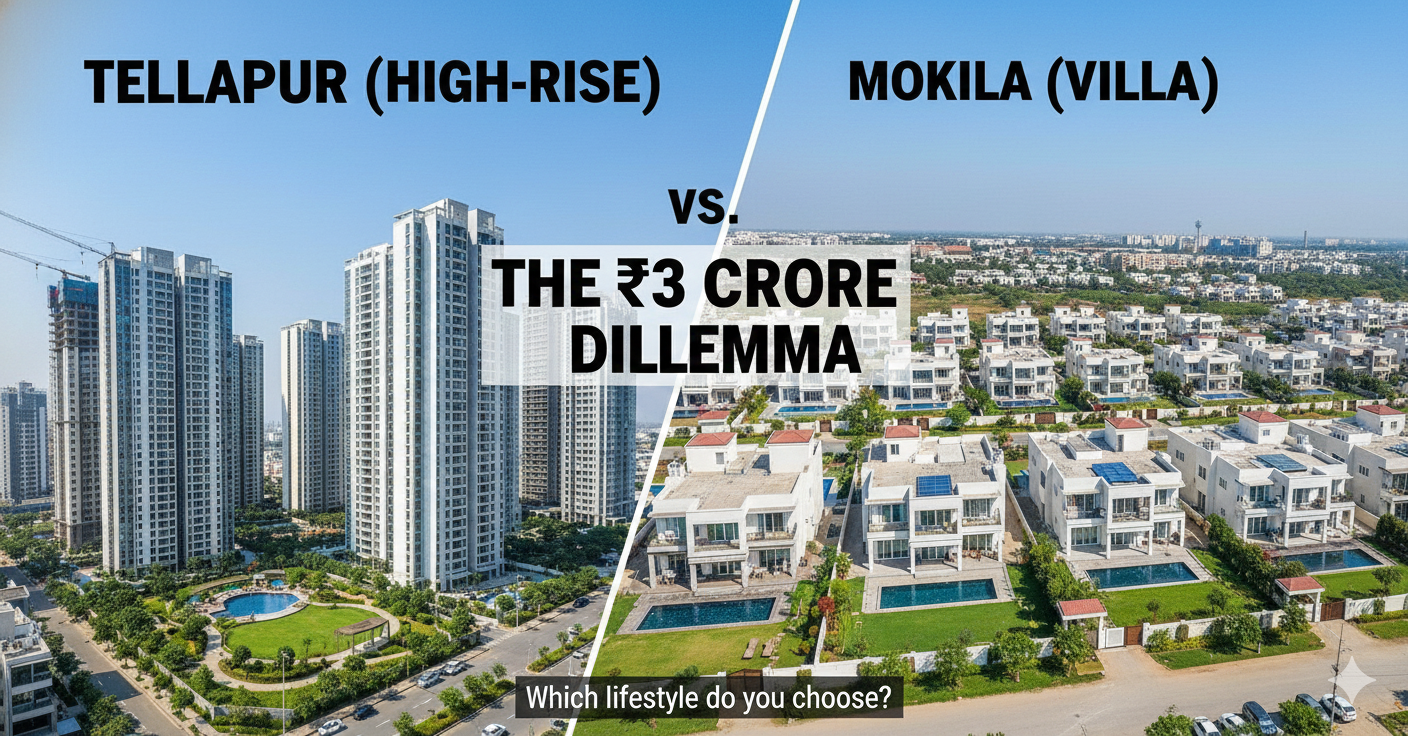
In 2025, a ₹3 crore budget in Hyderabad puts you at a serious crossroads. You are no longer choosing between good and better. You are choosing between two very different lifestyles.
On one side is Tellapur, where a luxury 4 BHK sky-villa sits inside a 35–40 floor high-rise, minutes from the Financial District. On the other side is Mokila, where the same budget can buy you a standalone 300-square-yard villa in a low-density, green-zone gated community.
This is not just a location decision. It is a choice between density and privacy, between capital-led growth and life-led living. This blog breaks down both options clearly, so high-intent luxury buyers can decide with confidence.
Understanding the Two Micro-Markets
Tellapur: Vertical Luxury Near the Financial District
Tellapur has evolved as an extension of Hyderabad’s western IT corridor. Proximity to the Financial District, Kokapet, and Gachibowli has made it a hotspot for premium high-rise developments.
Here, ₹3 crore typically gets you a large 4 BHK apartment or sky-villa in a gated community with clubhouse amenities, concierge services, multiple lifts, and high security. The appeal is convenience, status, and access.
Tellapur works best for professionals, NRIs, and investors who value time, rental demand, and long-term capital appreciation driven by commercial growth.
Mokila: Horizontal Living in a Green Zone
Mokila sits further west, beyond Tellapur, and is officially classified as a low-density development zone. This planning restriction is what keeps the area open, green, and villa-focused.
With ₹3 crore, buyers can own a 300-square-yard villa with private setbacks, terraces, and often a small garden. The environment is quieter, the roads are wider, and the community density is significantly lower.
Mokila attracts families looking for long-term self-use, people planning retirement homes, and buyers who value space and calm over proximity.
Density vs. Privacy: The Real Lifestyle Divide
Living in a 40-Floor High-Rise (Tellapur)
High-rise living is efficient but shared. You share lifts, corridors, clubhouses, parking ramps, and amenities with hundreds of families.
The upside is managed living. Power backup, security, housekeeping access, and social spaces are professionally handled. Everything works, but very little is private.
Noise insulation is better than older apartments, but you are still part of a vertical community. Privacy exists inside the home, not outside it.
Living in a Low-Density Villa Community (Mokila)
Villa living is personal. You have your own entrance, your own walls, and no one above or below you.
Children play on internal roads instead of indoor play zones. Morning walks happen in open air, not corridors. The silence is noticeable.
The trade-off is responsibility. You manage more things directly, either yourself or through hired help. Privacy increases, but so does involvement.
Capital Appreciation vs. Quality of Life
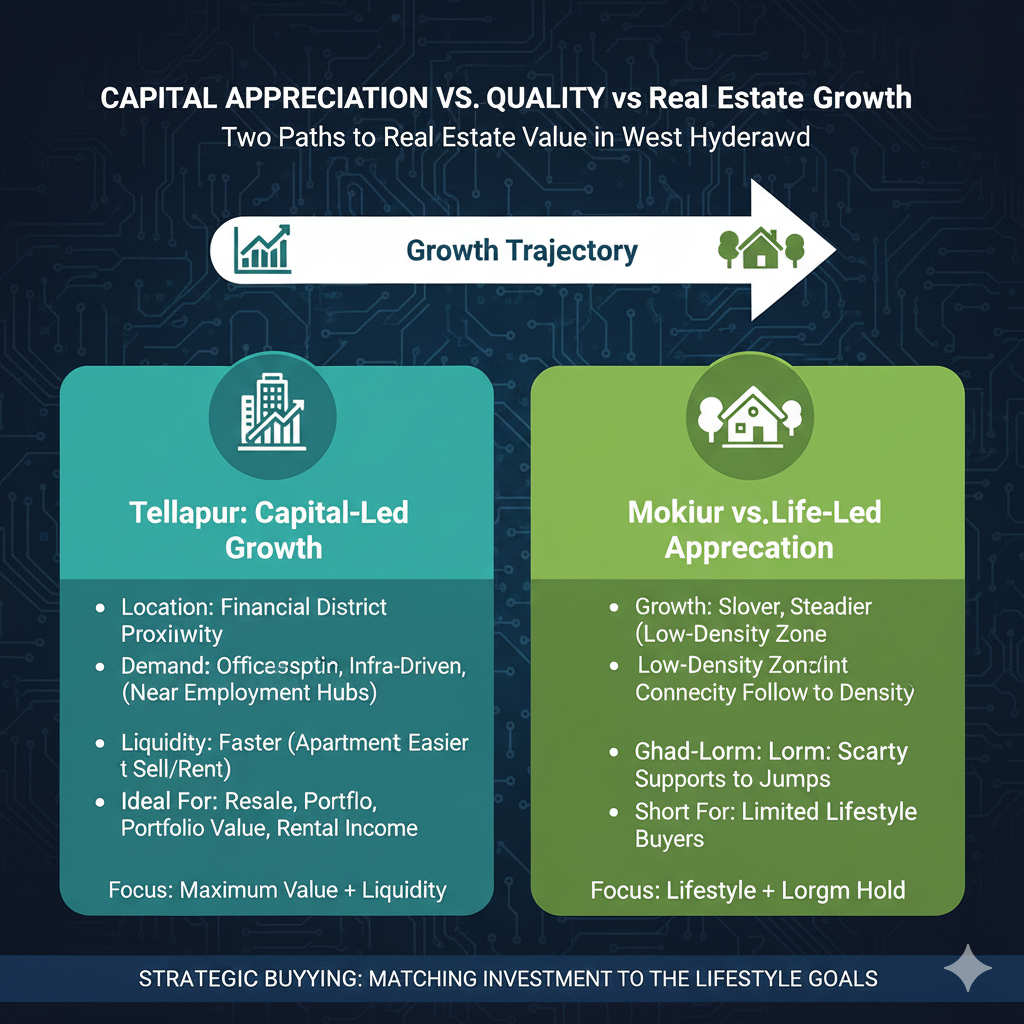
Tellapur: Capital-Led Growth
Tellapur’s strength lies in its location. Continued office absorption in the Financial District, infrastructure upgrades, and premium supply keep demand strong.
Historically, apartments closer to employment hubs see faster price discovery. Liquidity is also higher. Selling or renting an apartment is usually easier than a villa.
For buyers focused on resale timelines, portfolio value, or rental income, Tellapur aligns well.
Mokila: Life-Led Appreciation
Mokila’s appreciation story is slower but steadier. Land value plays a bigger role here than built-up value.
As Hyderabad expands westward, low-density zones become rarer. Over time, scarcity supports long-term appreciation, even if short-term price jumps are limited.
This suits buyers who plan to live in the home for many years and see appreciation as a secondary benefit.
Rental Yield Comparison
Rental yield is a key consideration for buyers planning partial or full leasing.
High-rise apartments in Tellapur generally offer around 1 percent higher rental yield than villas. This is due to:
• Proximity to offices
• Higher demand from senior professionals and expats
• Easier maintenance and management
Villas in Mokila attract tenants mainly for long-term family stays. Rents are stable but yields are lower because capital values are land-heavy.
If rental income matters, Tellapur has a clear advantage.
Maintenance Cost Breakdown
Tellapur Apartments
Most luxury high-rises charge maintenance around ₹5 per square foot. For a 3,500 sq. ft. apartment, this translates to roughly ₹17,500 per month.
This covers security, lifts, common areas, clubhouse, power backup, and facility management. Costs are predictable and shared.
Mokila Villas
Villas do not have per-square-foot maintenance in the same way. Costs are itemized.
Typical monthly expenses include:
• Private security or society security contribution
• Gardening and landscaping
• External cleaning and minor repairs
On average, villa maintenance can range from ₹12,000 to ₹20,000 per month, depending on how premium the setup is and how much is outsourced.
Who Should Choose What
Choose Tellapur if you:
• Work in or around the Financial District
• Want higher rental yield and liquidity
• Prefer managed living with amenities
• See the home as a financial asset first
Choose Mokila if you:
• Value privacy and open space
• Plan long-term self-use
• Want a calmer environment for family life
• See the home as a lifestyle anchor
FAQ Section
Is ₹3 crore enough for a luxury home in both locations?
Yes. In 2025, ₹3 crore comfortably buys a premium 4 BHK apartment in Tellapur or a mid-to-premium 300-yard villa in Mokila, depending on the project and specifications.
Which is better for appreciation, Tellapur or Mokila?
Tellapur typically shows faster short-term appreciation due to commercial proximity. Mokila offers slower but land-backed long-term appreciation.
Are villas harder to resell than apartments?
Yes, villas generally have lower liquidity compared to apartments, especially in emerging zones. However, they attract serious end-users.
Which option is better for families with children?
Mokila offers more open space and quieter surroundings, while Tellapur offers better access to schools, offices, and social infrastructure.
Conclusion

The ₹3 crore dilemma between Tellapur and Mokila is not about which is better. It is about which is right for you. Tellapur represents growth, access, and efficiency. Mokila represents space, privacy, and long-term living comfort. When buyers align their decision with intent instead of trends, regret disappears.
At Relai – For right home, we help buyers evaluate not just projects, but priorities. Because the right home is not always the most expensive one, but the most aligned one.
Let’s Join Together to Bring Change to the World of Real Estate.
Thinking about your next home?
relai scores every project on data, not paid placements, and it's free for buyers.