Navigating the GO 111 “Gold Mine”: Safe Buying vs Speculative Risks

Introduction
In 2026, the long-awaited zoning update for the ~1.32 lakh acres of land previously restricted under GO 111 has changed the Hyderabad real estate landscape. Once no-build buffer zones around Osman Sagar and Himayat Sagar, many of these villages are now being reconceptualized in a new master-planning context — with clearly defined Conservation and Residential zones.
This transformation has fueled demand among HNIs seeking luxury farmhouse plots, villa land, and premium residential land parcels near lakeside belts. Yet the same opportunity carries risks — especially when buyers confuse speculative optimism with actual buildable rights.
This blog is a Buyer’s Survival Guide for land acquisition in the GO 111 belt — focusing on how to distinguish between safe buildable zones vs restricted areas, understand environmental guardrails such as Low-Density Residential norms and FSI limitations, and highlight why hubs like Shankarpally and Moinabad are seeing price surges — alongside the critical need for title due diligence.
Key search intents covered: Buy land in GO 111 Hyderabad, Moinabad villa plots 2026, GO 111 zoning rules update.
The GO 111 Shift: From No-Build to Zoning Clarity
GO 111 was a government order meant to protect the catchment areas of two major reservoirs — Osman Sagar and Himayat Sagar. For years, land under this order was treated as a constrained zone due to environmental concerns. Now, with the government finalizing zoning rules and updated land-use classifications for the 84 villages previously under GO 111, several categories are emerging:
Conservation Zones (No-Build) — Strict protection; development prohibited
Low-Density Residential Zones — Permitted, but with environmental guardrails
Agricultural and Greenbelt Buffers — Restricted or controlled development
Draft master plans outlining precise zonal demarcations are now a key reference for buyers. HMDA master plan zoning datasets should be reviewed before any plot acquisition in the GO 111 belt.
Green, Grey, or Red: What Your Plot’s Zoning Really Means
Conservation Zone (Strict No-Build)
These areas remain off-limits for residential or commercial structures. Even luxury villas, farmhouses, and gated estates cannot be built here. Buyers must confirm the exact survey number and zone code within the master plan to avoid pitfalls.
Consequences of buying here include:
No legal build permissions
Difficulty in securing utility approvals
No resale market in the foreseeable future
Always request a zonal classification certificate from HMDA/HUDA as part of due diligence.
Low-Density Residential Zone (Buildable with Limits)
This is where genuine opportunities exist — but with clear environmental parameters:
Key features you must know:
FSI (Floor Space Index) caps are typically low — ensuring minimal landscape disturbance.
Construction footprints are regulated — often below 20–25% of plot area.
Height restrictions often apply to preserve watershed integrity.
Low-Density Residential zones allow villas, luxury plots, and farmhouses — but with strict compliance to environmental regulations.
Understanding these constraints is crucial for pricing, design, and future resale.
Why Shankarpally and Moinabad Are in Demand — and Why Due Diligence Matters
Price Surge Dynamics
Two emerging land hubs — Shankarpally and Moinabad — have witnessed price surges of ~20%+ in recent quarters. This is driven by:
Proximity to ORR and regional highways
Ease of access to the airport and key IT/commerce belts
Newly allotted zones under the GO 111 master plan that allow residential building potential
Developers and HNIs seeking villa plots and premium farmland have gravitated towards these areas, anticipating expanded build rights.
Title Due Diligence: The 30-Year Link Document
When transacting in newly declared buildable zones, verifying the 30-year property history (link documents) is non-negotiable. This ensures you are not buying encumbered, disputed, or ambiguous rights on land that might later be deemed non-compliant.
A proper title due diligence checklist should include:
Last 30 years’ possession chain (Patta/B-form, ECGC records)
Encumbrance certificates
Zonal classification under the updated master plan
Water-body proximity clearance certification from authorities
Buyers often overlook this at their peril.
Environmental Guardrails: What “Low-Density Residential” Means
As Hyderabad evolves, protecting water catchments and ecology remains a core planning principle. Low-Density Residential zoning comes with specific constraints:
1. FSI and Built-Up Limits
Unlike urban zones where FSI can exceed 1.0 or more, GO 111 areas under Low-Density Residential classification typically have FSI limits below 0.5. This means:
Large land holdings are more valuable for open space, landscaping, and garden areas
Built-up area is limited, which can affect design and resale premiums
This also means developers tend to market low-density plots with premium pricing per sq. ft., even if the actual constructed area remains modest.
2. Setback and Buffer Requirements
Builders must adhere to strict setbacks from water bodies, drainage lines, and natural contours, as mandated in the updated environmental clearances. The intention is to preserve hydrology and prevent erosion or runoff issues.
For buyers, this translates into:
More open landscaping
Limits on swimming pools or built-up perimeter structures
Additional landscaping cost expectations
Where Safe Buying Makes Sense and Where Speculation Does Not
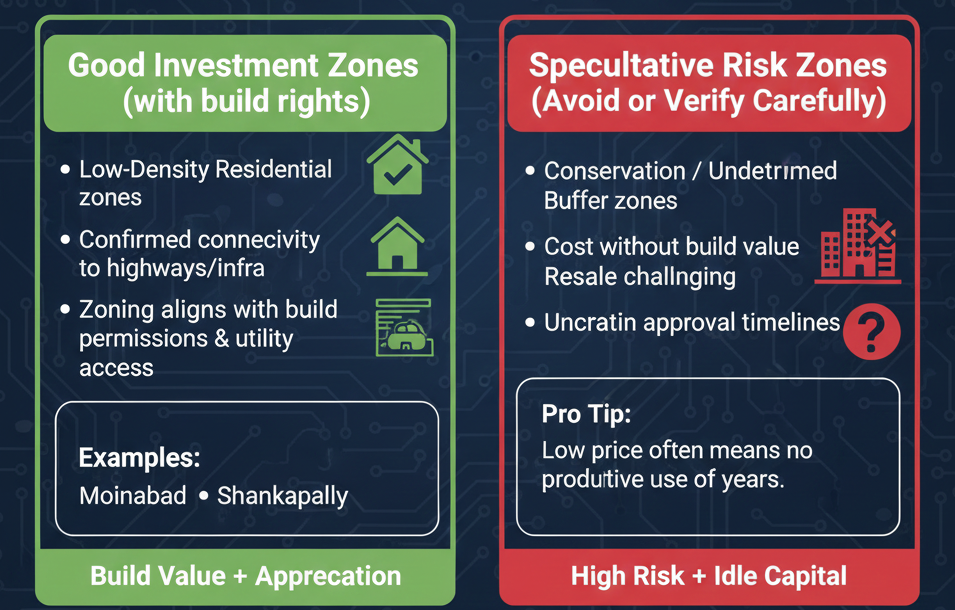
Good Investment Zones (with build rights)
Buyers looking for villa plots or luxury farmhouse land should prioritize:
Low-Density Residential zones with clear master plan notification
Areas with confirmed connectivity to highways or upcoming infrastructure
Plots where zoning aligns with build permissions and utility access
Examples include specific survey blocks within designated Residential Zones near Moinabad and select pockets of Shankarpally where build rights are established.
Speculative Risk Zones (Avoid or Verify Carefully)
Areas still classified as Conservation or undetermined buffer zones should be approached with caution. Rarely do these zones become build-permissive in the short to medium term, meaning:
Buyers incur cost without build value
Resale becomes challenging
Approval timelines remain uncertain
Pro tip: A plot may be theoretically priced lower in a speculative zone, but the lack of confirmed build rights often leaves buyers with no productive use for years.
Pricing Snapshot: GO 111 Zones vs. Surrounding Micro-Markets
Location | Typical ₹/sq. ft. in 2026 | Zoning Status | Build Potential |
Moinabad (Residential Zone) | ₹1,800–2,800 | Build Permitted | High (villa/farmhouse) |
Shankarpally (Residential Zone) | ₹2,000–3,200 | Build Permitted | High |
Adjacent Conservation Pockets | ₹800–1,500 | No Build | Speculative |
Tellapur (Core West Hyderabad) | ₹6,000–8,500 | Urban Residential | Very Build-Ready |
Kokapet (Neopolis) | ₹10,000+ | Urban Premium | Prime |
This table shows how buildable GO 111 land can offer value relative to core urban pockets, while highlighting how Conservation or pending zoning areas can remain stagnant in price.
FAQ Section
Q: What is the GO 111 zoning update about?
A: The government has released specific zoning classifications for the ~1.32 lakh acres previously under GO 111, dividing land into Conservation, Low-Density Residential, and other categories with defined build rights.
Q: Can I build a villa or farmhouse in all GO 111-related lands?
A: No. Only areas explicitly classified as Low-Density Residential in the updated master plan allow such development — it’s essential to verify the zonal designation.
Q: Why is title due diligence critical in Shankarpally and Moinabad?
A: These areas have seen strong price appreciation, but gaps in the 30-year link document chain can create legal issues. Confirming clean, uncontested title history is essential before transfer.
Q: What does low FSI mean for villa plot buyers?
A: It means your total built-up footprint is capped, and larger plots may be needed to achieve the structure sizes you want — which affects layout, design, and cost planning.
Q: Are prices likely to continue rising in these zones?
A: Yes, areas with confirmed build rights and connectivity improvements are likely to continue appreciating — though speculative zones without build rights may remain flat.
Conclusion

The evolution of GO 111 zoning in 2026 is a major milestone for Hyderabad real estate, especially for buyers seeking luxury plots, farmhouses, or villa land near watershed belts. But navigating this “gold mine” requires clarity — not hype.
To buy safely:
Confirm the plot’s zoning designation in the updated master plan;
Ensure thorough title due diligence (30-year link documents);
Understand environmental constraints like Low-Density Residential FSI and setbacks;
Focus on confirmed buildable pockets in Moinabad, Shankarpally and aligned Residential zones.
By separating real buildable opportunities from speculative or no-build land, investors can make informed decisions, avoid costly mistakes, and capture genuine upside as Hyderabad’s real estate footprint expands.
Let’s Join Together to Bring Change to the World of Real Estate.
Relai – For right home.
Thinking about your next home?
relai scores every project on data, not paid placements, and it's free for buyers.