Movable vs Immovable Property: Legal Differences Every Buyer Should Know in 2025
Movable vs Immovable Property: Legal Differences Every Buyer Should Know in 2025

When it comes to property ownership in India, most people think only about land and buildings. But the law divides assets into two key categories — movable and immovable property. The distinction matters because it affects how assets are transferred, taxed, mortgaged, or inherited.
In 2025, as property documentation, taxation, and digital registrations become more standardized, understanding this difference isn’t just a legal requirement — it’s essential for every homebuyer, investor, and NRI managing assets across India.
What Is Movable Property?
According to Section 3(36) of the General Clauses Act, 1897, movable property includes all property except immovable property. In simpler terms, anything you can move from one place to another without altering its essential character qualifies as movable.
Examples include:
Vehicles, furniture, jewelry, and electronics
Shares, bonds, and money
Portable machinery not permanently attached to land
Movable property can be sold, gifted, or pledged easily, often without requiring formal registration. Transactions are generally governed by the Sale of Goods Act, 1930.
What Is Immovable Property?
As per Section 3 of the Transfer of Property Act, 1882, immovable property includes land, buildings, hereditary rights, and anything permanently attached to the earth.
Examples include:
Land and plots
Houses and apartments
Trees rooted in the ground
Machinery fixed permanently to a building
Unlike movable property, immovable property transfers require registered sale deeds and are subject to stamp duty, registration fees, and property tax.
Key Legal Differences Between Movable and Immovable Property
Aspect | Movable Property | Immovable Property |
Definition | All assets not classified as immovable | Land, buildings, and fixtures permanently attached |
Transfer Law | Sale of Goods Act, 1930 | Transfer of Property Act, 1882 |
Registration Requirement | Usually not required | Mandatory for ownership transfer |
Ownership Proof | Invoice, bill, or possession | Registered sale deed |
Taxation | Subject to GST or capital gains | Subject to stamp duty, registration, and property tax |
Transfer Speed | Quick and simple | Requires legal verification and government approval |
Examples | Cars, gold, shares, furniture | Land, flats, houses, commercial spaces |
This legal distinction helps determine how ownership is proven, taxed, or inherited — especially in estate planning and investment management.
Why This Difference Matters for Property Buyers
1. Legal Ownership and Registration
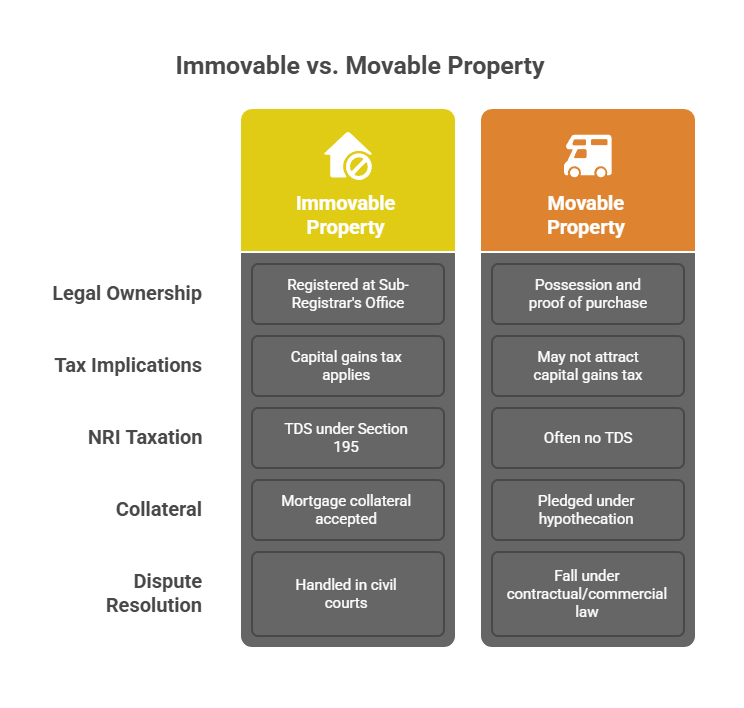
When you buy immovable property, it’s legally recognized only after registration with the Sub-Registrar’s Office. For movable property, possession and proof of purchase are usually enough.
2. Tax and Financial Implications
Selling immovable property attracts capital gains tax, while selling movable property (like jewelry or vehicles) may not, depending on its classification.
For NRIs, taxation rules differ — property sales attract TDS under Section 195, whereas movable assets often do not.
3. Collateral and Loan Security
Banks accept immovable property as mortgage collateral, while movable assets are pledged under hypothecation (like vehicles or machinery loans).
4. Dispute Resolution
Immovable property disputes are handled in civil courts, often involving title verification. Movable property disputes, however, fall under contractual or commercial law.
Movable vs Immovable Property in Real Estate Context
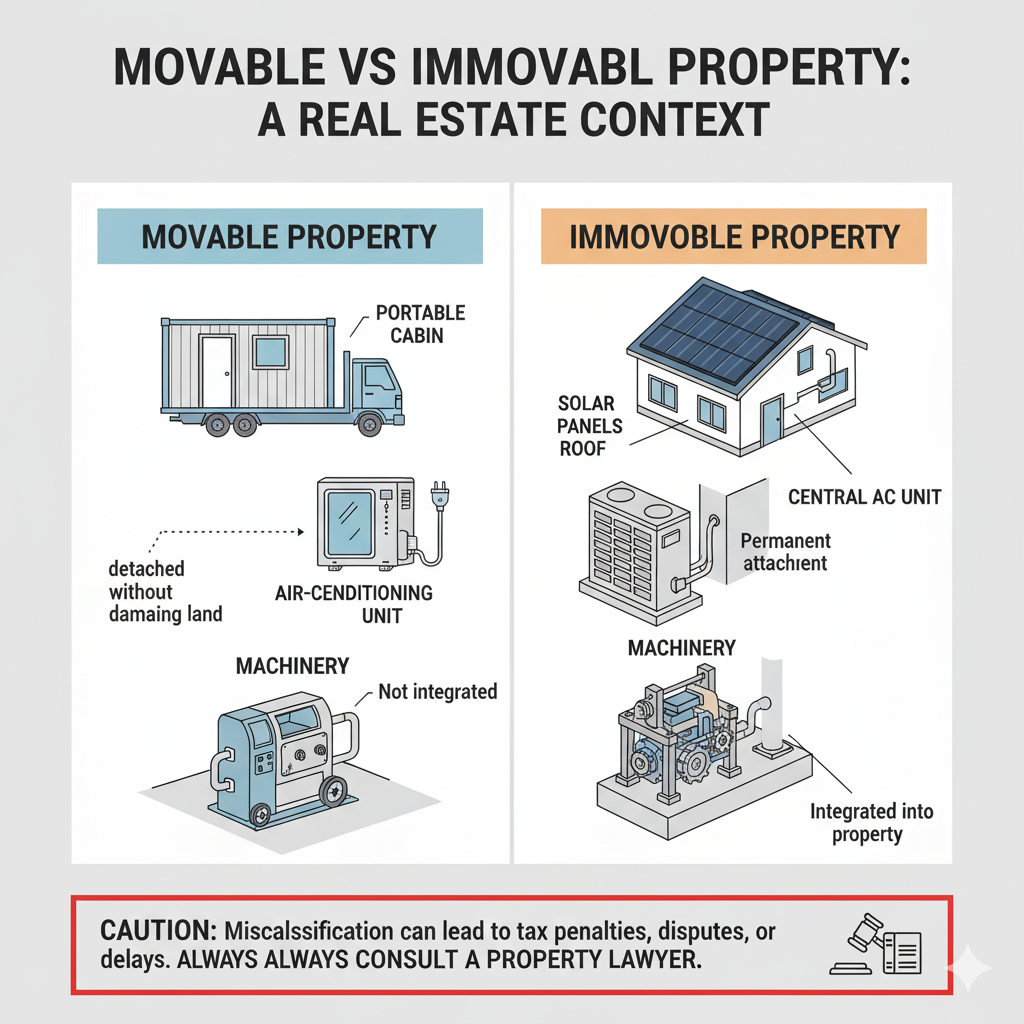
Many modern real estate projects blur the line between the two categories. For instance:
Portable cabins are considered movable if they can be detached without damaging land.
Solar panels or air-conditioning units fixed to a building may be treated as immovable due to permanent attachment.
Machinery in industrial units can shift categories based on how it’s fixed or integrated into the property.
For developers and investors, misclassifying assets can lead to tax penalties, disputes, or delays in property registration. Always consult a property lawyer before finalizing such transfers.
How NRIs and Investors Should Approach It
NRIs investing in India often hold a mix of movable (shares, mutual funds) and immovable (flats, land) assets. The legal and tax implications differ widely.
Repatriation of funds: RBI allows repatriation of sale proceeds from movable assets freely, but immovable property sales have conditions.
Inheritance: Movable property can be transferred internationally, while immovable property is governed by Indian succession laws.
Joint ownership: For immovable assets, joint ownership must be registered; for movable assets, co-ownership can be declared contractually.
Understanding this ensures smoother compliance with FEMA, taxation, and repatriation norms.
FAQ Section
1. What are the main laws governing movable and immovable property in India?
The Transfer of Property Act, 1882, and the Registration Act, 1908 govern immovable property. The Sale of Goods Act, 1930 governs movable property.
2. Can movable property be converted into immovable property?
Yes, if it becomes permanently attached to the earth (like a mobile cabin fixed with a concrete base).
3. Are leasehold properties considered immovable?
Yes. Even leasehold rights are treated as immovable property under Indian law.
4. How are taxes calculated differently for movable and immovable property?
Movable assets may attract GST or income tax, while immovable property attracts stamp duty, registration fees, and capital gains tax.
5. Why should NRIs care about this classification?
Because their tax, repatriation, and inheritance rights depend on whether the asset is classified as movable or immovable.
Conclusion

The difference between movable and immovable property is more than a legal definition — it determines how ownership, transfer, and taxation work in India’s real estate system. For homebuyers and investors, clarity on this distinction helps avoid compliance errors and legal disputes.
In 2025, as India’s property laws move toward transparency and digitization, informed ownership is your best safeguard. Whether you’re buying land, leasing property, or managing investments from abroad, knowing what your asset legally represents gives you real control.
At Relai, we make such clarity simple — helping you understand every document, regulation, and decision that shapes your real estate journey.
Let’s Join Together to Bring Change to the World of Real Estate.
Thinking about your next home?
relai scores every project on data, not paid placements, and it's free for buyers.