How Europe’s Slow Growth Is Quietly Fueling India’s Urban Housing Demand

When Europe’s economy slows, that doesn’t just affect diners in Paris or shoppers in Berlin — it ripples through global business decisions, corporate strategies, and ultimately urban housing demand in India’s fast‑growing cities.
While India grew at a relatively strong clip even amid global headwinds, Europe’s stagnation has accelerated two related trends that benefit cities like Hyderabad and Bengaluru: offshoring of jobs and talent movements to India, and the resulting expansion of global corporate presence. These shifts are quietly shaping where people live, where they work, and where homes are absorbed over the long term.
Europe’s Growth Slowdown and Global Corporate Shifts
Large parts of Europe have experienced sluggish growth, weighed down by demographic challenges, high energy costs, and slow productivity increases. For example, Germany — one of Europe’s economic engines — has seen prolonged challenges in housing, construction, and growth in recent years. These structural issues depress domestic corporate expansion and hiring.
When growth slows at home, global companies adjust by seeking cost‑efficient, high‑growth markets to build capabilities and drive innovation. A clear example is this trend of European firms shifting tech and engineering jobs to India, partly in pursuit of richer talent pools and strategic growth.
Offshoring and Hiring Shifts: Europe to India
In practice, this shows up in hiring and investment decisions.
The London Stock Exchange Group (LSEG) — whose roots are firmly in the UK and EU markets — is increasingly expanding its technology workforce in India, especially in Bengaluru and Hyderabad, where it now employs thousands of engineers and tech staff.
Similarly, Lloyds Banking Group from the UK has significantly ramped up its Hyderabad tech centre, planning thousands of permanent tech roles in India while reducing its UK IT headcount.
These moves are part of a broader global pattern: European firms are relocating or growing strategic functions in India instead of their home bases, driven in part by the need to stay competitive amid slower domestic growth.
How Offshoring Drives Urban Housing Absorption
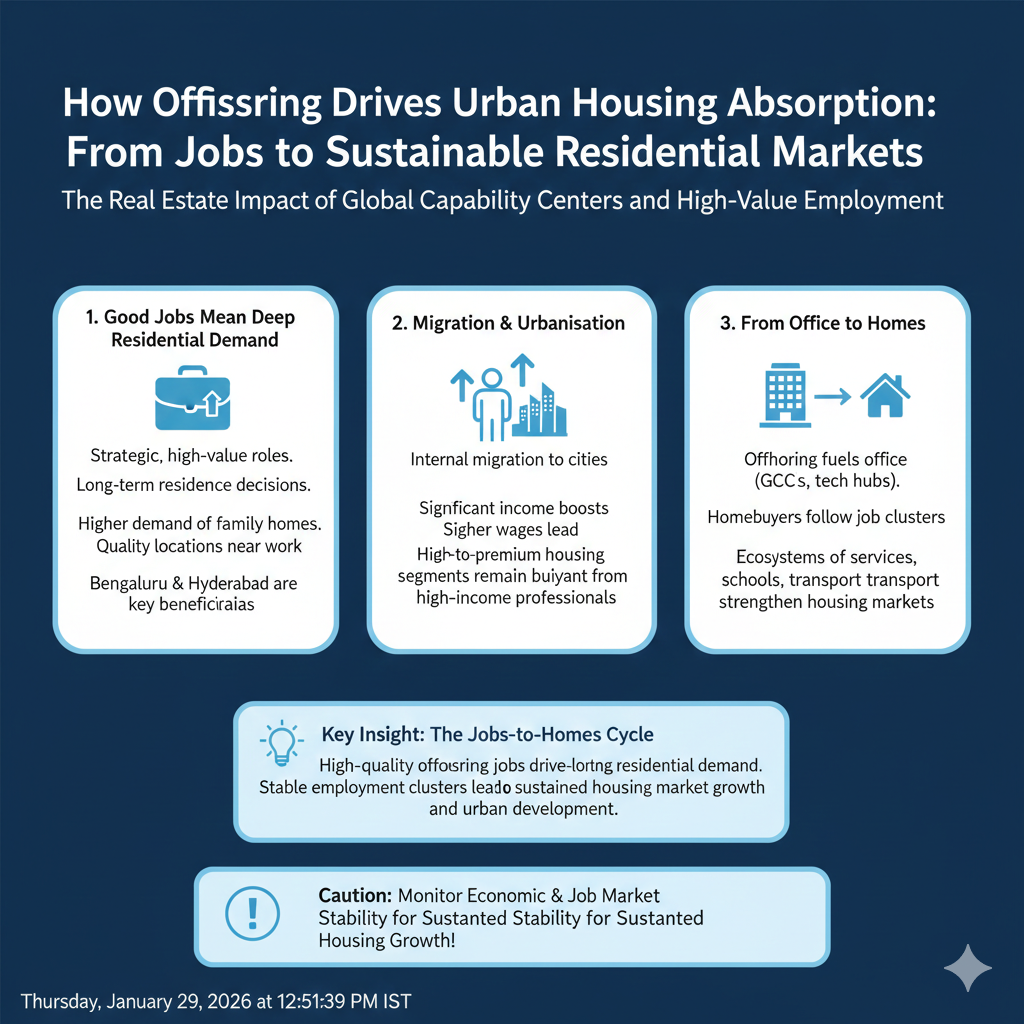
Jobs create demand for homes. It’s a simple connection — but powerful and persistent.
1. Good Jobs Mean Deep Residential Demand
Once companies hire for strategic and high‑value roles instead of just temporary contract work, employees often choose to settle rather than churn. This leads to:
Long‑term residence decisions
Higher demand for family homes
Preference for quality locations near work hubs
Cities like Bengaluru and Hyderabad have been primary beneficiaries of this pattern — recent job expansions by global firms attract professionals who need houses, not just short‑term rentals.
2. Migration Patterns Support Urbanisation
Internal migration data shows that moving to cities often boosts incomes significantly, especially for white‑collar workers relocating for tech, finance, and related sectors. Higher wages lead to bigger housing aspirations and purchase capability in urban markets.
Even though overall housing sales data recently showed softness in some markets, mid‑to‑premium segments remain buoyant, reflecting underlying demand from higher‑income professionals.
3. Offshoring Increases Office Absorption — and Then Homes
Offshoring growth doesn’t just create residential demand directly. It first feeds office space needs — through Global Capability Centres (GCCs) and tech hubs absorbing substantial office inventory, which in turn anchors long‑term employment clusters.
Once clusters form — think electronic and software hubs in Bengaluru or tech corridors in Hyderabad — homebuyers follow. Those clusters create ecosystems of services, schools, healthcare, and transport — all of which strengthen and sustain housing markets.
A Long‑Term Structural Shift
What’s happening here isn’t a short blip driven by demand shifts in a single quarter. It’s a structural reallocation of jobs and capital.
Europe’s slower growth makes India’s resilient and faster‑growing economy more attractive for global corporations looking for scale, innovation, and a supply of skilled workers. As global firms invest locally, they are not simply offshoring cheap work — they are building innovation centres, capability hubs, and strategic engineering bases.
That means stable job creation and sustained housing demand rather than one‑off relocations.
Why Hyderabad and Bengaluru Are Prime Winners
Both cities already had strong foundations:
Bengaluru as India’s original tech capital
Hyderabad as an emerging diversified tech and innovation hub
As European companies move strategic roles here rather than near home, these cities benefit from:
Enhanced corporate hiring
Deeper talent ecosystems
Higher incomes
Reinforced residential markets
This pattern is similar to the earlier IT boom but even broader, because the new hiring covers data, analytics, R&D, and strategic tech roles as well as traditional IT jobs.
FAQ Section
Does Europe’s slow growth directly boost Indian housing demand?
Not directly like currency effects or visas. The link comes through corporate hiring and offshoring. When European firms move jobs and investment to India, that strengthens local urban employment and thereby housing demand.
Is this trend temporary?
Corporate strategies shift over years, not quarters. Offshoring strategic jobs and building long‑term centres implies ongoing demand rather than a short‑lived spike.
Does this mean more demand in smaller cities too?
Potentially yes, as offshoring and GCC growth expand beyond the top two cities. Early indicators show broader absorption across urban clusters.
Is remote work reducing housing demand?
Remote work affects where people live but job relocations and urban clusters still drive significant housing demand where opportunities are concentrated.
Conclusion

Europe’s slower growth is creating an unexpected catalyst for India’s urban housing demand by accelerating offshoring, strategic hiring, and relocation of functions that once stayed in Europe. When firms build capability hubs and expand engineering and tech teams in Indian cities, they’re not just boosting office leasing — they are creating long‑term residential demand patterns that support housing absorption, premiumisation, and urbanisation.
For homebuyers and investors alike, understanding this global‑to‑local linkage is key to anticipating where Indian real estate demand will deepen next.
Let’s Join Together to Bring Change to the World of Real Estate.
Thinking about your next home?
relai scores every project on data, not paid placements, and it's free for buyers.