HMDA vs DTCP: 7 Red Flags to Spot in Hyderabad Plot Ventures
Introduction
Plot investments in Hyderabad have surged over the past decade, driven by infrastructure growth, suburban expansion, and rising land values. However, alongside genuine opportunities, the market has also seen a rise in non-compliant and misleading plot ventures, particularly in peripheral zones.
One of the biggest sources of confusion for buyers is understanding the difference between HMDA and DTCP approvals — and more importantly, identifying red flags that can turn a plot purchase into a long-term liability.
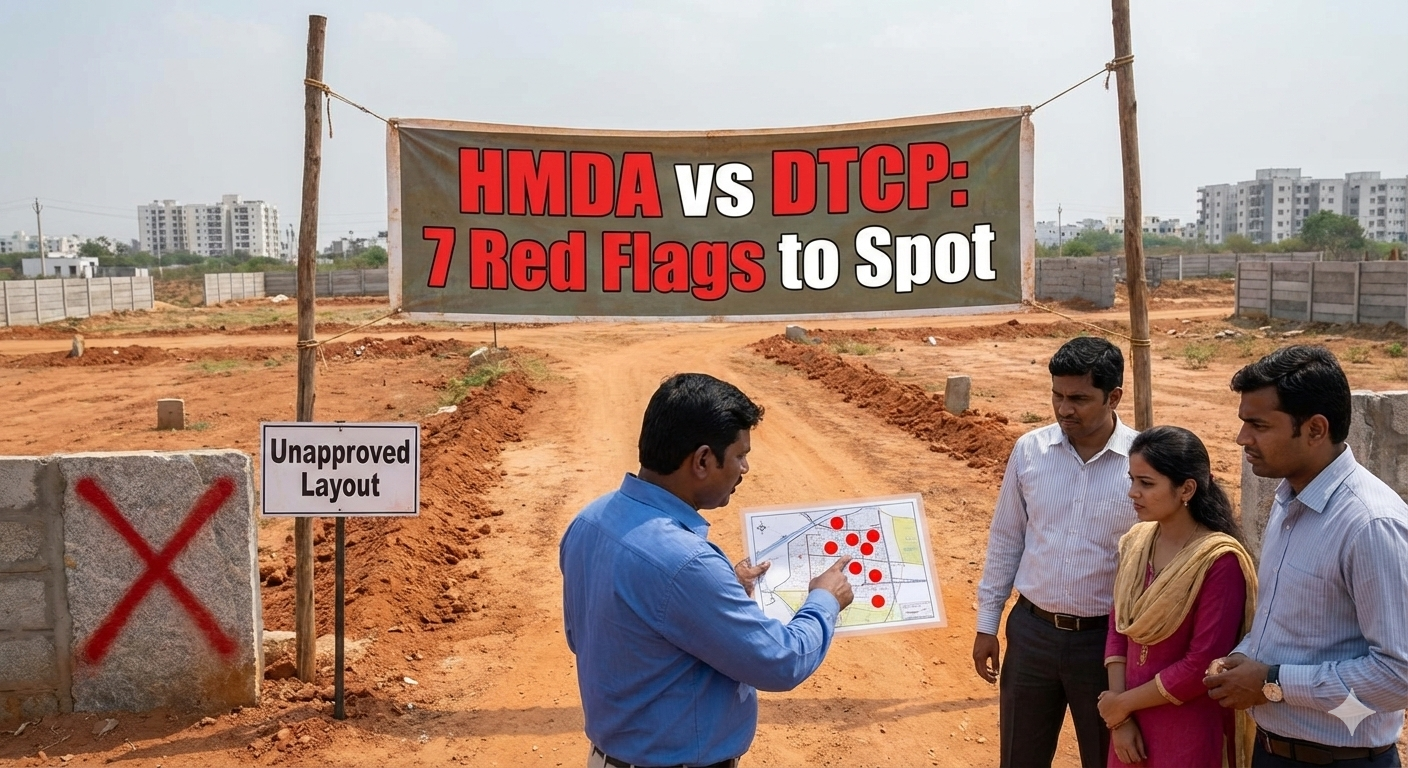
This blog breaks down the 7 critical red flags every buyer must check before investing in a Hyderabad plot venture, with special focus on water-logging risks, lake buffer zones, GO 111 implications, and approval status traps.
HMDA vs DTCP: Why the Difference Matters
Hyderabad Metropolitan Development Authority (HMDA) governs planning and approvals within the Hyderabad Metropolitan Region, covering urban and fast-growing suburban corridors. DTCP (Directorate of Town and Country Planning) applies to areas outside HMDA limits, usually semi-urban or rural zones.
While both are statutory authorities, HMDA approvals generally carry higher scrutiny, stricter norms, and stronger long-term resale confidence. DTCP-approved layouts may be valid, but they demand extra diligence, especially in fast-developing corridors.
Official planning jurisdiction details are outlined by the HMDA master plan documentation (https://hmda.gov.in).
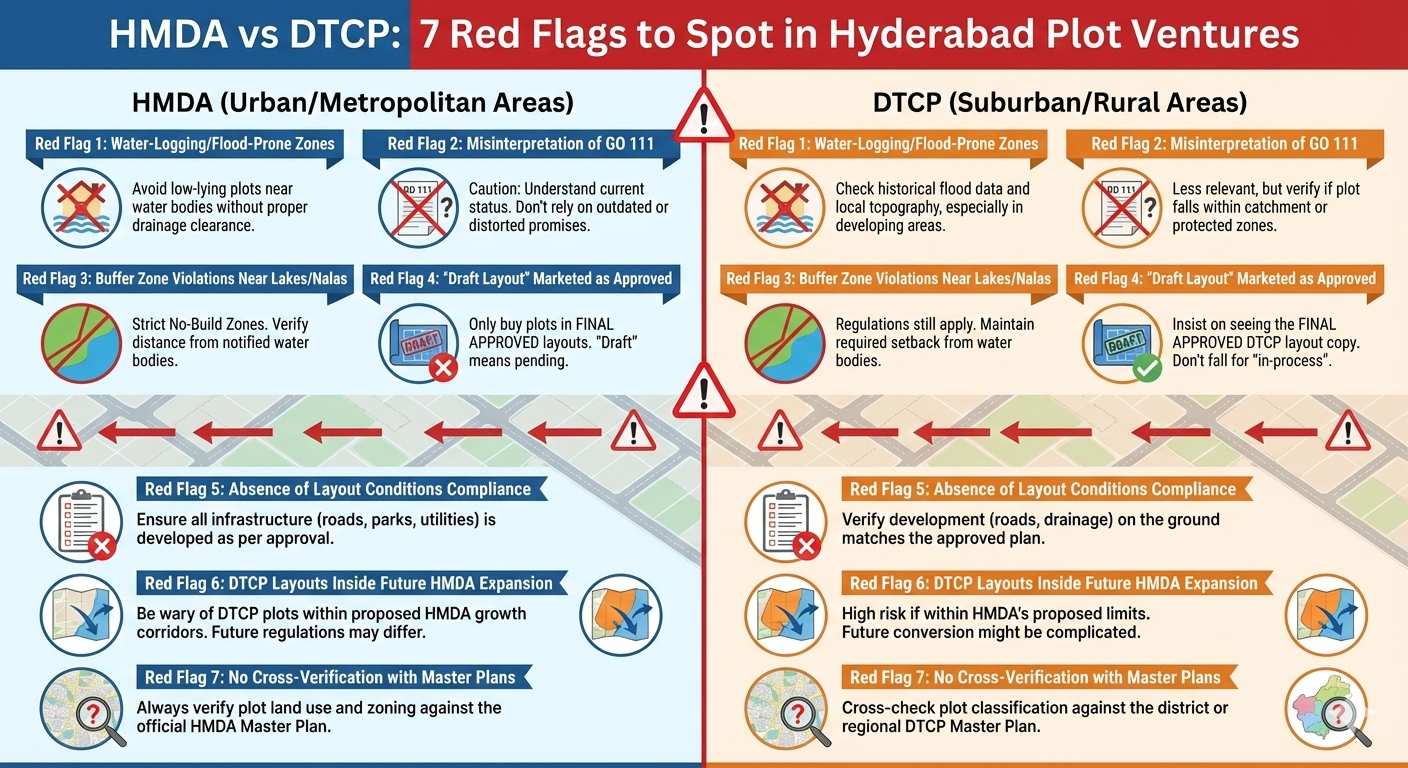
Red Flag 1: Location in Water-Logging or Flood-Prone Zones
Several Hyderabad plot ventures are marketed in low-lying areas that experience seasonal water accumulation. These zones may look dry during site visits but face serious flooding risks during monsoons.
Buyers should cross-check layouts against:
Natural drainage paths
Stormwater flow maps
Historical flood reports
The Greater Hyderabad Municipal Corporation (GHMC) publishes flood-prone and water-logging data that should always be verified before finalizing a plot.
Red Flag 2: Misinterpretation of GO 111 Updates
GO 111 historically restricted construction around Osman Sagar and Himayat Sagar catchment areas. While certain relaxations have been discussed, blanket claims of “GO 111 removed” are misleading.
Key risk indicators include:
Vague marketing claims without written government notification
Layouts near reservoir catchment zones
Absence of updated environmental clearance
Buyers should rely only on official government notifications, not sales brochures or verbal assurances.
Red Flag 3: Buffer Zone Violations Near Lakes and Nalas
Hyderabad has strict buffer regulations around:
Lakes
Water bodies
Stormwater nalas
As per environmental and planning norms, construction is prohibited within defined buffer distances. Many illegal plot ventures either:
Ignore buffer markings
Alter ground boundaries
Hide lake extents during site visits
The Telangana State Lake Protection Committee (TSLPC) (https://tslpc.gov.in) provides data on protected water bodies that buyers should verify independently.
Red Flag 4: “Draft Layout” Marketed as Approved Layout
This is one of the most common and dangerous traps. Developers often market ventures claiming:
“HMDA applied”
“DTCP under process”
“Draft layout available”
A Draft Layout is NOT a legal approval. It has no statutory value for construction, registration safety, or resale security.
Only a Final Approved Layout, issued with an official approval number and conditions, is legally valid. Anything else exposes buyers to future demolition or regularization risks.
Red Flag 5: Absence of Layout Conditions Compliance
Even in approved layouts, conditions are imposed such as:
Road width compliance
Open space reservation
Utility and civic provision commitments
If these conditions are not executed on ground, the approval can be revoked or restricted. Buyers should demand proof of condition compliance, not just approval letters.
Red Flag 6: DTCP Layouts Inside Future HMDA Expansion Zones
Some DTCP layouts fall within areas earmarked for future HMDA expansion. While not illegal, this creates regulatory uncertainty if:
Roads are not as per HMDA norms
Open space ratios are lower
Infrastructure planning is misaligned
As highlighted in NITI Aayog’s urban expansion studies, transitional zones require higher diligence due to shifting governance frameworks.
Red Flag 7: No Cross-Verification with Master Plans
Many buyers rely solely on developer-provided documents. This is risky. Every plot must be cross-verified against:
HMDA Master Plan
Zoning classification
Land use designation
The Hyderabad Metropolitan Development Plan 2031 (https://hmda.gov.in/masterplan) clearly defines residential, commercial, conservation, and restricted zones. Any mismatch is a serious warning sign.
Why These Red Flags Matter for Buyers
Ignoring these warning signs can lead to:
Registration blocks
Construction restrictions
Demolition notices
Poor resale liquidity
Long-term legal disputes
Plot investments lack the regulatory cushioning of apartments. This makes independent verification and expert advisory critical, especially in fast-growing suburban corridors.
FAQ Section
What is safer: HMDA or DTCP approval?
HMDA approvals generally offer stronger long-term security due to stricter norms, but DTCP layouts can also be safe if fully compliant and verified.
Is a draft layout legally valid?
No. Draft layouts have no legal standing for construction or long-term ownership security.
How can buyers check lake buffer violations?
By verifying survey maps, master plans, and official lake boundary data published by government authorities.
Are GO 111 restrictions fully removed?
No blanket removal exists. Buyers must rely on official notifications, not marketing claims.
Can future HMDA expansion affect DTCP plots?
Yes. It can introduce new compliance requirements and infrastructure obligations.
Conclusion

Plot investments in Hyderabad can be rewarding, but only when backed by rigorous due diligence. Understanding the difference between HMDA and DTCP approvals, verifying buffer zones, avoiding draft layouts, and cross-checking master plans are non-negotiable steps for safe investing.
As regulatory enforcement tightens and environmental compliance gains priority, buyers who rely on facts over promises will protect both capital and peace of mind.
Let’s Join Together to Bring Change to the World of Real Estate.
Relai – For right home.
Thinking about your next home?
relai scores every project on data, not paid placements, and it's free for buyers.