GCC Boom vs IT Boom: Which One Creates More Stable Real Estate Growth?
Contextualising Hyderabad’s and Bengaluru’s Next Growth Cycle
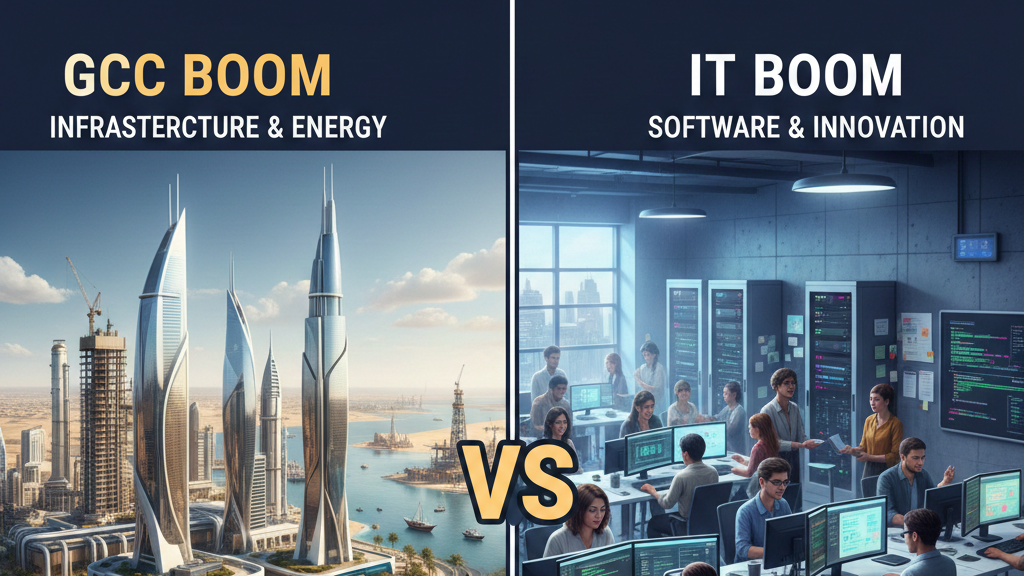
As India’s major urban economies evolve, two big forces have shaped commercial and residential real estate demand: the traditional IT boom and the newer Global Capability Centre (GCC) boom. Both drive jobs and space needs, but they differ in structure, stability, sector mix and how they influence where people live and invest.
Understanding these differences is key to anticipating which markets will benefit most over the next decade — especially in Hyderabad and Bengaluru, where both cycles are active.
What We Mean by “IT Boom” and “GCC Boom”
IT Boom refers to the long-standing growth of India’s technology services industry — companies building software, outsourcing, support services and digital products. This trend drove demand for office parks, high‑quality housing near these campuses, and associated infrastructure. Bengaluru and Hyderabad were early beneficiaries of this pattern as technology hubs flourished.
GCC Boom is a related but distinct trend. GCCs — offshore units of global multinationals — handle not just IT support but strategic functions such as analytics, AI, R&D, finance and digital transformation. These centres lease large amounts of Grade‑A office space and deepen global corporate presence in local markets. Since 2021, GCCs have leased about 100 million sq ft of office space in India, with a forecasted rebound and strong future growth over the next two years.
Scale and Momentum: GCCs Are Taking Over Office Growth
It’s no longer just IT that drives office demand.
Recent market data shows that GCCs now account for roughly 40 % of India’s total office leasing demand, compared with under 30 % in 2022 — a clear sign of their increasing influence in commercial real estate.
Cities such as Bengaluru and Hyderabad together have driven around 60 % of GCC leasing activity across top Indian metros in recent years, and demand is expected to rise further as global firms expand their captive and innovation hubs.
This shift means that a larger portion of office absorption — and the supporting ecosystem of services jobs — now stems from GCCs rather than traditional outsourcing IT alone. Office dynamics are becoming more diversified and innovation‑oriented, not just cost‑ or service‑driven.
Job Quality and Demand Stability: GCCs Add Depth
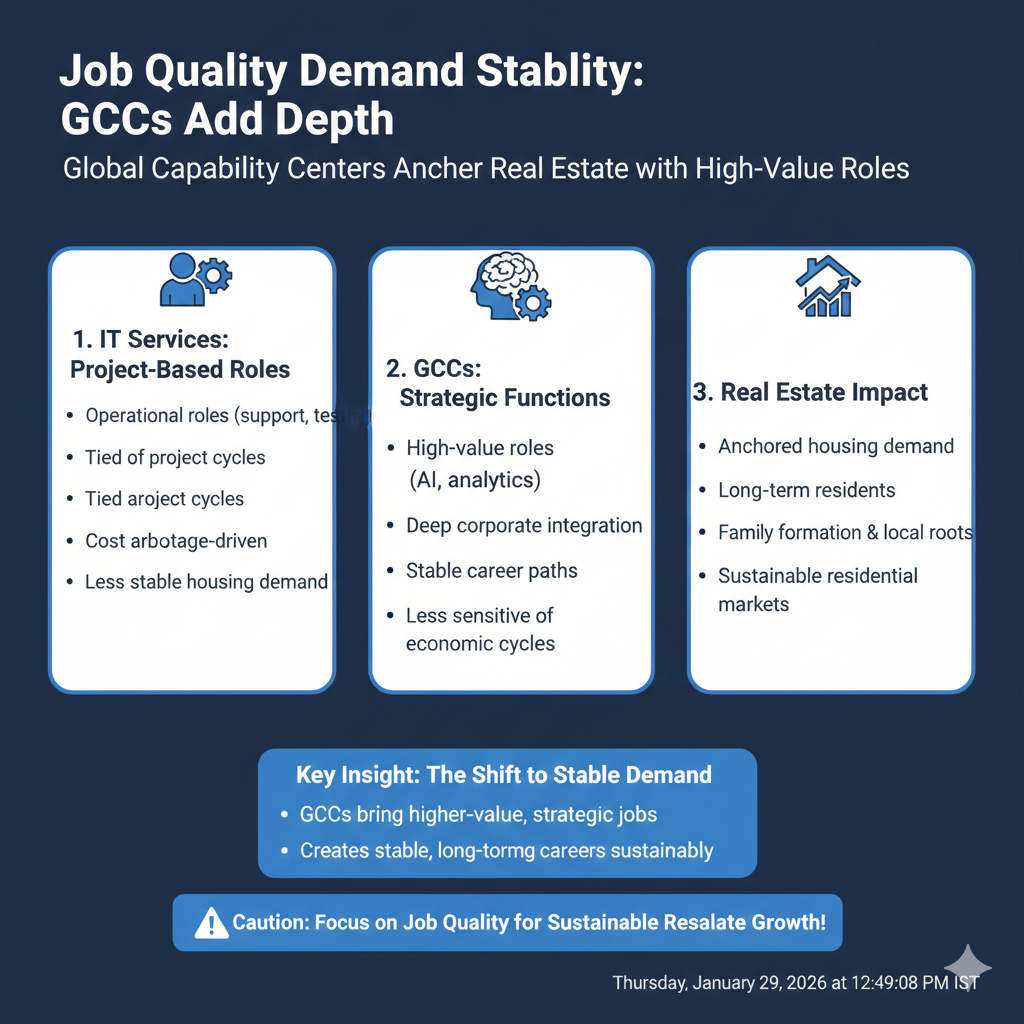
One of the biggest differences between the two booms is job quality and depth.
IT services typically created large numbers of operational roles — support, development, testing — often tied to project cycles and cost arbitrage.
GCCs tend to bring higher‑value strategic functions — analytics, AI development, software platforms and global operations — offering more stable, long‑term career paths with deeper integration into corporate strategy.
These roles often stay in place through economic cycles because they are tied to core business functions, not just delivery arbitrage. This tends to anchor housing demand more sustainably, since professionals in GCCs are more likely to put down local roots, form families, and stay long enough to influence residential markets.
Geographic Shifts: Hyderabad’s Rising Share
Hyderabad’s rise as a GCC hub highlights how growth patterns can shift over time.
Experts note that Hyderabad has recently captured a significant share of new GCC setups, driven by competitive office costs (about a dollar per sq ft in some markets), a strong talent pool, world‑class infrastructure and supportive policy frameworks.
While Bengaluru still leads in overall GCC leasing (with a near majority share in many reports), Hyderabad’s cost advantage and diversified talent base are drawing more global centres. This deepens job creation in both cities but broadens the residential impact beyond traditional IT corridors.
Residential Ripple Effects: Where Home Demand Follows Jobs
Both booms influence residential real estate — but they do so in slightly different ways:
IT Boom Effects
Housing demand clustered around classic tech parks and campuses.
Focus on project types popular with IT employees: 2–3 BHK apartments near transit and office clusters.
Growth tied heavily to expansion cycles in outsourcing contracts.
GCC Boom Effects
Demand is less cyclical and more tied to global corporate strategy and long‑term commitment.
Professionals in GCCs often seek premium housing and quality urban lifestyle, raising demand for higher‑end segments.
Broader job profiles (analytics, finance, engineering) diversify residential demand across different income brackets and locations.
Recent broader market indicators also show strong residential activity even as some segments cool, with composite demand supported by stable job growth. Domestic capital flows into real estate and infrastructure projects are also rising, signalling confidence in long‑term urban growth cycles.
Why GCCs May Be a More Stable Long‑Term Growth Engine
Here are the key reasons why many analysts see the GCC boom as a potentially more stable driver of real estate growth compared with the classic IT boom:
1. Broader Sector Base:
GCCs are not limited to IT — they span finance, engineering, analytics, life sciences, and more. This reduces dependence on the IT services cycle.
2. Strategic Stay:
GCCs often build innovation and product development capabilities locally, making them less vulnerable to outsourcing cost shifts or short‑term contract changes.
3. Higher‑Value Roles => Stronger Housing Demand:
Jobs in GCCs often come with better compensation and stability, which can support stronger residential demand, particularly in mid‑to‑premium segments.
4. Global Capital Confidence:
Institutional and foreign investors are actively tracking GCC growth as a structural trend, not just cyclic office space demand. This adds liquidity and funding to markets tied closely to GCC hubs.
But the IT Boom Still Matters
It’s not that the IT boom is irrelevant. It laid the foundation:
Bengaluru’s identity as India’s tech capital still draws deep talent pools.
Existing tech institutions continue to hire and support startups.
Hybrid work and digital services are still big demand drivers for both office and residential space.
What’s changing is the mix and resilience of demand. As GCC functions evolve, they absorb a portion of IT‑related roles while adding new ones in innovation and global operations.
FAQ Section
Do GCCs displace IT jobs?
No — GCCs absorb many IT professionals while diversifying roles into analytics, AI, finance and strategic functions.
Are GCC jobs better for real estate demand than classic IT jobs?
Generally, yes. GCC roles often carry longer tenure and higher pay, supporting stable housing demand.
Will Hyderabad overtake Bengaluru?
Both cities remain major hubs. Hyderabad’s cost advantages are helping it gain ground, but Bengaluru’s larger ecosystem still leads overall. Growth may become more balanced rather than one city dominating.
Does this trend affect rentals too?
Absolutely. Stable job growth from GCCs supports both ownership demand and rental demand across multiple segments.
Conclusion

The IT boom transformed Indian urban real estate in the early 2000s by creating jobs, boosting housing demand, and shaping urban corridors. Today’s GCC boom builds on that legacy but with a broader, deeper, and more stable economic foundation.
In cities like Hyderabad and Bengaluru, GCCs are not just driving office space absorption — they’re diversifying talent demand, supporting higher‑value jobs, and anchoring residential markets more sustainably over the long term.
Real estate growth in the next cycle is likely to be less cyclical, more quality‑driven, and driven by strategic global commitments, not just contract cycles. For homebuyers, investors, and planners, that’s a fundamental shift worth understanding.
Let’s Join Together to Bring Change to the World of Real Estate.
Thinking about your next home?
relai scores every project on data, not paid placements, and it's free for buyers.