Co-Working Spaces: India’s Evolution vs Global Giants
Co-Working Spaces: India’s Evolution vs Global Giants
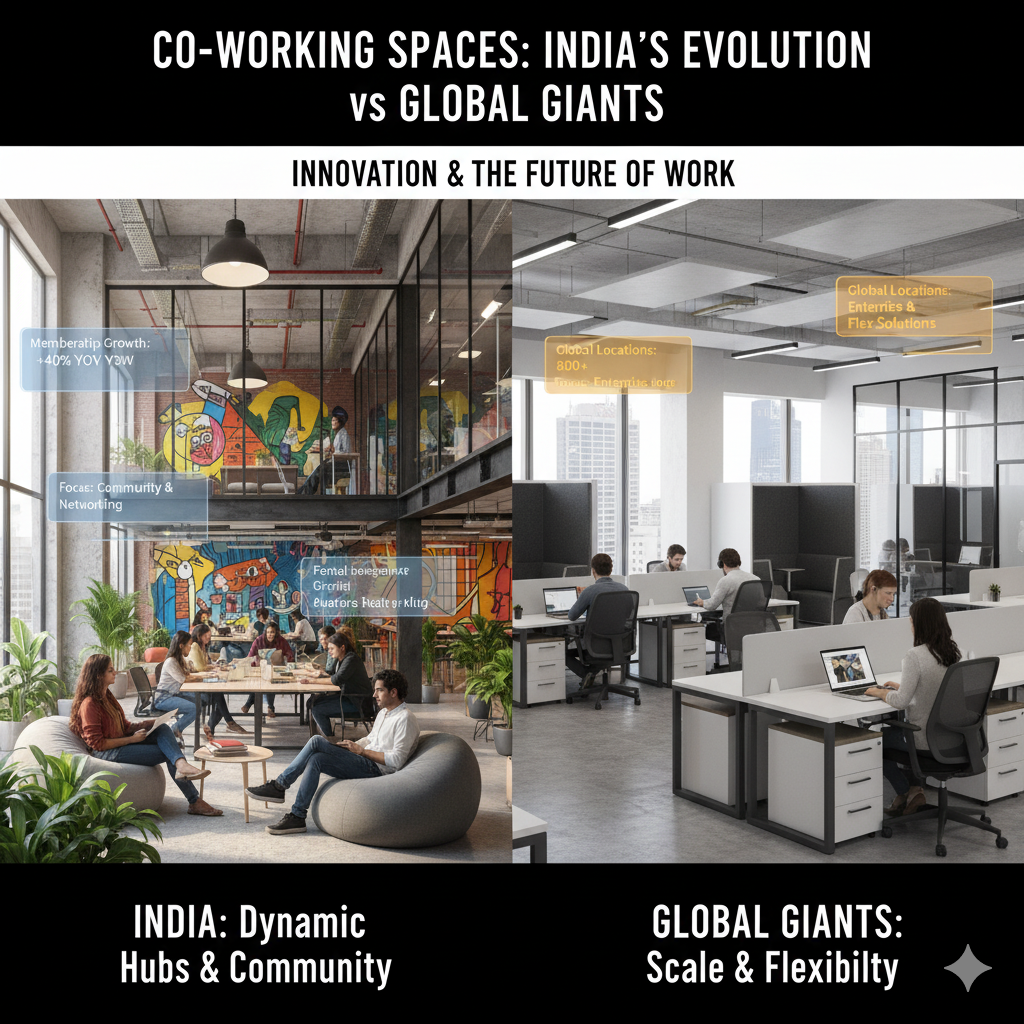
The way we work has changed forever. Remote work, startups, and digital-first companies have reshaped the demand for flexible office spaces. Co-working has emerged as the backbone of this transformation—not just as shared desks, but as ecosystems where networking, innovation, and cost-efficiency thrive.
In this blog, we’ll compare India’s co-working journey with global giants like WeWork, Regus, and Industrious. How has India caught up, what challenges remain, and where does the future lie?
The Rise of Co-Working in India
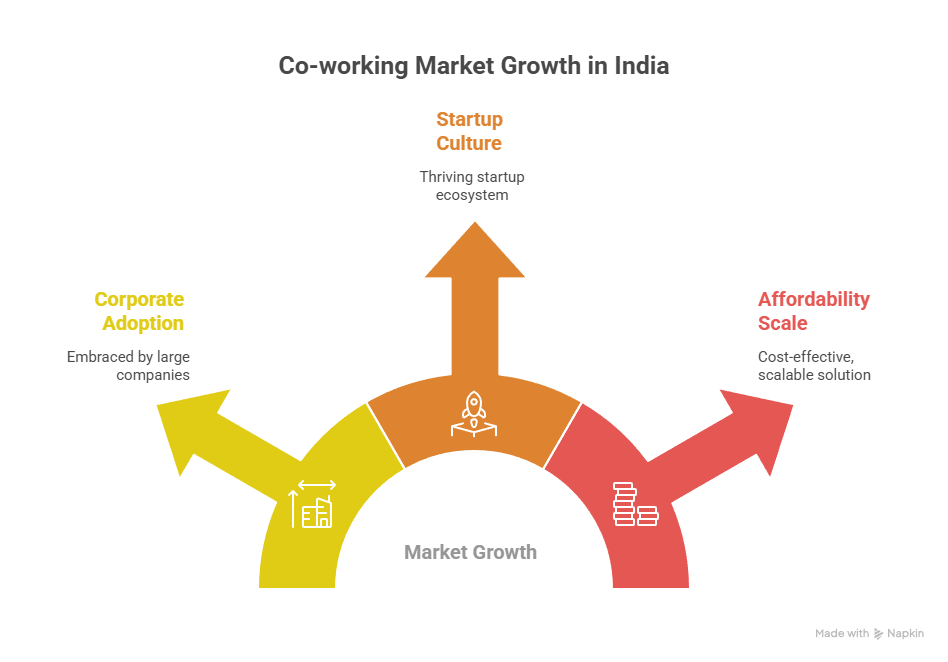
India’s co-working market has exploded over the last decade. Once seen as “cheap alternatives” for freelancers, today these spaces are being embraced by corporates, SMEs, and even Fortune 500 companies.
Market growth: According to Knight Frank, India had ~55 million sq. ft of co-working space by 2024, growing at nearly 15% YoY.
Key players: Indian startups like Awfis, Smartworks, and 91springboard have built strong domestic brands, while international names like WeWork have expanded aggressively.
Demand drivers: High rental costs in metros, hybrid work models post-COVID, and India’s thriving startup culture.
Unlike the US or Europe, India’s co-working spaces aren’t just about flexibility—they’re about affordability and scale.
Global Giants: The Benchmark
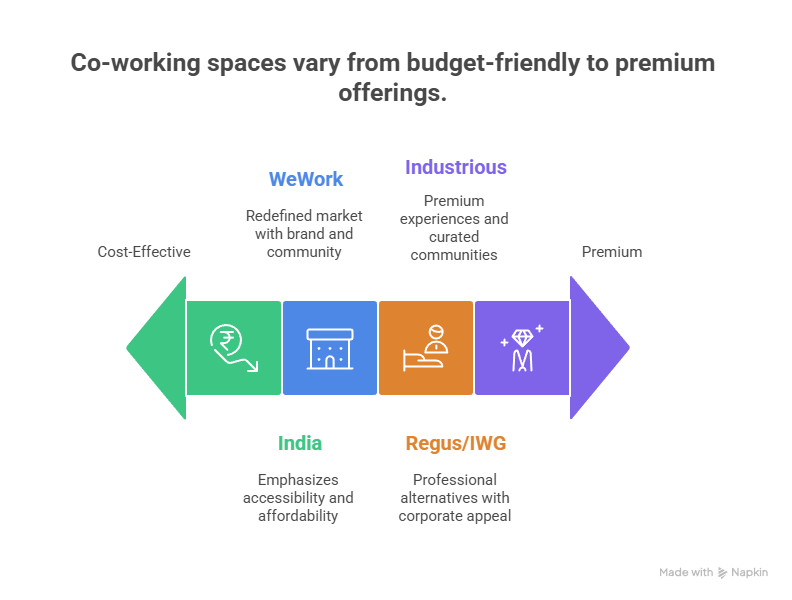
Globally, co-working took off earlier. WeWork, founded in 2010, redefined the office market with its brand-driven approach, sleek designs, and community focus. Other giants like Regus (now IWG) and Industrious positioned themselves as professional, corporate-ready alternatives.
Scale: The US has over 6,000 co-working spaces, with New York and San Francisco leading.
Positioning: Global giants tend to emphasize premium experiences, curated communities, and high-end amenities.
Revenue model: Many rely on long-term leases converted into short-term memberships, a model that has faced sustainability questions.
Compared to India, global co-working has been more brand-focused, while India leans heavily on cost-effectiveness and accessibility.
Key Differences: India vs Global Co-Working
Factor | India | Global Giants |
Pricing | Highly cost-sensitive; $50–200/month memberships common | Premium pricing; $300–800/month in cities like NYC, London |
Target Audience | Freelancers, startups, SMEs, corporates | Mostly startups and corporates |
Design & Amenities | Focus on functional, affordable infrastructure | Premium design, curated experiences |
Expansion | Rapid metro and Tier-2 city expansion | Focused on global financial hubs |
Business Model | Asset-light, management partnerships common | Lease-heavy, brand-driven |
India’s unique strength is in Tier-2 and Tier-3 expansion, where global players haven’t entered meaningfully yet.
Why Corporates Are Adopting Co-Working in India
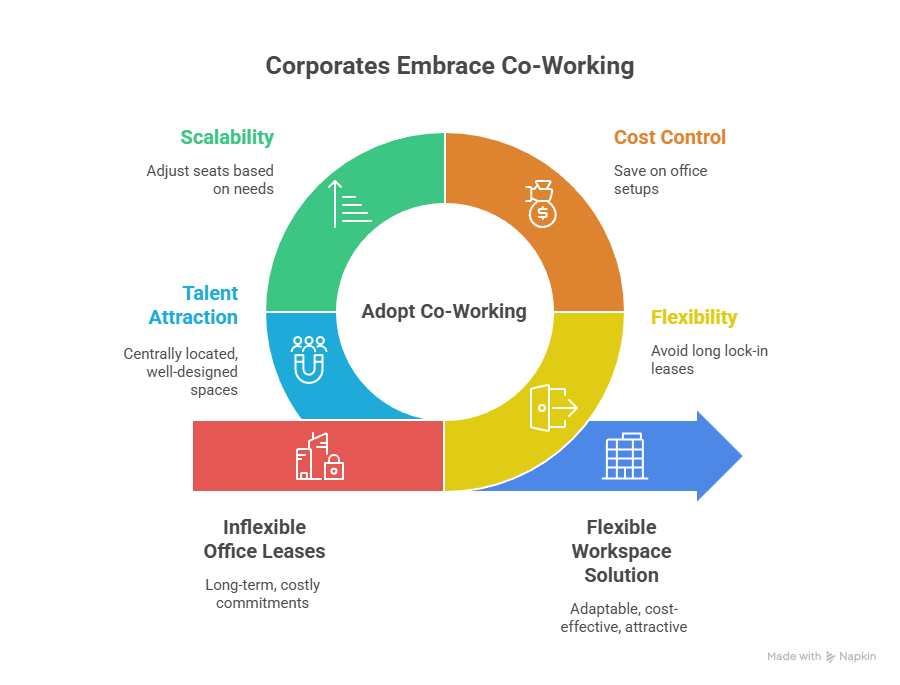
A decade ago, co-working was seen as “casual.” Today, even traditional corporates are signing up. Why?
Flexibility: Avoid long lock-in leases.
Cost Control: Save on capex-heavy office setups.
Scalability: Expand or reduce seats based on business cycles.
Talent Attraction: Employees prefer centrally located, well-designed workspaces.
This mirrors trends in the US and Europe, where Fortune 500 firms are among the biggest users of co-working seats.
Challenges Ahead
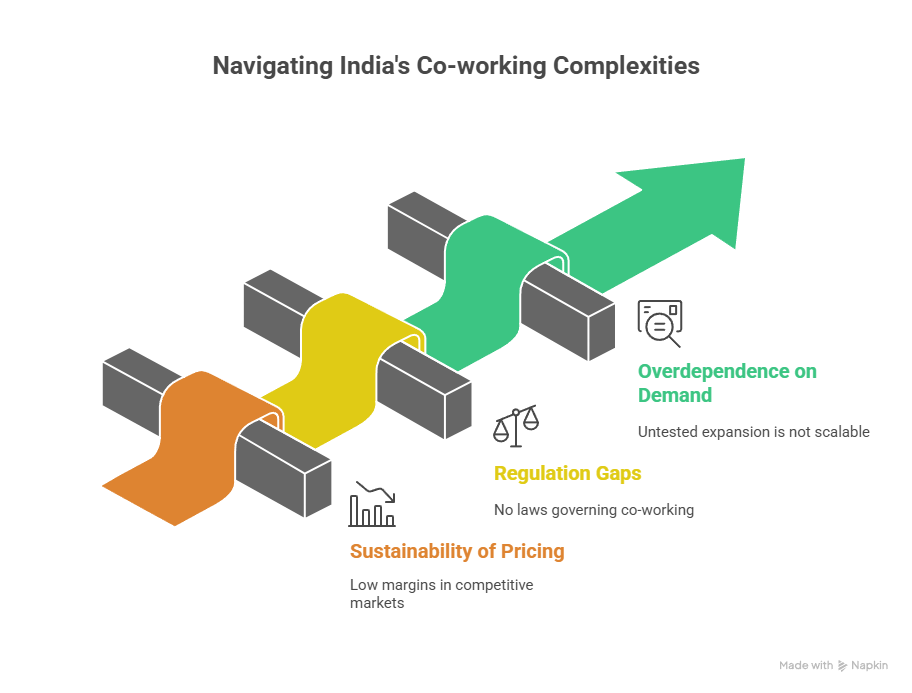
India’s co-working boom isn’t without hurdles:
Sustainability of pricing: Low margins in highly competitive metros.
Regulation gaps: No specific laws yet governing co-working.
Overdependence on urban demand: Tier-2 expansion is promising but untested at scale.
Globally, WeWork’s financial struggles are a cautionary tale—rapid growth without profitability can shake investor confidence. Indian players will need to balance growth with financial prudence.
The Road Ahead: Collaboration, Not Just Co-Working
The future of co-working in India will go beyond desks and meeting rooms:
Hybrid-first models: Supporting companies that adopt remote + in-office work.
Niche communities: Sector-specific hubs for startups, fintech, or creatives.
Tech integration: AI-driven seat allocation, IoT-enabled smart workspaces.
Sustainability: Green-certified co-working spaces will gain traction.
As India’s economy scales and its workforce urbanizes, co-working will evolve into co-creation hubs, rivaling global giants not just in scale, but in innovation.
Conclusion

Co-working has moved from being a freelancer’s escape to a mainstream corporate strategy. While global giants have set the benchmarks, India’s evolution shows a uniquely cost-conscious, scalable, and democratized model.
For investors, startups, and corporates alike, the real opportunity lies not in copying Silicon Valley or New York but in shaping India’s own version of co-working—affordable, flexible, and future-ready.
Thinking about your next home?
relai scores every project on data, not paid placements, and it's free for buyers.